
The settings pipeline
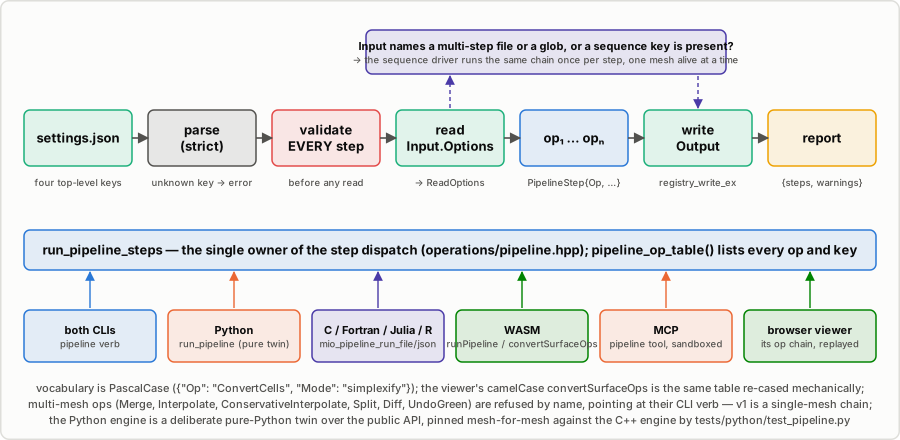
Since v9.11.0 meshio++ can run a whole chain of operations declaratively: one settings.json document describes read → operations → write, and every surface executes it — both CLIs (the pipeline verb), Python (meshioplusplus.run_pipeline), C (mio_pipeline_run_file/_json), Fortran, Julia, R, WASM (runPipeline) and the MCP server (the pipeline tool).
meshioplusplus pipeline settings.json            # either CLI
meshioplusplus pipeline settings.json --input other.msh --output out.vtu
meshioplusplus pipeline settings.json --json # machine-readable report{
"Version": 1,
"Input": { "Path": "bracket.msh", "Format": "gmsh" },
"Operations": [
{ "Op": "Transform", "RotateAxis": [0, 0, 1], "RotateDegrees": 45 },
{ "Op": "Gradient", "Array": "temperature", "Operator": "gradient" },
{ "Op": "ConvertCells", "Mode": "simplexify" },
{ "Op": "Refine", "Array": "temperature:gradient", "Compare": ">",
"Value": 0.5, "Closure": "redgreen" },
{ "Op": "Clean" },
{ "Op": "Quality" }
],
"Output": { "Path": "out.vtu", "Encoding": "binary", "Codec": "zlib" }
}
The rules
- Vocabulary is PascalCase for op names and parameter keys (
"Op": "ConvertCells","RemoveOrphans": true). Enum values keep the exact lowercase spellings the rest of meshio++ uses ("simplexify","redgreen","cell","rcm"). Refine's comparison key isCompare, neverOp—Opis the step discriminant. - Parsing is strict. An unknown op, an unknown key on a step, an unknown top-level key, or a mis-typed value is an error naming the offender — never silently ignored (the same rule
registry_write_exapplies toOutputoptions a format cannot honour). - A chain runs over one mesh at a time.
Merge,Interpolate,Split,DiffandUndoGreenneed extra inputs or produce extra outputs, and a step naming one errors pointing at the matching CLI verb (undo-greenforUndoGreen, which needs a second coarse mesh exactly asInterpolateneeds a second source mesh).Partitionas a step attaches thepartition:partlabels (colour-by-part) rather than splitting into pieces. - Steps are validated before the input is read — a typo in step 7 never costs reading a 10 GB mesh first.
- The run returns a report:
{"steps": [{"op", ...counters}], "warnings": [...]}with PascalCase counter keys (PointsWelded,SectionFaces,NumSkipped, ...).
Top-level schema
| Key | Required | Meaning |
|---|---|---|
Version | no (default 1) | schema version; this build knows 1 |
Input | yes | {Path, Format?, Options?} — Format defaults from the extension, with the sniff_format read fallback |
Operations | no (default []) | the step array; empty = a plain convert |
Output | yes | {Path, Format?, Encoding?, Codec?, FloatFormat?} |
Input.Options narrows the read (see selective reads): PointsOnly (bool), DataArrays (string array; absent = all, [] = none), TimeStep (int), Lenient (bool), Mmap ("auto" | "on" | "off").
Output maps onto registry_write_ex: Encoding ("ascii" | "binary"), Codec ("none" | "zlib" | "lz4" | "zstd", VTU/VTP block codecs), and FloatFormat (a printf-style float format for ASCII writers that take one). An option the output format cannot honour is an error.
Operations
Op | Parameters (defaults) | Notes / counters |
|---|---|---|
Quality | — | attaches quality:* cell data |
Clean | Weld (false), Atol (1e-8), RemoveOrphans (true), DropDegenerate (true), DropDuplicateCells (true) | counters PointsWelded, PointsRemovedOrphan, CellsDroppedDegenerate, CellsDroppedDuplicate |
Smooth | Method ("taubin"), Iterations (10), Lambda (method default), Mu (−0.34), FixBoundary (true), PreserveFeatures (true), FeatureAngle (30), GuardInversion (true) | counters NumNodesMoved, MaxDisplacement, NumSkippedInversion |
Refine | Levels (1), Cells, Region, Array + Compare ("<") + Value (0), Closure ("redgreen"), RecordLevels (false), RecordHierarchy (false) | at most one selector; Compare, not Op; RecordHierarchy attaches refine:cell_id/refine:parent_id and forces refine:entity |
Decimate | Ratio | TargetFaces | MaxError (none → Ratio 0.5), Placement ("optimal"), PreserveBoundary (true), PreserveFeatures (true), FeatureAngle (30) | counters FacesRemoved, CollapsesRejected |
DecimateVolume | Ratio | TargetCells | MaxError (none → Ratio 0.5), Placement ("optimal"), PreserveBoundary (false, unlike Decimate), PreserveFeatures (true), FeatureAngle (30) | counters TetsRemoved, CollapsesRejected |
Partition | Nparts (2), Method ("auto"), Imbalance (0.03), Mode ("eco"), Seed (0), WeightsKey | attaches partition:part; counter Nparts |
Slice (alias Section) | Point, Normal (required), RecordParentIds (false) | counter SectionFaces; warns when the plane misses |
Gradient | Array (required), Operator ("gradient"), Method ("green-gauss"), Location ("cell"), Output, Component | counters NumSkipped, NumFallback; warns on skipped cells |
Normals | PointNormals (true), CellNormals (false), Weight ("angle" | "area"), SplitAngle (absent → one smooth normal per point; a number of degrees in [0, 180] splits vertices at creases), RecordParentIds (false), Region | attaches normals; counters NumIsolated, NumUndefined, NumDegenerate, NumSplitPoints, NumAddedPoints; warns when the input winds inconsistently and no split was asked for; see normals |
EstimateError | Array (required), Method ("zz"), Marking ("none" | "absolute" | "fraction" | "dorfler"), MarkingValue (0), Output, Marked | attaches error:zz (and error:marked when Marking isn't "none"); counters GlobalError, NumSkipped, NumMarked; warns on skipped cells |
Isosurface | Array (required), Isovalue (0) or Isovalues, Component, RecordParentIds (false) | counter ContourCells; warns when empty |
Transform | exactly one of Translate[3], Scale (number or [3]), RotateAxis[3]+RotateDegrees, Matrix[16] (row-major), ScaleUnits (a factor, e.g. 0.001 for mm→m); plus RotateData (false) | |
ConvertCells | Mode ("linearize" | "simplexify" | "elevate"), RecordParentIds (false) | |
Subdivide | RecordParentIds (false) | one polyhedral child per 3D cell face, connected to a new interior point; no per-type template table |
Agglomerate | TargetGroupSize (8) | greedy seed-and-grow over the shared-face dual, merging face-adjacent cells into one polyhedron per group; the many-to-one counterpart to Subdivide |
Crop | one of Bbox[6] ([xmin,ymin,zmin,xmax,ymax,zmax]), Point[3]+Normal[3], or Where (a scalar cell_data name) + Compare ("<") + Value (0); Mode ("all" | "any", not with Where), RecordIds (false) | counter CellsKept |
ExtractSurface | RecordParentIds (false) | |
ExtractSkin | Linearize (false) | |
Reorder | Method ("rcm" | "morton" | "hilbert") | |
DataDrop | Point/Cell/Field (string arrays), IgnoreMissing (false) | |
DataKeep | Point/Cell/Field — only locations mentioned are touched; [] drops all there | |
DataRename | Point/Cell/Field, entries "OLD:NEW" (split on the last colon — names carry colons: gmsh:physical) | |
DataCalc | Expr ("NAME = EXPRESSION", split on the first =), Location ("point"), Overwrite (false) | |
DataCondition | Mode ("clamp" | "normalize" | "standardize"), Location ("point"), Names, Scope ("component" | "magnitude"), Lo (0), Hi (1), NanPolicy ("ignore"), NanReplacement (0), Suffix | |
TensorInvariants | Location ("point"), Names (every 6- or 9-component array by default), Outputs ("mises,principal,hydrostatic,deviatoric" by default), Prefix, Suffix, Overwrite (true) | |
ToCell / ToPoint | Names; ToPoint also Weight ("uniform" | "measure") |
Sequences (transient / multi-file runs)
Since v9.12.0 the same document can describe a whole transient run: a glob/list input, the chain applied per step, and a fan-out or fan-in output. Seven additional keys, all optional:
| Key | Where | Meaning |
|---|---|---|
Mode | top level | "sequence" / "fan-in" / "fan-out"; asserts the inferred shape rather than selecting it, and errors naming both on a mismatch |
Parallel | top level | run the steps in a process pool (Python driver only; an error for a fan-in, and the C++ engine warns and runs serially) |
Workers | top level | worker count for Parallel; 0 means one per core |
Pattern | Input | a glob (* and ? only); mutually exclusive with Path/Paths |
Paths | Input | an explicit, ordered list; not re-sorted |
Times | Input | explicit per-step times; the count must match |
TimeFrom | Input | "auto" (the documented precedence) / "file" / "filename" / "index" |
Output.Path may carry {step} or {index} to write one file per step.
{
  "Version": 1,
  "Input": { "Pattern": "raw/out_*.vtu" },
  "Operations": [{ "Op": "Quality" }, { "Op": "Clean" }],
  "Output": { "Path": "post/out_{step}.vtu" }
}
Two rules worth stating explicitly:
- A document using none of these keys behaves exactly as before — the C++ engine literally delegates to the single-file
run_pipeline, and Python'srun_pipelinenever enters the sequence code path. - Conversely, the typed single-file parser (
parse_pipeline_json) rejects a sequence key by name rather than ignoring it. Ignoring one would run a transient document as its first step, which is exactly the silent truncation this feature exists to prevent. The CLI verb, Python'srun_pipelineand the MCP tool all route a sequence document to the right engine automatically, so nobody has to know which kind of document they hold.
See sequences for the ordering rule, the time-value precedence, the mode-inference table and the streaming guarantee.
Where the engine lives
The engine is operations/pipeline.{hpp,cpp} in the C++ core, split in two layers:
- The typed layer (
PipelineStep,apply_pipeline_step,run_pipeline_steps,run_pipeline) always compiles and is the single owner of the step dispatch — the browser viewer'sconvertSurfaceOpspipeline goes through the same code, so the viewer's op chips and a settings.json cannot drift apart (the viewer's op specs are the same words in camelCase; the two casings differ by exactly the first character). - The JSON front-end (
parse_pipeline_*,run_pipeline_json/_file) parses the document with nlohmann/json v3.12.0, vendored as a git submodule atsrc/cpp/third_party/jsonexactly like Eigen. When the submodule is absent or-DMESHIOPLUSPLUS_WITH_JSON=OFF, the entry points still exist and throw naming the flag (pipeline_has_json()/mio_pipeline_has_json()/_core.__has_json__report which build you have). Wheels, the release CLI binaries and the from-source builds all carry it; the conan/vcpkg packages currently do not (the submodule is not in a source export — the Eigen rule), so there the C ABI entry points fail by name.
Python's run_pipeline is deliberately a pure-Python twin dispatching over the public Python API rather than the C++ engine: it inherits every operation's C++/numpy parity contract and the per-format Python fallbacks (a gmsh $Periodic input still runs), and it works on an sdist install with no submodule. _core.run_pipeline_file/_core.run_pipeline_json expose the C++ engine too, and tests/python/test_pipeline.py pins the two engines' outputs — and the transcribed op/key table (_core.pipeline_op_table()) — against each other.
Per-surface entry points
| Surface | Call |
|---|---|
| both CLIs | pipeline SETTINGS.json [--input P] [--output P] [--json] [--quiet] |
| Python | run_pipeline(settings, input_path=None, output_path=None) — settings = dict | JSON text | path |
| C | mio_pipeline_run_file(path), mio_pipeline_run_json(text), mio_pipeline_has_json() |
| Fortran | mio_pipeline_run_file(path [, stat, errmsg]), mio_pipeline_run_json(...), mio_pipeline_has_json() |
| Julia | run_pipeline_file(path), run_pipeline_json(text), pipeline_has_json() |
| R | mio_pipeline_run_file(path), mio_pipeline_run_json(text), mio_pipeline_has_json() |
| WASM | runPipeline(settings) — object | JSON text | MEMFS .json path (no nlohmann in the wasm build; JSON.parse does the text forms) |
| MCP | tool pipeline(settings_path, input_path?, output_path?) — the sandbox covers the paths inside the document too |
The flat ABI (C/Fortran/Julia/R) carries JSON text only and reports status + mio_last_error(); the structured report is a recorded follow-up.
Follow-ups (recorded, not implemented)
- Multi-mesh steps:
Merge/Interpolate/UndoGreenwould need per-stepInputs: [paths], andSplit/partition-to-pieces anOutput.Patternwith{key}/{part}— the v2 schema sketch; today the CLI verbs cover these. (v9.12.0's sequences added the input-list and{step}-output halves of this for the transient case, but a step that consumes or produces several meshes at once is still out of scope.) - A C ABI report accessor (caller-buffer JSON string of the run report).
- conan/vcpkg packages shipping the parser via a registry
nlohmann_json/3.12.0dependency instead of the submodule.
Voxelize
{ "Op": "Voxelize", "Resolution": [64, 64, 64], "Fill": "surface" }Keys: Resolution, CellSize, Bounds, Padding, PaddingRelative, Fill, AttachOccupancy, MaxCells, Sign. Reports NumOccupied.
It and ComputeSdf are the only steps that replace their input's geometry rather than transforming it — read a skin, voxelize it, write a grid. See doc/voxelize.md.
ComputeSdf
{ "Op": "ComputeSdf", "Structure": "octree", "RootResolution": 8, "MaxDepth": 4 }Keys: Structure ("voxel" | "octree"), Resolution, CellSize, Bounds, Padding, PaddingRelative, RootResolution, MaxDepth, BandCells, RecordLevels, MaxCells, Sign, Location, Band. Reports MaxDepth and NumBanded.
Resolution/CellSize size a voxel grid and are an error with "Structure": "octree", whose finest cell is RootResolution / 2^MaxDepth and is therefore already determined. See doc/sdf.md.