
Data and datapipes
physicsnemo.datapipes is the answer to "I have simulation output on disk; how does it become batches?". It is a set of readers, transforms and dataset classes built on torch's Dataset/DataLoader, plus a handful of ready-made pipelines for specific model families.
The pieces
Readers turn a file into a TensorDict: NumpyReader, HDF5Reader, VTKReader, ZarrReader, TensorStoreZarrReader, MeshReader, DomainMeshReader.
Transforms are composable operations on what a reader produced — Compose, Normalize, Scale, Translate, Rename, ConcatFields, DropMeshFields, SubsampleMesh, SubsamplePoints, KNearestNeighbors, ComputeSDF, ComputeNormals, ComputeCellCentroids, CreateGrid, BoundingBoxFilter, and the mesh augmentations RandomRotateMesh, RandomScaleMesh, RandomTranslateMesh.
Datasets hold it together: DatasetBase, IterableDatasetBase, MeshDataset, MultiDataset (mixing several series), plus Collator variants and physicsnemo's own DataLoader.
Ready-made pipelines under datapipes.cae for external aerodynamics (domino_datapipe, transolver_datapipe, mesh_datapipe, cae_dataset), and under datapipes.gnn for the published GNN benchmarks (Ahmed body, DrivAerNet, Stokes, vortex shedding, Lagrangian, HydroGraphNet). Also datapipes.climate and datapipes.healpix.
Four contracts that bite
These are not obvious from the API, and every one of them has cost somebody a debugging session:
IterableDatasetBaseis an ABC, not atorch.utils.data.IterableDataset. A bare subclass is rejected by torch'sDataLoaderfor having nolen(). Inherit both.- physicsnemo's
DataLoaderunpacks each item as(data, metadata)— an(inputs, targets)tuple would have its targets silently swallowed. Settingyields_batches = Truepasses items through verbatim. num_workers > 0duplicates an iterable stream across workers, training on every sample twice.- Output buffers must not be reused across yields — the loader may still be reading the previous one.
Where mesh data enters
Two routes, and the difference is whether the data touches disk.
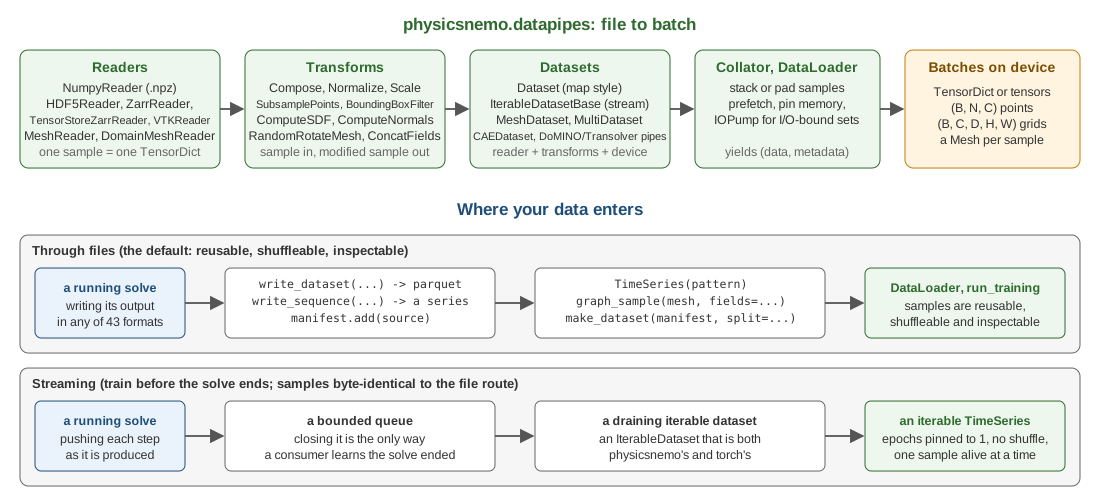
Figure 1: The datapipe stages, and the two places a solve feeds them.
Through files. The solve writes its output as it goes; a dataset reads it back afterwards. Samples are reusable, shuffleable and inspectable — the right default, and the only one that lets you look at a training sample after the fact and ask what went wrong.
Streaming. The solve pushes each step into a queue that an iterable dataset drains, and training starts before the solve finishes. Worth it only when the dataset genuinely does not fit on disk, and worth verifying against the file path first: the two must produce byte-identical items, which is a thing to assert rather than assume.
On augmentation
Rotating a mesh must rotate its vector and rank-2 tensor fields with it. Upstream's transform defaults skip them, which quietly teaches the model that a rotated velocity field is the same velocity field — a model trained that way is not merely less accurate, it has learned a false invariance and will keep it.
meshio++'s transform takes rotate_vector_data=True and does the coherent thing: R·v for a trailing-dimension-3 array, R·A·Rᵀ for a trailing-dimension-9 one (as of v10.33.0 it rotates cell_data blocks of trailing dim 3/9 too, not point_data alone). The dataset wrapper around it shipped in the same release: Augmentation draws a per-epoch, seeded transform (random.Random(f"{seed}/{epoch}/{index}"), a pure function of the triple) and applies the identical draw to a paired input/target so augmenting them independently never teaches the model that a part rotates between one step and the next. See temporal windows and augmentation.
In meshio++
meshio++ owns the step before a datapipe: turning forty-odd solver output formats into arrays that are already the right shape.
| Concern | meshio++ |
|---|---|
| One solve's steps as one ordered value | TimeSeries — random access, no mesh cached between reads |
| Many solves catalogued, split and tagged | DatasetManifest — a hand-editable JSON, the single source of truth |
| A whole campaign as one training table | write_dataset — Parquet, Zarr or HDF5, one mesh alive at a time |
| One mesh as one graph sample | graph_sample — pos, x, y, edge_index, edge features |
| The tensors, on the device, with no file | to_torch, to_dlpack |
A mesh in the format MeshReader globs for | pmsh and zarr — the same two layouts, written in pure numpy |
| A case in the DoMINO/Transolver sample layout | cae — one .npz per case, or data export-cae for a whole run |
The streaming invariant is a contract rather than an optimization: read_sequence is a generator, write_dataset reads one entry at a time, and TimeSeries holds only the plan. A dataset of a thousand transient solves never has more than one mesh in memory, which is what makes the file route practical at all.
The Reader ABC that make_reader returns plugs straight into physicsnemo's own Gen-2 datapipes, so none of the above replaces physicsnemo.datapipes — it feeds it.
Next: Mesh and geometry.