
Mesh reordering / renumbering
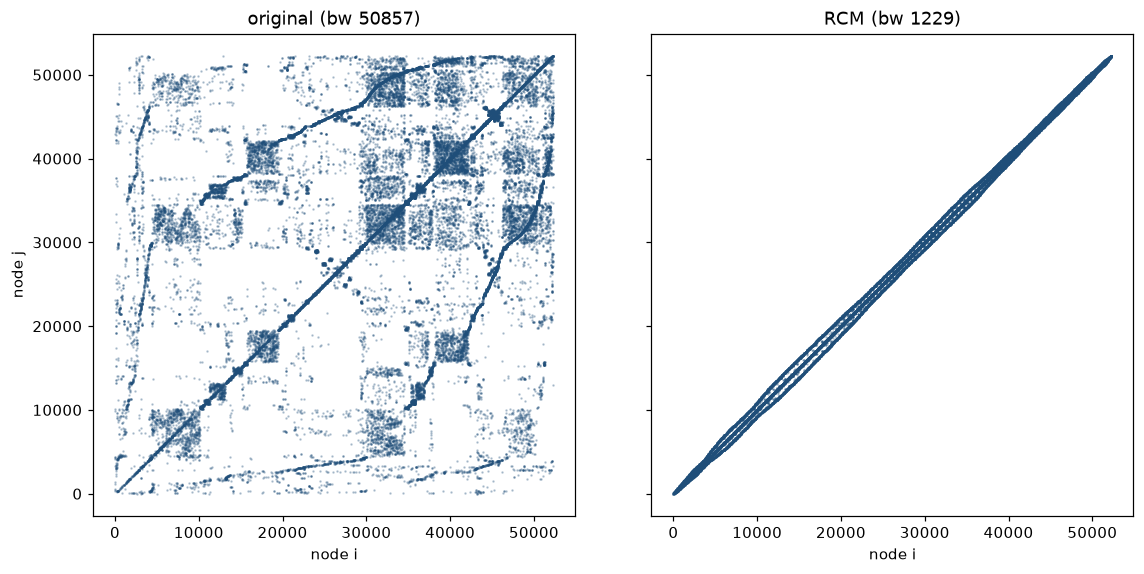
meshioplusplus.reorder(mesh, method="rcm") renumbers a mesh's nodes and elements to reduce sparse-matrix bandwidth and improve cache locality. It is a pure permutation: no nodes or cells are added or removed, the geometry and all data are preserved, and the applied permutations are returned so you can remap external per-node / per-cell arrays. It is a mesh operation (like surface extraction and quality metrics), not a file format, and uses only standard C++/numpy, so it runs under every mesh backend.
import meshioplusplus

mesh = meshioplusplus.read("part.vtu")
print(meshioplusplus.compute_bandwidth(mesh))          # before

out = meshioplusplus.reorder(mesh, method="rcm")
print(meshioplusplus.compute_bandwidth(out))           # after (smaller)

meshioplusplus.write("part_reordered.vtu", out)

# also return the permutations (old index -> new index)
out, node_perm, cell_perms = meshioplusplus.reorder(
    mesh, method="rcm", return_permutation=True
)
external_dof = external_dof[node_perm]                  # remap your own arrays
Methods
method | strategy | uses | good for |
|---|---|---|---|
"rcm" (default) | Reverse Cuthill–McKee on the node-adjacency graph | connectivity | reducing matrix bandwidth / profile |
"morton" | Morton (Z-order) space-filling curve | coordinates | cache locality, connectivity-free |
"hilbert" | Hilbert space-filling curve | coordinates | cache locality (better than Morton) |
- RCM builds the node graph (nodes sharing a cell are neighbours) as a CSR structure, finds a pseudo-peripheral start node per connected component (via the rooted-level-structure heuristic), runs a Cuthill–McKee BFS visiting neighbours in increasing degree order, and reverses the result. Disconnected components and isolated/orphan nodes are handled.
- Morton / Hilbert quantize the node coordinates to 21 bits per axis over the mesh bounding box and sort the nodes along the curve. These optimise spatial locality (spatially close nodes get nearby indices); they do not target bandwidth the way RCM does.
What gets permuted
- Points are reordered by the node permutation.
- Connectivity of every cell block is remapped to the new node indices, and each block's cells are reordered by their minimum new node index (deriving a per-block element permutation).
point_datarows follow their nodes;cell_datarows follow their cells.field_datais preserved unchanged (mesh-global).point_sets/cell_setsindices are remapped to the new numbering (done in the Python layer).
mesh.info and gmsh_periodic are not carried through the operation.
Return value
By default reorder returns the renumbered Mesh. With return_permutation=True it returns (mesh, node_permutation, cell_permutations):
node_permutation— anint64array,old index → new index(new_points[node_permutation[i]] == old_points[i]), zero-copy from the C++ core where possible.cell_permutations— oneint64array per cell block,old → new.
Bandwidth
meshioplusplus.compute_bandwidth(mesh) returns the connectivity bandwidth: the maximum over all cells of (max node index − min node index) within a cell. It is a convenient before/after measure of an RCM reordering.
CLI
meshioplusplus reorder input.vtu output.vtu --method rcm       # default
meshioplusplus reorder input.vtu output.vtu --method morton
meshioplusplus reorder input.vtu output.vtu --method hilbert
meshioplusplus reorder input.vtu output.vtu --method rcm --report
--report prints the connectivity bandwidth before and after. See the CLI reference.
Other languages
The operation is exposed across every binding surface:
- C API —
mio_reorder(mesh, method)returns amio_reorder_result(borrow the mesh withmio_reorder_result_mesh, read the permutations withmio_reorder_result_node_perm/..._cell_perm, or take ownership of the mesh withmio_reorder_result_take_mesh);mio_compute_bandwidth(mesh). See the C API reference. - Fortran —
mesh%reorder(method, node_perm=...)andmesh%compute_bandwidth(). See the Fortran reference. - WebAssembly / JavaScript —
reorder(mesh, method)returns{mesh, nodePermutation, cellPermutations};computeBandwidth(mesh). See the WebAssembly reference.