
Mesh comparison (diff)
meshioplusplus.diff(mesh_a, mesh_b, ...) compares two meshes and reports whether they are equivalent within a tolerance, plus a structured description of any differences. meshioplusplus.meshes_equal(a, b, ...) is the convenient boolean wrapper for test suites. It is a mesh operation (like reordering, surface extraction and quality metrics), not a file format, and uses only standard C++/numpy, so it runs under every mesh backend.
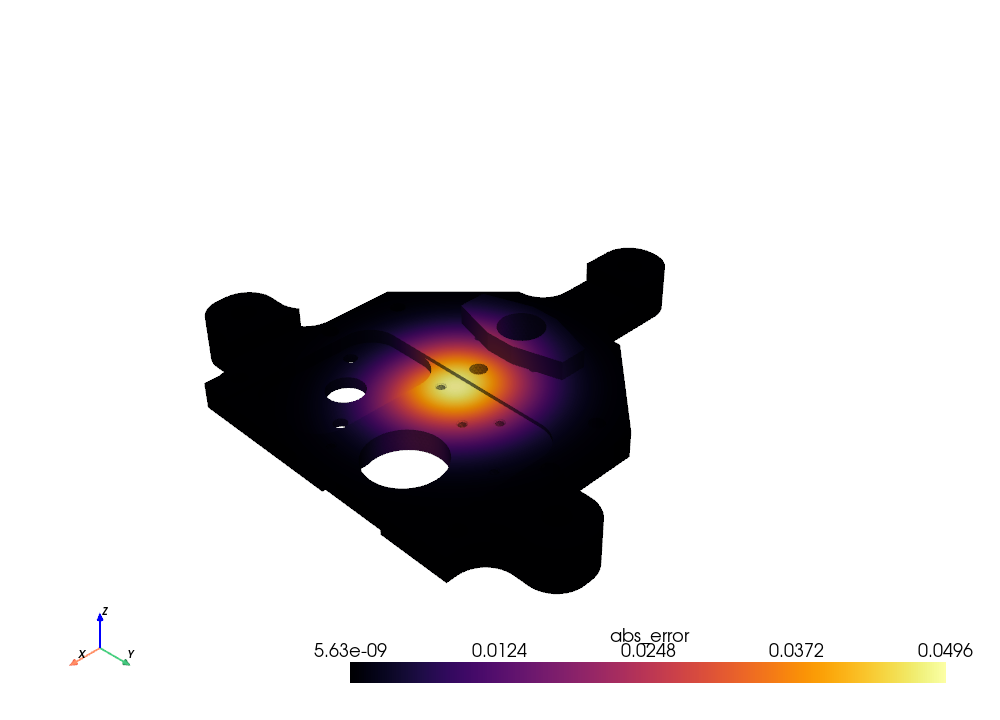
import meshioplusplus

a = meshioplusplus.read("reference.vtu")
b = meshioplusplus.read("candidate.vtu")

# quick boolean, ideal in a regression test
assert meshioplusplus.meshes_equal(a, b, atol=1e-8, rtol=1e-6)

# full structured report
report = meshioplusplus.diff(a, b, atol=1e-8, rtol=1e-6)
print(report["verdict"])                       # "identical" / "equal within tolerance" / "different"
print(report["points"]["max_abs_error"])
Verdicts
| verdict | meaning |
|---|---|
"identical" | structurally equal and every value bitwise-equal |
"equal within tolerance" | structurally equal; values differ but stay within tolerance |
"different" | a structural difference, or a value beyond tolerance |
The verdict is the most severe outcome over every compared section.
Tolerance
Values are compared elementwise with the rule
abs_err <= atol + rtol * |expected|where expected is the value from mesh_a. Defaults are atol=1e-12 and rtol=1e-9. For a round-trip through an ASCII format, pass a looser atol (e.g. 1e-6).
What gets compared
- Points — same count and dimension? per-coordinate errors within tolerance (max abs / max rel error, flat index of the worst offender, count exceeding).
- Cells — same cell blocks (types + counts)? same connectivity per block? The first few mismatching cell indices and the total mismatch count are reported per block.
point_data/cell_data/field_data— same set of keys? For shared keys, same shape and values within tolerance (per-array max abs/rel error and mismatch counts); keys present in only one mesh are listed.point_sets/cell_sets— added / removed / changed named sets, under a"sets"section. These live only on the PythonMesh, so they are compared in the Python layer and are not seen bymeshes_equal(nor by the C / Fortran / WebAssembly bindings).
Ordered vs. unordered
By default the comparison is ordered: points and cells are compared index-by-index — the fast, O(N), parallel path for the common regression-test case where only numerical values may have drifted.
With unordered=True the points of the two meshes are matched by spatial proximity within tolerance using a bucket-grid coordinate hash (no O(N²) scan), then connectivity is compared up to that node correspondence. This makes two meshes with the same geometry but a shuffled node order compare equal. It is conservative: if a robust one-to-one correspondence cannot be established it sets correspondence_failed and reports "different" rather than guessing.
# same geometry + connectivity, nodes numbered differently -> equal
assert meshioplusplus.meshes_equal(a, b, unordered=True)
Report structure
diff returns a nested dict:
verdict,unordered,correspondence_failed,messagespoint_count_mismatch,num_points_a/b,points(an array diff)block_count_mismatch,num_blocks_a/b,blocks(a list of block diffs)point_data,cell_data,field_data(each a data diff)sets(point_sets/cell_sets, each withonly_in_a/only_in_b/changed)
An array diff has shape_mismatch, size_a/b, max_abs_error, max_rel_error, worst_index (flat index), num_exceeding, exact. A block diff has type_a/b, count_a/b, type_mismatch, count_mismatch, conn_mismatch_count, first_mismatches. A data diff has only_in_a, only_in_b, and shared (a list of array diffs).
CLI
meshioplusplus diff a.vtu b.vtu                      # human report, exit 0 if equal
meshioplusplus diff a.vtu b.vtu --atol 1e-8 --rtol 1e-6
meshioplusplus diff a.msh b.vtu --unordered          # tolerant node matching
meshioplusplus diff a.vtu b.vtu --exact              # only bitwise-identical passes
meshioplusplus diff a.vtu b.vtu --quiet              # no output, only exit code
The command sets a nonzero exit code when the meshes differ and zero when they are equal (identical, or — unless --exact — equal within tolerance), so it drops straight into CI, shell scripts and Makefiles:
meshioplusplus diff expected.vtu actual.vtu --atol 1e-8 || echo "regression!"See the CLI reference.
Other languages
The operation is exposed across every binding surface:
- C API —
mio_diff(a, b, atol, rtol, unordered, &result)fills amio_diff_result(read the verdict withmio_diff_result_verdict, the point summary withmio_diff_result_point_summary, per-block flags withmio_diff_result_block; free withmio_diff_result_free); the conveniencemio_meshes_equal(a, b, atol, rtol, unordered, &equal). See the C API reference. - Fortran —
mesh%equals(other, atol=..., rtol=..., unordered=...)(logical) andmesh%diff(other, ...)(verdict0/1/2). See the Fortran reference. - WebAssembly / JavaScript —
diff(meshA, meshB, atol, rtol, unordered)returns a report object;meshesEqual(meshA, meshB, atol, rtol, unordered). See the WebAssembly reference.