
Sequences: multi-file and transient datasets
Since v9.12.0 meshio++ can treat a set of files — or the steps inside one multi-step file — as one ordered logical dataset. That is how transient solver output actually arrives (out_0000.vtu … out_0500.vtu), and how most of the 41 formats have to express time, since only a minority carry several steps natively.
# fan-in: N single-step files -> one multi-step XDMF (quote the glob!)
meshioplusplus convert 'out_*.vtu' series.xdmf

# ... or one transient VTKHDF: the geometry once, one appended step per file
meshioplusplus convert 'out_*.vtu' series.vtkhdf

# fan-out: one multi-step file -> one file per step
meshioplusplus convert series.xdmf 'step_{step}.vtu'

# a whole transient post-processing run, chain applied per step
meshioplusplus pipeline transient.jsonimport meshioplusplus as mp
for time, mesh in mp.read_sequence("out_*.vtu"): # lazy: one mesh at a time
print(time, mesh.points.shape)
mp.write_sequence("series.xdmf", mp.read_sequence("out_*.vtu"))It is a driver, not an operation
Everything here reads and writes through the existing format registry and runs operation chains through the existing typed pipeline layer. run_pipeline_steps remains the single owner of the step dispatch — there is deliberately no second if (op == ...) chain — so a sequence document and the browser viewer's convertSurfaceOps still cannot drift apart. Nothing here adds a mesh operation, a file format, or a dependency.
The three shapes
| input expands to | output has {step}/{index} | mode |
|---|---|---|
| 1 file, 1 step | no | sequence (degenerate — identical to a plain single-file run) |
| 1 file, >1 step | yes | fan-out |
| 1 file, >1 step | no | error — refuses to truncate |
| >1 files | no | fan-in |
| >1 files | yes | sequence (N→N) |
| 1 file, 1 step | yes | sequence with one entry |
The mode is inferred. An explicit Mode ("sequence", "fan-in", "fan-out") never changes the run: it asserts the inference and errors naming both on a mismatch. That is worth having because the inference depends on how many files a glob happened to match — a pattern matching exactly one file would otherwise quietly take the single-file path, and someone who wrote "Mode": "fan-in" wants that to fail.
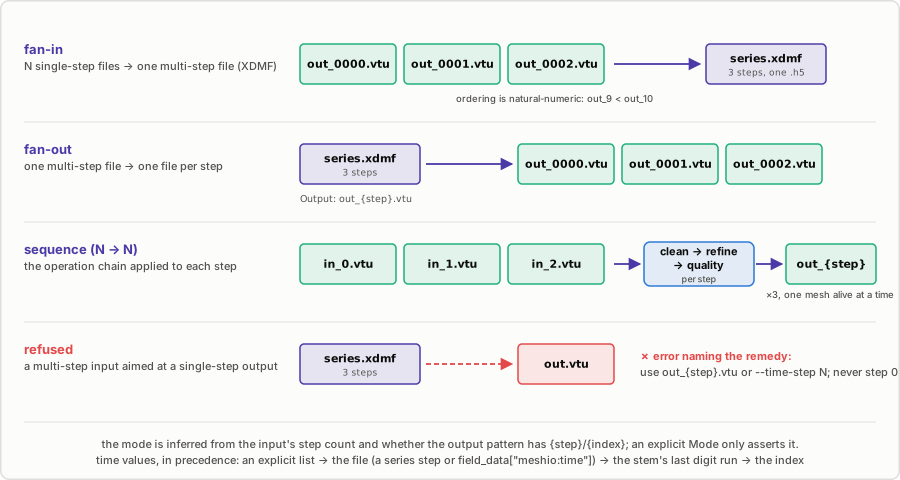
Ordering is natural-numeric
A sequence has a defined order and it is not lexicographic: out_10.vtu must follow out_9.vtu, which a plain sort gets backwards. The rule is a documented contract, not an implementation detail:
- Both strings split into maximal runs of digits and maximal runs of non-digits, compared run by run.
- Two non-digit runs compare byte by byte as unsigned bytes — plain
charsignedness is implementation-defined, and would order the same UTF-8 paths differently on ARM than on x86. - Two digit runs compare numerically: leading zeros stripped, a shorter stripped run is less, equal lengths compare lexicographically. This is done on the digits themselves and never through
stoull/int(), so a 40-digit hash-named file cannot overflow. - A digit run at the same position as a non-digit run sorts first.
- If every run compares equal, the unstripped strings compare byte-wise, so
out_1<out_01deterministically. - The whole path is compared, not the basename, so
a/out_9<a/out_10<b/out_1.
Rule 5 is not cosmetic: without it out_1 and out_01 are mutually "not less" yet not equivalent, which makes the comparator not a strict weak ordering and std::sort undefined behaviour on any directory mixing padded and unpadded names. tests/cpp/test_sequence.cpp brute-forces all four axioms over a table containing exactly that case.
An explicit path list is a stated order and is not re-sorted; pass sort=True (Python) / opts.sort (C) to sort it anyway. A pattern is always sorted, since a directory listing has no meaningful order of its own.
The pattern language
Exactly * (any run, possibly empty) and ? (exactly one character). No **, no [set], no brace expansion, and the directory component of a pattern is taken literally — a * there is an error naming the restriction rather than a recursive walk nobody asked for.
This is deliberately narrower than POSIX glob(3) and than Python's glob/fnmatch. Matching lives in the C++ core, so the native CLI, the C API, Fortran, Julia and R all get it; the Python twin re-implements the same restricted matcher rather than delegating to fnmatch, precisely so the two cannot accept different things. [abc] is three literal characters here.
Shell quoting
Quote the pattern. A shell expands out_*.vtu before the CLI ever sees it, so convert out_*.vtu out.xdmf reaches the CLI as a dozen positional arguments and fails on the argument count. Two forms work:
meshioplusplus convert 'out_*.vtu' out.xdmf                       # quoted
meshioplusplus convert a.vtu --input b.vtu --input c.vtu out.xdmf  # pre-expanded
--input appends to the positional infile and is repeatable — it is what to reach for when your shell (or your build system) has already expanded the glob. Both forms produce the same dataset.
--no-sequence forces the single-file path, for the rare filename that genuinely contains * or {step} (legal on POSIX). --sequence forces the sequence path.
Time values
Every entry carries a time and a record of which source it came from, because "the file said 0.25" and "nothing said anything, so this is position 3" are different facts and a user plotting against it needs to know which they have. The precedence:
| priority | source | reported as | where it comes from |
|---|---|---|---|
| 1 | explicit | explicit | the caller's own list (Times / times=) |
| 2 | file | file | a multi-step file's own step time, or a single-step file's field_data["meshio:time"] |
| 3 | filename | filename | the last maximal digit run of the stem, so run17/out_0042.vtu gives 42 |
| 4 | index | index | the integer position — the fallback, with a warning carrying the count |
time_from ("auto" by default) restricts this: "file", "filename" and "index" each pin one source, falling back to the index when it says nothing.
An explicit list whose length does not match the entry count is an error naming both counts.
field_data["meshio:time"]
A length-1 Float64 array holding the one time a mesh is a snapshot at. It generalizes the exodus:time convention the Exodus reader/writer already round-trips, and is colon-namespaced like partition:part because a bare "time" would collide with a solver's own field far too often.
It only survives where the target format carries field_data at all, which today means Exodus, Gmsh, MDPA and (since v15.0.0) VTU and VTP — VTK and most others carry none in either direction. A fan-out to out_{step}.vtu therefore records each step's time in the file (as <FieldData>, where ParaView also reads it as the time step), but a fan-in over the {step} glob still takes the number in the filename, which outranks a time found in the file, and the entry reports filename so you can see that. To close such a round trip on time, supply the times on the way back in:
mp.write_sequence("series.xdmf", mp.read_sequence("step_*.vtu"), )   # times from filenames
mp.write_sequence("series.xdmf",
                  mp.read_sequence("step_*.vtu", times=[0.0, 0.1, 0.2]))
A fan-in to XDMF needs no help: the series records its own step times, and a later sequence_entries on it reports file.
{step} and {index}
{index} is the plain decimal index. {step} is that index zero-padded to max(4, digits(count - 1)), so a 12-step run writes out_0000 … out_0011 and a 20000-step run widens to out_00005 rather than sorting wrongly in a directory listing.
Expansion is substring replacement, not str.format: an unrelated { in the path is a literal. This matches the native CLI's existing {key}/{part} helpers for split and partition, and differs from the Python CLI's str.format-based versions of those, which raise on a stray brace. That asymmetry is pre-existing; these tokens inherit the C++ side's semantics rather than introducing a third convention. (The three expanders are deliberately kept separate: split's and partition's output must stay byte-identical, and because the two languages differ a "shared" helper would be two helpers anyway.)
Which formats carry time
Two different questions, answered two different ways:
Reading — how many steps does this file have? — is registry-derived: read_metadata(...).time_values. A format whose metadata reader fills no time values has one step, which is the truthful answer for every format that cannot express time. Today XDMF, Exodus, GiD, MED, CGNS, Tecplot, Gmsh (4.1 only), EnSight, OpenFOAM, VTKHDF, PVD, CalculiX .frd, UNV, MSC Nastran HDF5, FEBio .xplt, Ansys .rst (and its full-rotor reading ansys_rst_cyclic), Marc .t19, LS-DYNA d3plot, Nastran OP2, OpenRadioss animation files and USD report real counts. USD's is the one that is not cheap: it has no native metadata path, so the summary comes from a full read whose reader attaches the stage's authored sample times — correct, and stated here rather than implied. MED, CGNS, Tecplot, Gmsh and EnSight joined in v11.3.0 (roadmap §1 tier B1): read_med_metadata is a native path over ENS_MAA/MAI attributes and every CHA/<field>/<step>'s PDT, never a full read — the sorted, deduplicated union of every field's own step times, since a summary reports one timeline per file rather than one per field. read_cgns_metadata is the CGNS twin, over Zone_t's own dimension triple and BaseIterativeData_t/TimeValues; the full CGNS reader now honours time_step too, picking the one FlowSolution_t the resolved step's ZoneIterativeData_t/FlowSolutionPointers names instead of reading (and silently letting a name collision between) every FlowSolution_t in the zone. read_tecplot_metadata scans every ZONE header's SOLUTIONTIME/STRANDID without decoding any zone's data body; the zones sharing the first zone's STRANDID (or, absent one, every zone with a SOLUTIONTIME) form the timeline time_step indexes into, sorted by SOLUTIONTIME, each distinct SOLUTIONTIME value giving one (possibly multi-zone) step. Several non-transient zones (no SOLUTIONTIME anywhere) are not a timeline, but are no longer truncated to the first either (v15.5.0, roadmap §1.1): the whole file becomes the single step, one cell block and one named region per zone — see Tecplot. read_gmsh_metadata (4.1 only; 2.2 has no native metadata path and falls back regardless) reads the sorted union of every $NodeData/$ElementData section's own real-tag time value; the full reader resolves time_step against it and keeps exactly the sections matching that one time, replacing the old "first section per name wins" rule the default step (0) still reproduces unchanged. read_ensight_metadata reads a .case file's own TIME time values: (shape still needs a full read, like Exodus); unlike the other four, EnSight's own convention is one file per step, so time_step templates every VARIABLE entry's *-bearing filename rather than picking a section out of one file — see EnSight. This closed the roadmap's last in-file-timeline item; reading a VARIABLE at all was new; the format was geometry-only before.
VTKHDF joined in v14.0.0: read_vtkhdf_metadata's time_values come straight from Steps/Values — a native path that never touches the geometry, and for a polyhedron-free UnstructuredGrid the whole summary is native too (fell_back_to_full_read = false); time_step reads only that step's slice of each flat array through the Steps offset tables. See VTKHDF.
PVD joined in v15.0.0: a .pvd's steps are the distinct timestep= values of its index, so read_pvd_metadata reports time_values from the index alone — no piece is opened for them — and summarizes step 0's pieces for the rest; time_step selects the step and piece one part of it, and the chosen step's time is attached as field_data["meshio:time"]. A .pvd whose entries are .pvtu files is the ordinary layout of a partitioned transient run. See PVD.
CalculiX .frd joined in v15.3.0: its steps are the 100C increments of the file, told apart by their frame id as well as their value (the modes of a frequency step can share a frequency). read_frd_metadata has no header-only path — it reads the file in full, like EnSight — so fell_back_to_full_read is true; time_step then parses only the chosen increment's result blocks, and the step's value, step counter and analysis type are attached as field_data["meshio:time"], frd:step and frd:analysis. The format is read-only, so it is never a fan-in target. See CalculiX results.
UNV (.unv/.uff) joined in v15.6.0 (roadmap §1.1): its steps are the analysis steps of its results — every 2414/55/56 block is keyed by its analysis type, its step, mode or frequency number and its time, frequency or eigenvalue, blocks with the same key merge, and each abscissa value of the dataset-58 functions of a test-lab file (FRFs, coherences, spectra) is one step as well. read_unv_metadata reads the whole file, like .frd, and a step's value, analysis type and number are attached as field_data["meshio:time"], unv:analysis and unv:step. The writer writes one step per file. See UNV.
FEBio .xplt joined in v16.2.0: its steps are the states of the plot file, one per saved time. read_xplt_metadata reads each state's header (inflating it when the file is compressed), and time_step then reads only that state's data. The state's time, index and status are attached as field_data["meshio:time"], xplt:step and xplt:status, and convert run.xplt 'out_{step}.vtu' fans a run out to one .vtu per state. A remeshed run (v16.10.0) writes a new mesh before the states that use it, and each state is read on its own mesh, so a sequence's steps can differ in points and cells; read_xplt_metadata describes the first mesh. The format is read-only, so it is never a fan-in target. See FEBio plot files.
Ansys .rst/.rth joined in v16.3.0: its steps are the result sets of the file (load steps, substeps or modes), in the order of its data-set index. read_ansys_rst_metadata reads the headers and the model and takes every set's time, or frequency in a modal analysis, from the time table, so convert file.rst 'mode_{step}.vtu' writes one file per mode. time_step then reads only that set's results. ansys_rst_cyclic (v16.8.0) has the same steps, each the full rotor. See ansys_rst.
Marc .t19 joined in v16.8.0: its steps are the increments of a Marc formatted post file, between its **** and ---- markers. read_marc_t19_metadata reads each increment's time from its increment blocks (a frequency or buckling factor in a modal, harmonic or buckling analysis), so convert job.t19 'inc_{step}.vtu' writes one file per increment, and time_step reads only that increment's results. See Marc.
Femap .neu joined in v16.5.0: its steps are the 450 output sets, in file order, with the set value (a time, a frequency, a load factor, whatever the analysis stored) as the step time; each set's 451/1051 output vectors are its data. read_femap_metadata has no header-only path (it reads the file whole), and femap_time_values returns the values alone. A model with no output set is one step.
Abaqus .fil joined in v16.7.0 (roadmap §1.3): its steps are the increments of the results file (each 2000 … 2001 record pair), in file order, with the increment's total time as the step time; abaqus:step, abaqus:increment, abaqus:step_time and abaqus:procedure say which analysis step and increment it is. read_abaqus_fil_metadata has no header-only path: it reads the file once and takes every increment's time. See Abaqus .fil.
MSC Nastran HDF5 (.h5) joined in v15.7.0 (roadmap §1.1): its steps are the result domains (/NASTRAN/RESULT/DOMAINS rows: a subcase, and within it a mode, time or frequency) that the INDEX tables of its nodal and element results reference, in DOMAINS order. read_nastran_h5_metadata reads the model and the first domain, like .frd (fell_back_to_full_read is true); time_step then reads only the chosen domain's rows, through hyperslabs. A step's TIME_FREQ_EIGR is field_data["meshio:time"] as written (an eigenvalue for a mode, not a frequency), with nastran:subcase, nastran:mode and nastran:analysis beside it. The format is read-only, so it is never a fan-in target. See MSC Nastran HDF5.
LS-DYNA d3plot joined in v16.9.0: its steps are the states of the family, d3plot then d3plot01, d3plot02... in numeric order, as many per file as fit before the file's end mark. read_lsdyna_d3plot_metadata reads the control block and the geometry and then only the time word of each state; time_step reads only the chosen state. The state's time and index are field_data["meshio:time"] and lsdyna:state. A glob over the family (run/d3plot*) keeps the base file only, so a d3plot folder is one sample, not one per file. The format is read-only, so it is never a fan-in target. See LS-DYNA d3plot.
Nastran OP2 joined in v16.9.0: its steps are the distinct (subcase, analysis code, mode, time or frequency) of the result tables it reads, in the order the file first names them. read_nastran_op2_metadata reads the model and the result headers; time_step decodes only the chosen step's records. The step's time, frequency or eigenvalue (0 for a static subcase) is field_data["meshio:time"], with nastran:subcase, nastran:analysis and nastran:mode. See Nastran OP2.
OpenRadioss animation files (radioss_anim) joined in v16.11.0: a run writes one file per output time (crashA001, crashA002, …), each a single state whose time is in the file. read_radioss_anim_metadata reports that one time (it reads the file whole), so a glob over the run, convert 'crashA*' crash.vtkhdf, takes every file's own time (time_source file) rather than the number in its name. The state's time is field_data["meshio:time"]. The format is read-only, so it is never a fan-in target. See OpenRadioss animation files.
OpenFOAM joined in v11.4.0 (roadmap §1 tier B2): read_openfoam_metadata's time_values is a real, cheap native path — a directory listing of the case root's numeric-named subdirectories that hold at least one field file, sorted ascending — but the rest of that summary still needs a full read (fell_back_to_full_read = true), like Exodus/EnSight, since a cheap point/cell count would otherwise re-derive the whole cell-reconstruction pipeline. time_step selects one time directory (an index into the sorted list, not the directory's own name); arrays selects which of its field files to attach. Unlike the five above, OpenFOAM's "steps" are directories of independent files rather than sections of one — closer to EnSight's own convention, except every step lives in a fully separate <time>/ tree rather than a numbered filename. See OpenFOAM.
Writing — can this format hold N steps? — has no file to probe, so it is a small owned predicate: XDMF, GiD, USD, VTKHDF and PVD (PVD since v15.0.0: a collection is an index over one .vtu per step, so a fan-in writes one piece and one index line per entry and rewrites the index after every step, so a killed run still leaves a collection ParaView opens; Encoding (ASCII or binary pieces) is honoured, Codec and FloatFormat are rejected — see PVD. VTKHDF since v14.0.0: its Steps group is an offset table into flat arrays, so a fan-in is the geometry written once plus one appended step per entry — see VTKHDF time series). A USD stage is the natural fan-in target of the three: points are time-sampled per step and topology re-authored only when it changes, so a remeshed series stays valid while a fixed-topology one stays compact. The anti-drift mechanism is a test rather than the table: a gtest iterates every registered writer and asserts the predicate agrees with whether a real two-step fan-in to that format actually succeeds, so a format that grows a series writer without updating the predicate turns CI red naming itself.
Fan-out is the answer for everything else, which is most of the format table.
Directory stores in a glob.
pmshandzarrwrite a directory per step, which an ordinary file glob would skip.read_sequence("out_*.pmsh")matches them anyway: a plan entry is a file, or a directory whose suffix is one of those two. Deliberately narrower than "any directory", so an unrelated subdirectory that happens to match a pattern is still ignored. The C++sequence_expandhas no counterpart, which costs nothing there — both formats are Python-only and unreadable from that surface.
Never a silent truncation
A multi-step input aimed at a single-step output is an error naming the remedy, not a quiet write of step 0:
meshio++: sequence: the input has 12 time steps but the output path 'one.vtu'
names a single file; add '{step}' to write one file per step, or select a
single step (--time-step on the CLI, Input.Options.TimeStep in a settings
document)
and a fan-in to a format that cannot hold a series:
meshio++: sequence: format 'vtu' cannot hold a multi-step series (only 'xdmf',
'gid', 'vtkhdf' and 'pvd' can); write one file per step with an Output path containing
'{step}' instead
An explicit --time-step / Input.Options.TimeStep is a deliberate single-step selection and opts out of the check. Before v9.12.0, convert series.xdmf out.vtu silently wrote the first step.
The streaming guarantee
At most one
Meshis alive at any point inside a fan-in, a fan-out or a per-step run, andread_sequenceyields at most one live mesh per iteration.
This is a contract, not an optimization — the whole feature exists so a 500-step dataset is traversable on a laptop. No implementation may buffer the sequence, including "just for sorting" or "just to compute the time range": expansion returns the plan (paths, step indices and times), never meshes.
It is pinned rather than asserted in prose. A gtest measures the peak through the BufferAllocator hook and requires it to be O(1) in the step count (the real assertion is that the 40-file peak matches the 20-file one, not that either is small); the Python suite uses weak references, so a regression names the retainer rather than merely being slow.
The C ABI expresses the same rule: mio_sequence_read hands back an owned mesh, deliberately unlike mio_split_result_mesh's borrow, because a borrow would force the handle to cache every mesh it produced.
What does not stream: list(read_sequence(...)) is your choice and your memory, and an operation's own internals are unchanged — a single step that does not fit in memory still does not fit.
Holding a series as one value: TimeSeries
read_sequence is a generator: exhausted after one pass, unable to answer len(...), unable to be indexed. That is deliberate — it is the surface for a single streaming traversal. But the C/Fortran/Julia/R sequence handles (mio_sequence, type(mio_sequence), Sequence, mio_sequence()) already give random access by construction: they hold the entry plan and read step i on demand, any number of times, in any order. Python had no equivalent — until TimeSeries:
series = mp.TimeSeries("out_*.vtu")
len(series)                  # 12, from the plan alone -- no reads
series.times                 # [0.0, 1.0, ..., 11.0], likewise
t0, mesh0 = series[0]        # exactly one read
t_last, mesh_last = series[-1]
for t, mesh in series:       # a fresh, independent pass every time
    ...
It closes the one item doc/roadmap.md had left open for this feature: a caller that genuinely needs to hold a series — random access across steps, more than one pass — no longer has to reach for list(...). It still honours the streaming invariant: only the plan is held, never a mesh, so series[i] performs exactly one read and nothing is cached between accesses — holding a 500-entry TimeSeries costs no more memory than holding its plan.
Sequences in a settings document
The v9.11.0 pipeline schema, plus seven keys. See the settings pipeline for everything else.
{
  "Version": 1,
  "Mode": "sequence",                 // optional: asserts the inferred shape
  "Input": {
    "Pattern": "run/out_*.vtu",       // or "Paths": [...], or "Path": "in.xdmf"
    "Times": [0.0, 0.1, 0.2],         // optional explicit times
    "TimeFrom": "auto",               // auto | file | filename | index
    "Format": "vtu",
    "Options": { "PointsOnly": false }
  },
  "Operations": [                     // applied to EVERY step
    { "Op": "Quality" },
    { "Op": "Gradient", "Array": "temperature" }
  ],
  "Output": { "Path": "post/out_{step}.vtu" },
  "Parallel": true,                   // Python driver only
  "Workers": 8
}Path, Pattern and Paths are mutually exclusive; naming more than one is an error. Parsing stays strict everywhere: an unknown key, op or enum value errors naming it.
Backward compatibility is absolute. A document using none of the new keys and naming a plain output takes a physically unchanged path — the C++ engine literally delegates to run_pipeline. Conversely, parse_pipeline_json (the typed single-file parser) rejects a sequence key by name rather than ignoring it, because ignoring one would run a transient document as its first step.
Parallel / Workers
Files are embarrassingly parallel at the driver level, so the Python driver can run them in a ProcessPoolExecutor (Workers defaults to one per core). Output is identical to the serial run, report included.
Two deliberate restrictions:
Parallelwith a fan-in is an error, not a silent serialization. The series writer is one stateful handle whose steps must be appended in order, and the obvious workaround — parallel reads feeding an ordered queue into one writer — would holdWorkers + 1meshes and break the streaming guarantee. If that trade is ever worth making it should be an explicit, named opt-in with its memory cost stated.- The C++ engine runs serially and records a warning when a document asks for parallelism. Every operation already parallelizes internally, so a step-level parallel region nested over them would oversubscribe on every backend.
Per-surface entry points
| Surface | Call |
|---|---|
| Python CLI | meshioplusplus convert 'in_*.vtu' out.xdmf, … in.xdmf 'out_{step}.vtu', meshioplusplus pipeline settings.json |
| Native CLI | the same words |
| Python | read_sequence, write_sequence, sequence_entries, run_sequence_pipeline, TimeSeries (and run_pipeline, which routes here) |
| C | mio_sequence_open/_open_list/_count/_path/_step/_time/_time_source/_read/_free, mio_sequence_to_timeseries/_ex, mio_timeseries_to_sequence, mio_sequence_pipeline_run_file/_json |
| Fortran | type(mio_sequence) with %open/%count/%path/%time/%read_step/%to_timeseries/%free, plus mio_timeseries_to_sequence |
| Julia | Sequence, read_step, to_timeseries, timeseries_to_sequence, run_sequence_file/_json |
| R | mio_sequence(), mio_sequence_read(), mio_sequence_to_timeseries(), mio_timeseries_to_sequence(), … |
| MCP | the sequence tool |
| WASM | sequenceEntries, openSequence (stateful, per-step reads), sequenceToTimeseries, timeseriesToSequence, and runPipeline (which routes) — over MEMFS paths |
WASM
The browser surface has these too, over MEMFS paths — the same filesystem convert and runPipeline already work on:
m.sequenceEntries('/seq/out_*.vtu');                      // the ordered plan
m.sequenceToTimeseries('/seq/out_*.vtu', '/seq/s.xdmf');  // fan-in
m.timeseriesToSequence('/seq/s.xdmf', '/seq/b_{step}.vtu');  // fan-out -> paths

// Stateful, lazy per-step reads (mirrors the C API's mio_sequence_* handle):
const seq = m.openSequence('/seq/out_*.vtu');
seq.read(3, { pointsOnly: true });   // readMeshSelective's options, per step
seq.close();
Parallel is accepted and ignored with a warning there: it is a Python-driver process pool, and a wasm module has no processes to pool. See the WASM docs.
Worked examples
Convert a directory of steps into one time series
meshioplusplus convert 'results/out_*.vtu' results/series.xdmfReads the twelve out_0.vtu … out_11.vtu in natural-numeric order (so out_10 follows out_9), takes each time from the trailing digit run of its filename, and streams them into one temporal XDMF collection — one mesh in memory at a time, whatever the step count.
A transient post-processing run
transient.json:
{
  "Version": 1,
  "Input": { "Pattern": "raw/out_*.vtu" },
  "Operations": [
    { "Op": "Quality" },
    { "Op": "Gradient", "Array": "temperature", "Operator": "gradient" },
    { "Op": "Clean" }
  ],
  "Output": { "Path": "post/out_{step}.vtu" },
  "Parallel": true
}meshioplusplus pipeline transient.jsonEvery step is read, run through the same three-operation chain, and written to its own file — the composition that turns the pipeline into a batch post-processor. The report carries one entry per (step, op).
Explode a multi-step file for a tool that cannot read one
meshioplusplus convert simulation.xdmf 'steps/frame_{step}.vtu'Writes steps/frame_0000.vtu …, each carrying its own field_data["meshio:time"] where the target format can hold it.
See also
- The settings pipeline — the operation chain a sequence applies per step.
- XDMF time series — the stateful writer a fan-in drives.
- VTKHDF time series — the other one:
Stepsis an offset table, so a fan-in is geometry × 1, fields × N. - Selective reads —
time_step, and whatread_metadatacan answer without a full read. - CLI reference.
- Dataset manifests — cataloguing many sequences (each entry is a
TimeSeriesplan) with splits/tags for ML training.