
Mesh and geometry
physicsnemo.mesh is the largest subpackage, and the one where the impedance mismatch with a general mesh library is biggest.
The representation, and the one thing to know about it
physicsnemo.mesh.Mesh is points plus simplices plus fields. Simplices: line segments, triangles, tetrahedra. That is the whole vocabulary.
Real meshes are not simplicial. Hexahedra, prisms, pyramids, quadrilaterals and every quadratic geometry have to be tessellated into simplices before PhysicsNeMo will look at them, and that is where the subtlety is: tessellating each element independently splits shared faces along contradictory diagonals, leaving gaps between neighbours that no amount of downstream care recovers.
DomainMesh adds named boundaries to a Mesh — the natural target for a mesh's named regions.
Meshes save and load in a memory-mapped format (.pmsh), which is what MeshDataset reads.
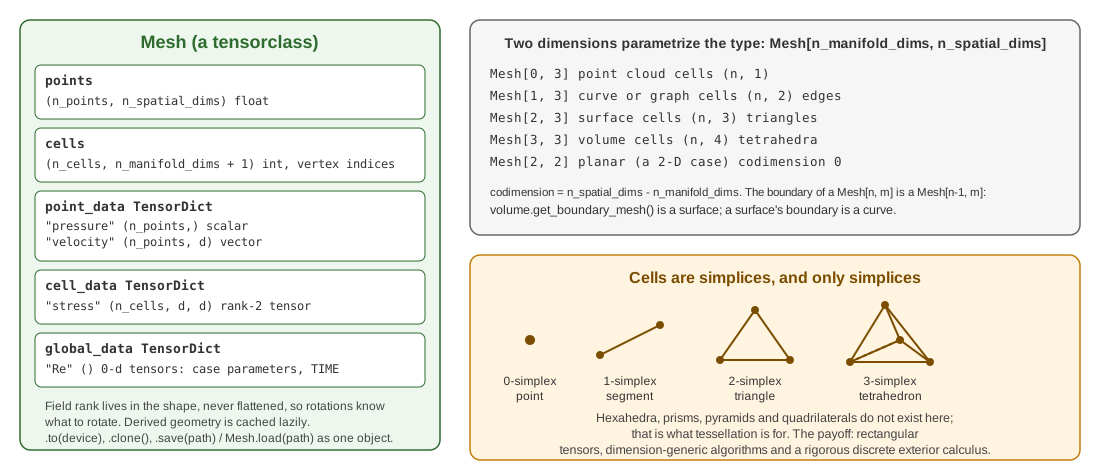
Figure 1: The data model. Field rank lives in the tensor shape; the type is parametrized by two dimensions; cells are simplices and nothing else.
What is in there
| Submodule | What it does |
|---|---|
tessellation | triangulate, fill_interior — simplices from polygons and surfaces |
calculus | gradient, divergence, curl, Laplacian, integrals on a mesh — LSQ and discrete-exterior-calculus backends, autograd-differentiable |
generate | implicit geometry: sdf_box/sdf_sphere-style primitives, sdf_union/sdf_difference/sdf_intersection combinators, marching_cubes, mesh_implicit_domain, refit_mesh_to_implicit |
spatial | signed_distance_field (a 3-tuple since 2.2: distances, hit points, hit faces), BVH for containing-cell and nearest-facet queries, ClusterTree for Barnes-Hut style far-field aggregation |
remeshing | remesh (Warp-backed) and partition_cells surface clustering |
deformation | mesh-quality energies: strain, measure, bending, and simplex inversion — the term that stops an optimizer tearing the mesh |
geometry | areas, normals, circumcenters, cotangent weights, dual volumes |
neighbors | point-to-cell, cell-to-cell and point-to-point adjacency |
boundaries | facet extraction and boundary categorization |
sampling | containing-cell search, barycentric coordinates, point sampling |
repair | hole filling, orientation fixing, duplicate and degenerate removal |
subdivision | linear, loop and butterfly refinement |
transformations | rotate, scale, translate, deform |
curvature | mean_curvature_vertices, gaussian_curvature_vertices (cotangent Laplace-Beltrami) — a natural node feature next to the SDF |
smoothing | smooth_laplacian |
projections | extrude (an N-D mesh swept into N+1), embed, project |
primitives | canonical meshes (cubes, spheres, planar shapes, procedural surfaces) for tests and demos |
validation | validate, quality_metrics, statistics |
visualization | draw through matplotlib or pyvista |
io | from_pyvista/to_pyvista (auto-triangulates polyhedral cells — no provenance), to_zarr/from_zarr (2.2) |
Two upstream behaviours worth knowing
The mesh-calculus gradient layout flipped between releases: 2.1's least-squares backend was channel-major, 2.2 is derivative-first (N, D, C) from every backend. A layout change that keeps shapes identical passes every test whose fixture is symmetric, which is exactly how it goes unnoticed — a canary gradient must be asymmetric and non-square to catch it.
Boundary surfaces come out inconsistently wound. Anything using an extracted surface for a signed distance has to re-orient it first, or the sign of the distance field flips from patch to patch.
In meshio++
This is the page where the two libraries overlap most, so it is worth being precise about what each is for. PhysicsNeMo's mesh package exists to make a mesh differentiable — every operation on it carries a gradient back to a model. meshio++'s exists to make a mesh portable and correct — forty-odd formats, every cell type, exact conservation, no framework. They are complements, and the honest division is: read, convert, repair and measure with meshio++; put the result on a device and differentiate it with physicsnemo.
Where meshio++ has a direct counterpart:
| PhysicsNeMo | meshio++ |
|---|---|
Mesh, DomainMesh | to_physicsnemo, from_physicsnemo — the bridge, one topological dimension at a time |
calculus | gradient, hessian, data_integrate — exact for a linear field, not differentiable |
generate | compute_sdf and isosurface — an SDF lattice and its contour |
spatial.signed_distance_field | sample_distance — with the angle-weighted pseudonormal sign a nearest-triangle normal gets wrong at a spike |
remeshing | remesh, remesh_volume, optimize_volume |
repair | repair — orientation, hole filling, bowtie splitting (v10.38.0); clean for the weld, degenerate/duplicate drop and orphan prune |
transformations.deform.shrinkwrap | shrinkwrap (v10.38.0) — one projection, offset along the hit feature's pseudonormal rather than the selected triangle's |
transformations.deform.sobolev_deform | sobolev_deform (v10.38.0) — the same screened-Poisson filter over the same P1 operators, not differentiable |
subdivision | refine, subdivide, and agglomerate going the other way |
boundaries | extract_surface, extract_skin, and named regions for the naming |
validation | compute_quality, compute_stats |
primitives | grid; the rest are on the roadmap |
.pmsh | pmsh (v10.35.0) — the memmap layout written in pure numpy, so a box with no torch can produce a training set; zarr writes the chunked alternative MeshReader also accepts |
Tessellation, and the thing that goes wrong. convert_cells(mode="simplexify") is meshio++'s answer to the simplices-only constraint: quadrilaterals fan into triangles, hexahedra into six tetrahedra by a canonical Freudenthal fan around the main diagonal 0–6, wedges into three, pyramids into two, and higher-order cells are linearized first. The diagonal is fixed rather than chosen per cell, which is precisely the conformity point above: two neighbouring hexahedra agree on how their shared face splits because neither of them chose.
meshio++ now has the other half too — tessellate (v10.39.0) isoparametrically subdivides a curved cell (triangle6/quad8/quad9/tetra10/hexahedron27) through synthetic points on a refinement lattice, interpolated on the way in, and records a full provenance map (Tessellation.source_point/source_cell) back to the cell each synthetic point/simplex was carved out of. record_parent_ids still gives a per-conversion parent index; Tessellation.gather/.scatter/.aggregate are the general "carry a prediction back through a tessellation" facility — a prediction made on a tetrahedron is written onto the hexahedron it was carved out of by scattering it through that map, and Graph.Tessellate wires the same thing into graph_sample/training/prediction directly.
Generation goes the other way too. remesh_volume takes a closed surface and produces a genuinely new tetrahedral mesh (isosurface stuffing over a body-centred cubic lattice), so an SDF-defined shape can be contoured with isosurface, meshed, and handed to a solver — without a Delaunay predicate kernel anywhere in the chain.
Next: Symbolic and physics.