
Polyhedra and ragged cells
Most cell types have a fixed node count: a tetra always has four nodes, a hexahedron always eight. A ragged block does not — its cells vary in size, which is what a Voronoi polygon or a general polyhedral CFD cell needs. meshio++ stores two ragged shapes, and this page is the single place their rules are stated, because five surfaces and four language bindings all have to agree on them.
The two shapes
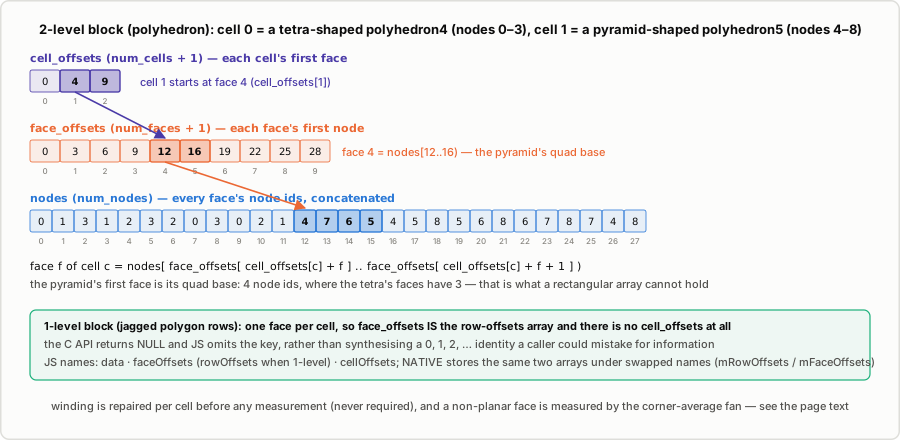
1-level ragged — a polygon* block. Each cell is one list of node ids of whatever length. MED POG, EnSight nsided and VTP Polys produce these.
2-level ragged — a polyhedron* block. Each cell is a list of faces, each face a list of node ids. There is no separate cell-node list: a cell's nodes are whatever its faces reference. OpenFOAM, EnSight nfaced and VTU's VTK_POLYHEDRON produce these.
The type name encodes the node count where the format supplies one — polyhedron4 has four distinct nodes, polyhedron12 twelve — which is how readers group cells into blocks. See Cell types.
Check the type name, not IsRagged()
A block whose cells all happen to have the same node count may be stored rectangularly and is then not ragged at all, even though its type is polygon. Code that must reject polyhedra (a format writer, say) has to test the type name, not IsRagged().
The flat CSR vocabulary
Nested lists do not cross a flat ABI, so every non-C++ surface carries ragged blocks as flat CSR arrays. There is one set of names:
| Array | Length | Meaning |
|---|---|---|
nodes (JS: data) | num_nodes | every face's node ids concatenated, 0-based |
face_offsets (JS: faceOffsets, or rowOffsets when 1-level) | num_faces + 1 | each face's start index into nodes |
cell_offsets (JS: cellOffsets) | num_cells + 1 | each cell's start index into the face list |
So face f of cell c is
nodes[ face_offsets[ cell_offsets[c] + f ] .. face_offsets[ cell_offsets[c] + f + 1 ] )A 1-level block has exactly one face per cell, so face_offsets is the row-offsets array and there is no cell_offsets at all — the C API returns NULL and JS omits the key, rather than synthesising a 0,1,2,… identity that a caller could mistake for information.
Every mesh backend stores ragged blocks in exactly this shape (the MESHIO backend since v16.16.0; it held nested vectors before), and C++ code hands it over whole: AddPolygonBlock(type, nodes, face_offsets) and AddPolyhedronBlock(type, nodes, face_offsets, cell_offsets) move the three arrays in, with no allocation per cell or face, after checking that each offset array starts at 0, never decreases and ends at the length it indexes (std::invalid_argument otherwise). The nested-vector overloads remain and convert. The readers that build polyhedra in bulk -- VTK XML, OpenFOAM, CGNS and MED -- use the CSR forms.
A naming skew worth knowing
The mesh backends store the same two offset arrays under the opposite names: their mRowOffsets is this page's face_offsets, and their mFaceOffsets is this page's cell_offsets -- which is also the order the C++ AddPolyhedronBlock overload takes them in. The CSR vocabulary above is what every binding uses; the backends' field names are internal and predate it.
Winding
Faces should be wound so that the right-hand normal points out of the cell. That is what OpenFOAM's polyMesh gives on read, what VTK's type 42 asks for, and what meshio++ writes.
meshio++ does not require it. Real meshes arrive with faces wound inconsistently — including, as it happens, this repository's own long-standing polyhedral test fixture — and rejecting them would be less useful than fixing them. Every geometric kernel therefore repairs the winding per cell before measuring, and reports the face set as unorientable only when it is genuinely not a closed orientable surface (some undirected edge is not used exactly twice).
The practical consequence: a cell volume never comes back negative because someone's faces were inside-out.
Non-planar faces
A face with four or more corners that are not coplanar does not bound a unique volume — the answer depends on how you triangulate it. meshio++'s answer is the corner-average fan: the face is the union of triangles from each of its edges to the face's corner average.
That is chosen, not arbitrary:
- It is independent of which corner the face's node list starts at. A fan about the first node is not, and OpenFOAM's
facesfile, MED'sINNand VTU'sfacesstream all pick that start node arbitrarily — so two readers of the same mesh could otherwise legitimately disagree about a volume. - It is the same surface
gradient's Green–Gauss integration already uses, for an independent reason (the corner average is the only apex whose value is known exactly for a linear field). - It is OpenFOAM's own cell-volume decomposition, so a round-tripped case reports the volumes its solver would.
Support across the surfaces
| Surface | Build a ragged block | Read one back |
|---|---|---|
| C++ | AddPolygonBlock / AddPolyhedronBlock | CellView::Row/RowSize, NumFaces/Face |
| Python | Mesh(..., cells=[("polyhedron4", [[[...]]])]) | CellBlock.data (a nested list) |
| C API | mio_mesh_add_polygon_block / _polyhedron_block | mio_poly_conn_create + the three array accessors |
| Fortran | m%add_polygon_block / m%add_polyhedron_block | m%get_polygon_block / m%get_polyhedron_block (CSR, 1-based) |
| Julia | add_polygon_block! / add_polyhedron_block! | polygon_block / polyhedron_block (nested vectors, 1-based) |
| R | mio_add_polygon_block() / mio_add_polyhedron_block() | mio_polygon_block() / mio_polyhedron_block() (nested lists, 1-based) |
| WASM | {type, data, rowOffsets} / {type, data, faceOffsets, cellOffsets} on the mesh object | the same shape back |
Each language gets its natural shape over one flat ABI: Fortran has no ragged array type so it gets the CSR triple; Julia has nested vectors and R has lists, so those are what they hand back. This is the same policy that already gives all three column-major arrays and 1-based indices.
The C API's snapshot is not a borrow
Every other getter in the C API is a zero-copy borrow that dies at the next mutating call (rule 3). mio_poly_conn is an owning snapshot instead, and deliberately so: until v16.16.0 the MESHIO mesh backend stored ragged blocks as nested vectors, with no offsets array inside the mesh to point at, and the KRATOS backend still rebuilds its blocks lazily. The snapshot is therefore safer than a borrow — it stays valid across mutating calls — and must be released with mio_poly_conn_free().
Julia's polygon_block/polyhedron_block copy out of that snapshot and free it, so there is no _ptr form for ragged blocks: a MeshBorrow carries the mesh's mutation generation as its guard, which is the wrong guard here.
Format support
Reading polyhedra: MED (POE), EnSight (nfaced), OpenFOAM, VTU (type 42), VTKHDF (type 42 plus the four face arrays, since v14.0.0) and CGNS (NGON_n+NFACE_n). CGNS additionally reads ADF containers and the CGNS 3.x section layout on a build with the optional cgnslib backend. Tecplot (FEPOLYHEDRON, ASCII and .plt) since v16.11.0. Reading jagged polygons: MED (POG/POG2), EnSight (nsided), VTP, OpenFOAM, Tecplot (FEPOLYGON, since v16.11.0).
Writing polyhedra: MED (POE), EnSight (nfaced) and VTU (type 42) since v9.19.0; VTKHDF since v14.0.0 (declared as VTKHDF 2.5); OpenFOAM since v9.20.0, where they are the native cell shape; CGNS (NGON_n+NFACE_n) since v9.21.0. Tecplot ASCII (FEPOLYHEDRON) since v16.11.0. Writing jagged polygons: MED (POG/POG2), EnSight (nsided; the Python twin writes nsided and nfaced too, with identical bytes), VTP, CGNS (NGON_n), Tecplot ASCII (FEPOLYGON, since v16.11.0).
VTKHDF's encoding differs from VTU's face stream: four arrays, FaceConnectivity/FaceOffsets (the faces, NumberOfFaces + 1 boundaries per piece) and PolyhedronToFaces/PolyhedronOffsets (which faces make each cell, with NumberOfCells + 1 boundaries that cover every cell, so a non-polyhedral cell is a zero-length span and a mixed mesh needs no -1 sentinel). The face table may be shared between neighbouring polyhedra; meshio++ owns faces per cell, so the sharing is expanded on read and faces are not de-duplicated on write. Node counts bucket a polyhedron run into polyhedron<N> blocks per piece, so a piece stays one contiguous range. See VTKHDF.
See Formats for the current table and each format page for what it can express. A writer that cannot represent a ragged block fails naming the format rather than silently dropping cells.
Operations
Structural operations carry ragged blocks through unchanged: crop, split, clean, merge, transform, reorder, diff and the data operations.
Geometric operations go through the kernel (detail/polyhedron.hpp) as of v9.16.0:
| Operation | On a polyhedron |
|---|---|
stats | volume, area and centroid, via the corner-average fan. A cell that is not a closed orientable surface is excluded and warned about, not silently counted as zero |
gradient | fully supported — Green–Gauss needs only faces, so a polyhedron goes through the same code as a hexahedron and recovers a linear field exactly |
compute_quality | a reduced set: volume, inverted, degenerate. Every metric defined against a reference element stays NaN — see below |
extract_surface / extract_skin | fully supported, including faces of any arity: a pentagon becomes a row of a ragged polygon block |
smooth | fully supported: the inversion guard and fix_boundary both cover them |
partition | fully supported, both methods: SFC works off centroids, and the KaHIP dual graph connects cells sharing a face |
clean | degenerate and duplicate polyhedra are dropped; the duplicate key is the sorted set of sorted faces |
data_average | Measure weighting works, instead of falling back to a unit weight |
Why quality reports so little
Aspect ratio, skewness, warpage and the angle metrics are all defined against a reference element — an ideal tetrahedron, an ideal hexahedron. A polyhedron has no reference element, so those numbers would be invented rather than measured. meshio++ reports NaN, which is its standing convention for a metric that does not apply, rather than something plausible-looking.
"Inverted" also means something different here: since winding is repaired rather than required, there is no convention for a cell to violate. What a polyhedron can fail to be is a closed orientable surface, and that is what the flag reports.
Not yet supported
refineanddecimateraise by name — both are built on fixed subdivision templates, and an arbitrary polyhedron has none. Both messages point atconvert_cells(simplexify), which since v9.17.0 decomposes a polyhedron into tetrahedra using the same fan the kernel measures — so the decomposition conserves volume exactly. That also makesslice,isosurfaceandinterpolate --barycentricwork on polyhedra, since all three go through it.- The pure-numpy
convert_cellsfallback is rectangular-only, so on a build with no compiled core a polyhedral simplexify raisesNotImplementedError.
One shared facet key (detail::FacetKey, variable arity with a four-entry inline fast path) backs extract_surface, smooth's boundary marking and partition's dual graph. That matters beyond tidiness: with a separate key per cell shape, a hexahedron and a polyhedron meeting on a face would not recognise each other, and both would report that interior face as boundary.