
Fit CAD
fit_cad(mesh, path) turns the fitted patches of a closed triangle skin into a CAD solid: every patch that fit_primitives accepted becomes a plane, sphere, cylinder, cone or torus face trimmed by the patch boundary, a rolling-ball fillet or a thread flank its own feature face, any other patch no primitive explains a freeform B-spline face, the faces are sewn into a solid that OpenCASCADE checks, and the solid is written as STEP. It is the last step of skin to CAD, after segment and fit_primitives, and it needs the optional OpenCASCADE backend.
import meshioplusplus as mp

skin = mp.repair(mp.read("part.stl"))
seg = mp.segment(skin, curvature_tolerance=1.0, min_patch_cells=20)
fit = mp.fit_primitives(seg, tolerance=2e-3)

solid, report = mp.fit_cad(fit, "part.step", return_report=True)
report["valid"], report["num_cylinder"], report["num_demoted"]
report["volume_ratio"], report["max_deviation"]   # against the skin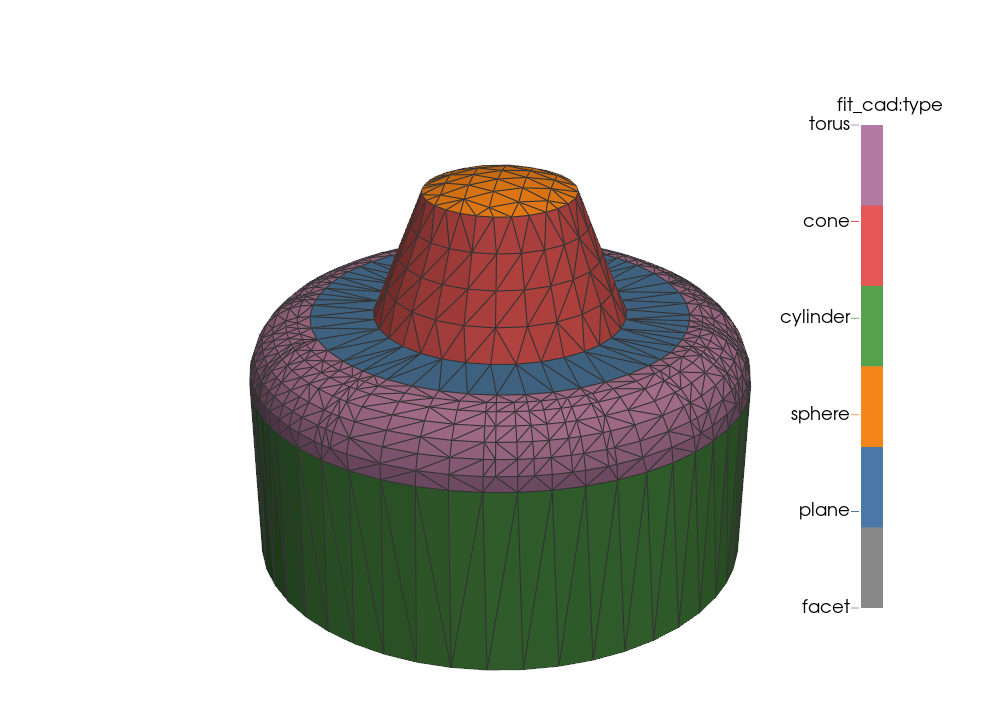
Unlike the faceted step writer, whose solid is one flat face per triangle, the STEP file fit_cad writes carries CYLINDRICAL_SURFACE, CONICAL_SURFACE, SPHERICAL_SURFACE and TOROIDAL_SURFACE faces a CAD tool can select, dimension and edit. A skin without segment:patch or the fit:patch_* table is segmented and fitted first with the default options; a noisy scan wants a curvature test and a min_patch_cells in the tens, so run those two yourself, or pass them to the CLI.
How the solid is built
- Faces. A patch whose fit was accepted, and whose type is in
types, becomes one face on its fitted surface. A patch no primitive explains is tried, in order, as a rolling-ball fillet (fillets), as a thread flank (threads) and, withfreeform(the default), as a B-spline face. Every other surface cell (a type left out, a freeform fit that failed, a cell with no patch) becomes planar facets, one per cell, as the faceted writer writes them. - Edges. Where two patches meet, the mesh edges between them form chains from one junction (a point where three or more patches meet) to the next; a closed chain is split in two. Between two analytic faces the edge is the branch of the two surfaces' exact intersection that lies within the tolerance of the chain, when
exact_edgesis set and one does (a plane meeting a cylinder gives a circle). Otherwise, notably where a fillet meets its wall tangentially and no intersection is stable, the edge is a B-spline through the chain, smoothed and moved onto both surfaces, kept only if it stays within the tolerance of both. Beside a facet, the edge is the mesh's own straight edge. - Vertices. A junction among analytic faces only is moved onto all of their surfaces; one beside a facet keeps the mesh position.
- Solid. Each face gets parameter-space curves that are continuous around its loops (so a boundary running along a cylinder's seam or a torus's equator does not fall apart), OpenCASCADE adds the seams and repairs the faces, sews them and closes each shell into a solid, one per edge-connected piece of the skin. A patch with no boundary at all, a whole sphere or torus, is its surface's natural face.
Freeform faces
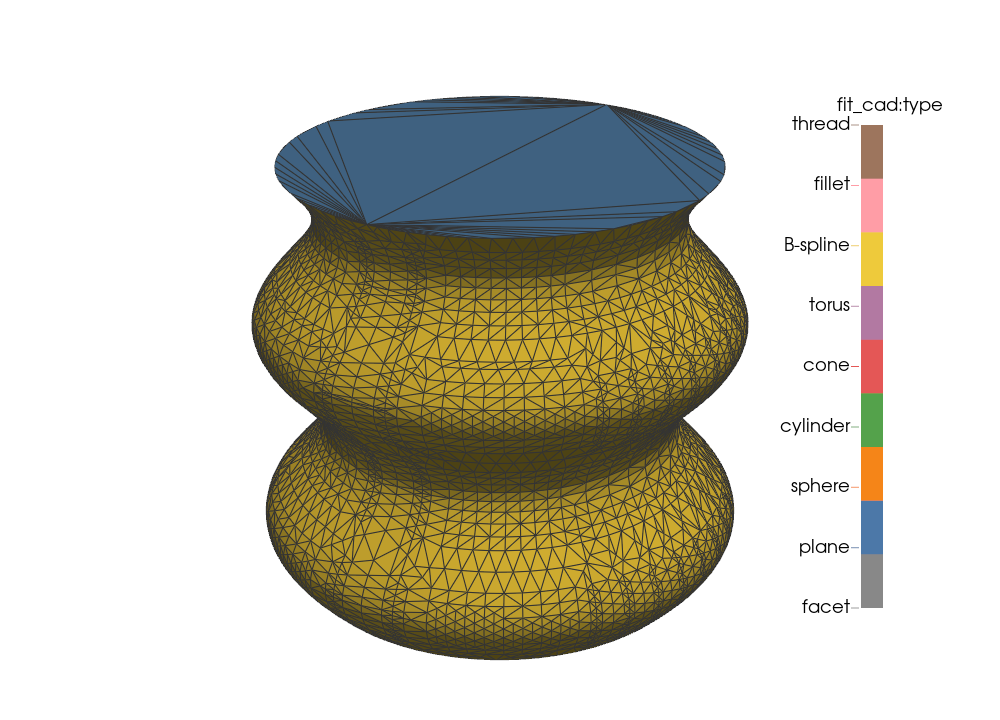
A patch fit_primitives left unexplained (no accepted primitive, or one with non-finite parameters) gets a B-spline surface fitted to it, so a smooth blend, a dent or a styled panel becomes one CAD face instead of hundreds of facets:
- A parametrisation. The patch is flattened over its best-fit plane (principal components) or, when that folds, unrolled around a cylinder: the axis is the direction its normals are most perpendicular to (the smallest eigenvector of Σ nnᵀ), the radius a least-squares circle fit of the points around it, the angle cut at the widest gap. A flattening whose triangles do not all keep one orientation is not a parametrisation and is not used. A patch that folds over both (a doubly curled one, or a band closed around an axis) is, with
freeform_split(the default), split into pieces that one of them does parametrise. - A height field. The offset from the plane or the cylinder is resampled on a grid over the flattened bounding box, interpolated inside the patch's triangles and continued from the nearest boundary point outside them, so the surface extends past the patch's trim.
- The fit.
GeomAPI_PointsToBSplineSurfacefits the grid (iso-parametric, C2, degrees up tofreeform_degree, default 3, valid 3–8). The grid starts near √n points a side and doubles up tofreeform_max_control(default 64, valid 4–1024) until every patch vertex lies within half the tolerance and every facet centre within the tolerance; a patch that never gets there, or a skin too coarse for any smooth surface to pass within it, stays faceted. - The face. The surface is oriented by the facet normals and goes through the same trimming, sewing, check and demotion as an analytic face; its
fit_cad:typeis 6 (kFitCadBsplineType), and the report'snum_bsplinecounts it.
freeform=False keeps every unexplained patch faceted.
Splitting curled patches
A patch that folds over both flattenings is halved at the area-weighted median of n · e, where e is the direction its normals spread along most (the principal axis of the area-weighted Σ nnᵀ): a cut along an iso-line of the normal, a smooth curve on a smooth surface. Each half is split into its edge-connected components, and a component that still folds is halved again, up to four times. Each piece that now flattens becomes its own freeform face under a new patch label, numbered after the largest existing one in the order of its lowest facet, so fit_cad:patch tells the pieces apart; a piece under 16 triangles, or one still folding at the fourth halving, stays faceted. The edges between pieces are approximated B-splines like any other tangent junction. The split is deterministic and needs no OpenCASCADE (detail/patch_flatten); num_split_patches counts the pieces, and freeform_split=False keeps such a patch faceted, as before.
Fillets and threads
Two features that no primitive explains are recognised before the freeform fallback, from the patches around them:
- Rolling-ball fillets (
fillets, type 7). A patch that runs between two analytic faces (the two neighbours sharing the most boundary, together at least 60% of it) is tried as a constant-radius fillet between them: each interior vertex, moved byragainst or along its normal, should be a ball centre atrfrom both primitives. The radius minimises that misfit over a log-spaced scan of[tolerance / 2, diagonal]refined by golden section, for a convex (centres inside) and a concave (centres outside) ball. The face is the pipe of that radius around the spine where the two surfaces, each offset byrtowards the centres, meet (GeomFill_Pipearound theGeomAPI_IntSSbranch nearest the centres, kept whole and periodic when the centres go most of the way round it). It covers a straight rounded edge, a swept fillet along a curved edge (the foot of a leaning boss, along an ellipse) and a ring. A constant-radius fillet between coaxial surfaces is a torus, whichfit_primitivesalready fits; this stage only sees what it left unexplained. - Thread flanks (
threads, type 8). A patch beside an accepted cylinder or cone is tried as a straight-flank thread about its axis: the ruled helicoidz = c + k θ + t ρ(kthe pitch over 2π,tthe flank's slope). Unwrapping each vertex's angle over the patch's edges makes the model linear, so one least-squares solve fits it; the patch must span at least half a turn (less of a helicoid is as well a cone or a plane) and keep every vertex within half the tolerance. The face is a B-spline through a grid on the helicoid over the patch's radial and angular extent. A trapezoidal or ISO thread then comes back as cylinders (root and crest) and two helical flanks.
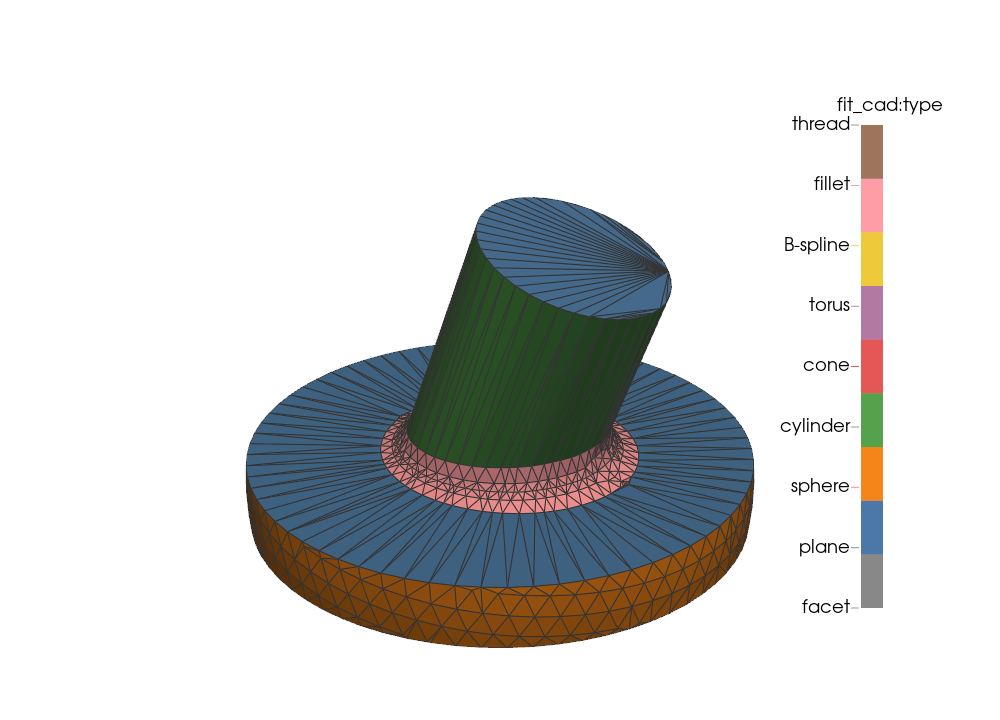
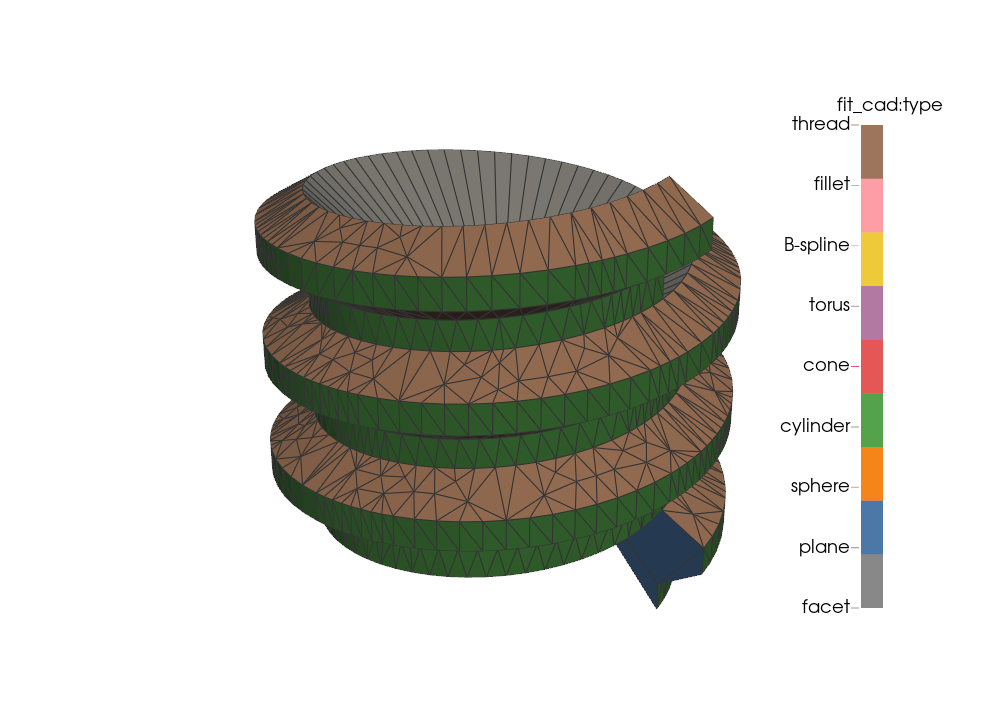
A candidate face must keep every patch vertex within half the tolerance and every facet centre within it, as a freeform face must, and is then trimmed, sewn, checked and demoted like any other. Edges beside a fillet or a flank skip the exact intersection, which is slow and unstable between tangent or long B-spline surfaces, and go straight to the approximated B-spline. The fits themselves need no OpenCASCADE (detail/feature_fit). num_fillet and num_helical count the faces; fillets=False and threads=False leave such patches to the freeform fit.
Checks and demotion
A face is not kept when OpenCASCADE's B-rep check rejects it, when sewing leaves an edge of it free, when its boundary cannot be built, or when it strays: the solid is re-meshed and a face with a point further than tolerance from the skin, or a patch with a skin point further than that from the solid, fails. A failed patch is demoted to facets and the solid is rebuilt; after max_demotion_rounds rounds (default 8) every remaining patch is faceted, which is always a valid solid for a closed skin. So a feature the fitter cannot explain, or a face the kernel cannot trim, comes back faceted, never silently wrong, and num_demoted counts the features dropped. MESHIOPLUSPLUS_LOG_LEVEL=debug logs why each patch was demoted.
tolerance defaults to three times the largest fit:patch_tolerance of an accepted patch, so it follows the scale fit_primitives worked at; with no accepted patch it is 1e-3 of the bounding-box diagonal. The re-meshing uses a chordal deflection of a quarter of the tolerance unless mesh_deflection says otherwise.
Output and report
The return value is the solid re-meshed by OpenCASCADE as one triangle block, with points welded where faces share them exactly, and Int64 cell data fit_cad:face (the B-rep face), fit_cad:type (0 a facet, else the fit:type value: 1 plane, 2 sphere, 3 cylinder, 4 cone, 5 torus; 6 a freeform B-spline, 7 a rolling-ball fillet, 8 a thread flank) and fit_cad:patch (the segment:patch label, -1 for a cell with no patch). With return_report=True the report holds:
| Key | Meaning |
|---|---|
valid | the solid passes OpenCASCADE's B-rep check |
tolerance | the tolerance applied |
volume, skin_volume, volume_ratio | the solid's volume, the skin's enclosed volume and their ratio |
max_deviation | the symmetric Hausdorff distance between the skin and the re-meshed solid |
num_faces, num_plane … num_torus, num_bspline, num_fillet, num_helical, num_faceted_faces | B-rep faces in all, by type (freeform B-splines, fillets and thread flanks included), and planar facets |
num_split_patches | pieces that freeform patches folding over every flattening were split into |
num_patches, num_demoted | patches in the fit table, and accepted ones demoted to facets |
num_exact_edges, num_approx_edges | edges between analytic faces built as exact intersections and as B-splines |
num_solids | solids written, one per piece of the skin |
The STEP file is AP214 in millimetres. Its header timestamp is pinned and its product is named meshio++ fit_cad, so the same input writes the same bytes; the bytes do depend on the OpenCASCADE version. The work is serial, so nothing depends on the thread count.
The solid as NURBS
solid.info["brep"] (C++ FitCadResult::mBrep, a BrepInfo) holds the solid with every face converted to NURBS (BRepBuilderAPI_NurbsConvert): the surfaces, their trimming loops and the edges with the faces they bound, as a STEP read gives them. Writing it as Kratos CAD JSON (mp.write("part.cad.json", solid), to-cad --cad-json) makes a scanned part Kratos IGA geometry.
Getting OpenCASCADE
Open CASCADE Technology is licensed under the GNU LGPL 2.1 with the additional exception in its OCCT_LGPL_EXCEPTION.txt. meshio++ stays MIT: the backend is off by default and bring-your-own (never vendored or downloaded), linked dynamically, and absent from the PyPI wheels, the WASM build and the release CLI binaries. A build that enables it links an LGPL library; distributing that build carries the LGPL's obligations for OpenCASCADE, not for meshio++. OpenCASCADE 7.6 or later is supported (7.6 is Ubuntu 24.04's package; the CI leg tests it).
sudo apt-get install libocct-foundation-dev libocct-modeling-data-dev \
    libocct-modeling-algorithms-dev libocct-data-exchange-dev libtbb-dev
CMAKE_ARGS="-DMESHIOPLUSPLUS_WITH_OCCT=ON" pip install meshioplusplus --no-binary meshioplusplus
From source, build/configure.sh --with-occt (or -DMESHIOPLUSPLUS_WITH_OCCT=ON) finds OpenCASCADE through its CMake config; point OpenCASCADE_DIR or CMAKE_PREFIX_PATH at an install outside the default prefixes, and make its libraries findable at run time as for any shared library. Debian's packages export toolkit targets that link TBB, hence libtbb-dev.
Without the backend, fit_cad raises NotImplementedError (C++ Unsupported) naming -DMESHIOPLUSPLUS_WITH_OCCT=ON; there is no pure-Python fallback, because trimming, sewing and checking surfaces is a CAD kernel's work. meshioplusplus._fit_cad.has_occt(), fit_cad_has_occt() in C++, mio_has_occt() in C and the language surfaces below say in advance whether a build has it.
CLI
meshioplusplus to-cad IN OUT.step [--curvature-tolerance C] [--min-patch-cells N] \
    [--fit-tolerance T] [--tolerance T] [--no-exact-edges] [--types plane,cylinder,...] \
    [--mesh-deflection D] [--max-demotion-rounds N] [--no-freeform] [--freeform-degree P] \
    [--freeform-max-control N] [--no-freeform-split] [--no-fillets] [--no-threads] [--mesh-out FILE] [--cad-json FILE] [--json] [--quiet]
A skin without segment:patch is segmented with --curvature-tolerance and --min-patch-cells, and fitted with --fit-tolerance (relative, as in fit-primitives), before the solid is built. --mesh-out also writes the re-meshed solid, --cad-json the solid as Kratos CAD JSON; --no-freeform, --freeform-degree, --freeform-max-control and --no-freeform-split are the freeform options, --no-fillets and --no-threads the feature ones. Both CLIs exit with 2 when the solid fails the B-rep check, as check does for a failed gate.
meshioplusplus to-cad part.stl part.step --curvature-tolerance 1 --min-patch-cells 20 --fit-tolerance 2e-3Pipeline
{"Op": "FitCad", "Path": "part.step", "Tolerance": 0.0, "ExactEdges": true,
 "Types": ["plane", "cylinder"], "MeshDeflection": 0.0, "MaxDemotionRounds": 8,
 "Freeform": true, "FreeformDegree": 3, "FreeformMaxControl": 64,
 "FreeformSplit": true, "Fillets": true, "Threads": true}
The step writes the solid to Path when given, and the mesh continues as the re-meshed solid; it reports Valid, VolumeRatio, MaxDeviation, NumFaces, NumBspline, NumFillet, NumHelical, NumSplitPatches, NumFacetedFaces and NumDemoted. A Tolerance or MeshDeflection of 0 is automatic; an empty Types facets everything.
Other languages
mio_fit_cad_opts opts;
mio_fit_cad_opts_init(&opts);
opts.types = (1u << MIO_FIT_PLANE) | (1u << MIO_FIT_CYLINDER);
opts.freeform = 1;             /* the default; freeform_degree, freeform_max_control */
mio_fit_cad_report report;
if (mio_has_occt()) {
    mio_mesh* solid = mio_fit_cad(fitted, "part.step", &opts, &report);
}solid = fit%fit_cad(step_path='part.step', valid=ok, num_demoted=ndropped, stat=ierr)has_occt() && (r = fit_cad(fit; step_path="part.step"); r.valid)if (mio_has_occt()) cad <- mio_fit_cad(fit, step_path = "part.step")The C report carries num_bspline, num_fillet, num_helical and num_split_patches, as do Fortran's, Julia's and R's results (freeform, freeform_degree, freeform_max_control, freeform_split, fillets and threads are their options; a zero-filled C struct keeps the last three off, mio_fit_cad_opts_init turns them on). The MCP server's fit_cad tool takes the same options plus curvature_tolerance, min_patch_cells, fit_tolerance and cad_json_output_path, and reports occt_available; without the backend it answers with the named error and occt_available: false. There is no WASM binding.
Not supported
- Variable-radius fillets and blends between freeform faces: the fillet stage fits one radius between two analytic neighbours; anything else falls to the freeform fit (roadmap 6.3.1).
- Rounded thread roots and crests, and threads with no cylinder or cone beside them: a flank needs an accepted cylinder or cone for its axis, and only straight flanks are helicoids; a rounded profile comes back freeform or faceted.
- Fitting a STEP or IGES model: those are read as their own NURBS B-rep, not refitted.