
Field integration
data_integrate(mesh, arrays=…) computes a cell-measure-weighted total and mean of one or more cell_data arrays — the natural companion to gradient: gradient differentiates a field, this integrates one. It is a mesh operation, not a file format, uses only standard C++/numpy, and runs under every mesh backend.
meshio++ could already differentiate (gradient), estimate error from a field (error estimation) and summarize a data array's raw statistics (data_info) — but none of those gives a physically meaningful total. A density field's total mass, a heat-flux field's total power, a material tag's occupied volume: all three need the value weighted by the cell it lives on, which data_info's plain unweighted mean of raw values cannot give.
import meshioplusplus as mp

mesh = mp.read("solution.vtu")

report = mp.data_integrate(mesh, arrays=["density"])
arr = report[0]
arr["domain"]["total_per_component"]   # sum(value * |measure|) -- total mass
arr["domain"]["mean_per_component"]    # the measure-weighted mean density
arr["regions"]                         # the same, independently, per named Cell region
Where it lives, and why
The five data operations are defined by never touching geometry. This one consumes data arrays but reads geometry (each cell's own length/area/volume via detail::cell_measure), so it lives in the mesh-operations layer (operations/data_integrate.hpp) alongside gradient and estimate_error, not in the data_* family.
It is still reachable as meshioplusplus data integrate in both CLIs, because that is where a user looks for it — the same deliberate inconsistency gradient and estimate_error already accept in the data group.
What it computes
For each requested array and each component k:
domain_measure[k] = Σ |measure(cell)|              over cells with a computable
                                                     measure AND a finite value[k]
total[k]          = Σ value[k](cell) * |measure(cell)|   over the same cells
mean[k]           = total[k] / domain_measure[k]          (NaN if the denominator is 0)
measure is the cell's own length (1-D), area (2-D) or volume (3-D), the same primitive gradient's Green-Gauss method and compute_quality use.
Exclusion is symmetric between geometry and value, and deliberately does not fall back to a unit weight. A cell whose measure cannot be computed (a ragged or unsupported-type block, or a degenerate one) is excluded from both the numerator and the denominator — never given a fallback weight of 1, unlike cell_data_to_point_data's own Measure weighting, because a silent unit-weight substitution would corrupt a physical total in a way it only softens an average. Excluded cells are counted in num_skipped.
A non-finite value in one component excludes that cell from that component's numerator and denominator too — not just zeroed into the numerator, or the mean would be silently biased. Counted per component in num_nan_per_component. This mirrors the geometric exclusion rule one level down, component by component: a NaN in component 1 of a 3-component array does not disturb components 0 and 2.
There is deliberately no whole-array (cross-component) total or mean, unlike data_info's collapsed statistics over a flattened numeric stream. Summing a vector field's x/y/z totals into one number has no general physical meaning, unlike a flattened mean, which needs only "these are numbers".
There is deliberately no nan_policy, like gradient and data_info: this is a reduction with nothing to exclude a value from — non-finite values are always excluded and always counted, with no configurable policy.
cell_data only
A point_data-only name fails, naming point_data_to_cell_data (CLI data to-cell) as the fix — the mirror image of gradient's own contract, which throws on a cell_data name pointing at data to-point. Proper point_data integration needs shape-function quadrature, a separate and larger job than this one.
arrays empty (or omitted) means every cell_data array, in sorted name order.
Regions
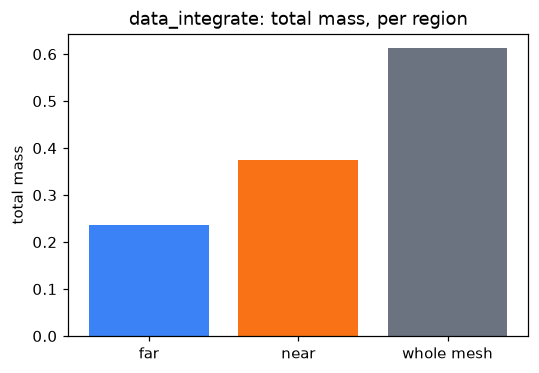
Every named Cell region present on the mesh gets its own independent entry in regions, alongside the whole-mesh domain entry — mirroring split's own "split by region" contract: regions are not a partition. A cell belonging to two regions contributes fully to both; a cell in none contributes to neither.
Point/Side regions are skipped, exactly as split skips them for the same reason — there is no cell-measure meaning for a group of points or facets.
mesh.regions.append(mp.Region(name="inlet", kind="cell", entries=[0, 1, 4]))
report = mp.data_integrate(mesh, arrays=["density"])
for region in report[0]["regions"]:
    print(region["name"], region["total_per_component"])
The mesh is never modified
Like data_info and compute_stats, this returns a read-only report; the input mesh comes back untouched. There is no counterpart to gradient's mesh-with-a-new-array-attached shape.
Determinism
Output is byte-identical across the three mesh backends, across thread counts, and across the C++-core / numpy-fallback boundary (pinned by tests/python/test_data_integrate.py::test_cpp_matches_python). Per-cell measures are computed once, shared across every array and every region, via parallel_for; every weighted-sum reduction is chunked-parallel_for-then-serially-merged (detail::accumulate_weighted), the same idiom data_info's detail::accumulate_stats already uses.
CLI
meshioplusplus data integrate IN --array NAME [--array NAME2 ...] [--json]Report-only, like data info — there is no OUT, since the mesh is never modified. Both CLIs produce the same report shape. See the CLI reference.
Other languages
mio_data_integrate* result = mio_data_integrate_create(mesh, names, count);
mio_field_integral_info entry;
mio_data_integrate_entry(result, 0, &entry);   // whole-mesh: num_cells, num_skipped, ...
double total, mean, domain_measure; int64_t num_nan;
mio_data_integrate_component(result, 0, 0, &total, &mean, &domain_measure, &num_nan);
mio_data_integrate_free(result);type(mio_field_integral_info), allocatable :: fi(:)
real(real64), allocatable :: totals(:), means(:), domain_measures(:)
fi = m%data_integrate(arrays=['density '], totals=totals, means=means, &
domain_measures=domain_measures)
! Per-region breakdown of one named array is a separate call:
fi = m%data_integrate_region('density', totals=totals)report = data_integrate(mesh, ["density"])
report[1].domain.components[1].total
report[1].regions # one entry per named Cell regionreport <- mio_data_integrate(mesh, "density")
report[[1]]$domain$components["total"]
report[[1]]$regions # a list, one per named Cell regionconst report = m.dataIntegrate(mesh, ['density']);
report[0].domain.totalPerComponent;
report[0].regions; // one entry per named Cell regionTwo conventions differ across these surfaces and are worth pinning down:
- On the flat ABIs (C, Fortran, Julia, R, WASM) this is a read-only report handle/value, never an opaque mesh-carrying result — there is no mesh to hand back, so
data_info's shape is the right one, extended with a region axis. - Fortran alone splits domain and region access into two calls (
data_integratefor the whole mesh,data_integrate_regionfor one named array's per-region breakdown) rather than nesting three axes (array × region × component) into one call's optional out-arguments.