
Partitioning
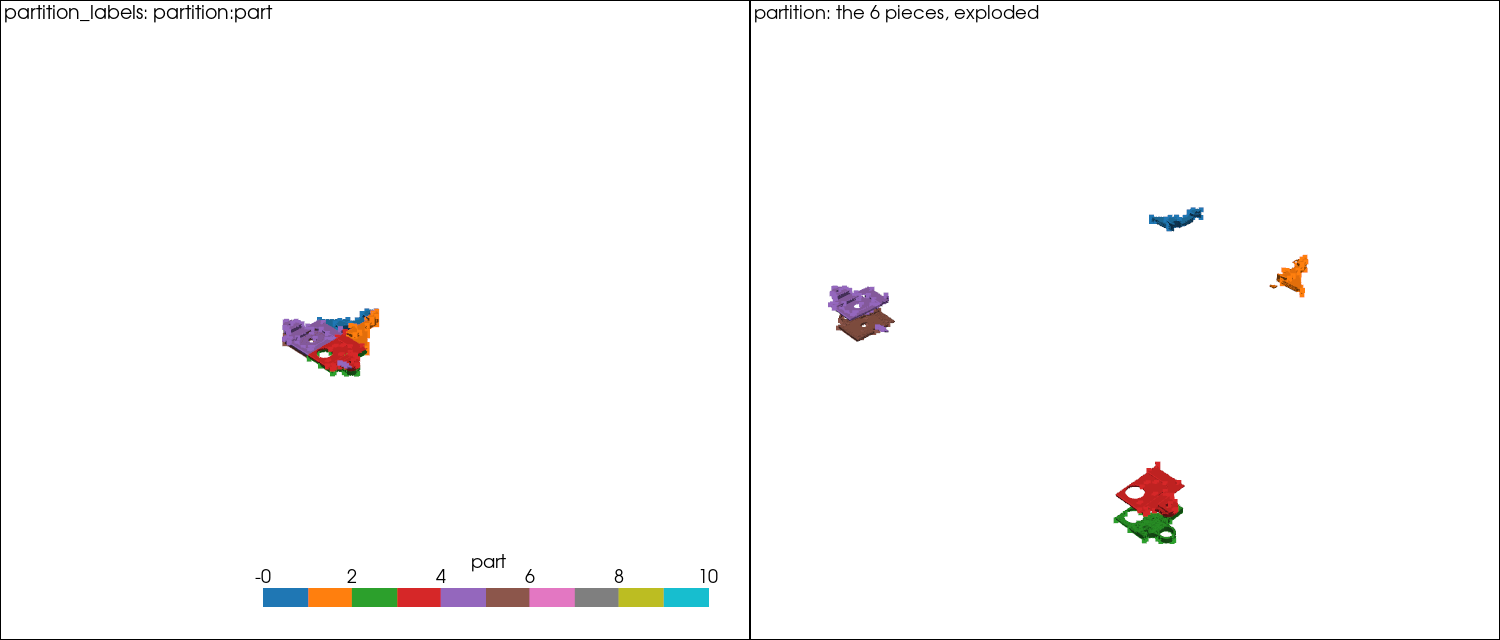
meshioplusplus.partition(mesh, nparts) decomposes a mesh into exactly nparts balanced pieces for domain decomposition — the count-driven complement to the criterion-driven split. It is a mesh operation, not a file format, and runs under every mesh backend.
import meshioplusplus

mesh = meshioplusplus.read("domain.msh")

# four balanced pieces (part id = list index)
pieces = meshioplusplus.partition(mesh, 4)
for part, piece in enumerate(pieces):
    meshioplusplus.write(f"domain_{part}.vtu", piece)

# just the assignment, one Int64 array per cell block
labels = meshioplusplus.partition_labels(mesh, 4)
mesh.cell_data["partition:part"] = labels

# weighted by a per-cell cost, tagged with the original indices
pieces = meshioplusplus.partition(mesh, 4, weights="cost", record_ids=True)
Both CLIs expose the same thing:
meshioplusplus partition domain.msh 'domain_{part}.vtu' --nparts 4
meshioplusplus partition domain.msh labelled.vtu --nparts 4 --labels-only
meshioplusplus partition domain.msh domain.pvtu --nparts 4 --ghost-layers 1
Writing a partition as one dataset
An Elmer mesh partitioned by ElmerGrid (partitioning.N/part.n.*) reads back merged with the same partition:part labels, one per cell (v16.2.0, see Elmer). The other way round, a mesh with partition:part labels is written as an Elmer partitioning.N directory ElmerSolver runs in parallel (v16.10.0, see Elmer).
A .pvtu (or .pvtp) is the ParaView index of a partition: one file that declares the arrays and names one piece per part, so the decomposition opens as a single dataset. pvtu.write_pieces takes exactly what partition returns — halo layers included, which a single mesh with a partition:part label cannot express, since a cell can be a ghost of several parts:
pieces = meshioplusplus.partition(mesh, 4, ghost_layers=1)
meshioplusplus.pvtu.write_pieces("domain.pvtu", pieces)   # domain.pvtu + domain/domain_0000.vtu ... domain_0003.vtu

meshioplusplus.pvtu.write("labelled.pvtu", mesh_with_partition_part)   # or carve one mesh by its partition:part labels
partition:ghost becomes vtkGhostType on cells (DUPLICATECELL for any layer) and on points (DUPLICATEPOINT when no owned cell of the piece uses the point), and sets the index's GhostLevel to the deepest layer; partition:ghost itself is kept too, since vtkGhostType collapses layer 2 onto layer 1. Reading the index merges the pieces (one piece_<i> region each); ghosts="drop" (on meshioplusplus.read, or --drop-ghosts on convert) removes the halo and returns the partition of unity, so partition → .pvtu → read is the original mesh up to point ordering (clean with weld=True fuses the interface points). See PVTU.
Two methods
SFC (always available, the default fallback)
Cells are ordered along a Hilbert space-filling curve of their centroids (bounding box quantized to 21 bits per axis — the same key transforms reorder uses, shared via detail/space_filling.hpp) and the curve is cut into nparts contiguous ranges:
- Unweighted: the cell at curve rank
rofngoes to part(r * nparts) / n, so part sizes differ by at most one cell. - Weighted (
weights=<cell_data name>, a scalar numeric array): each cell goes to the ideal interval containing its weight midpoint,min(nparts − 1, ⌊(S_r + w_r/2) · nparts / W⌋)over the prefix sumS_r. Monotone along the curve, hence still contiguous; a part can end up empty when a single weight exceedsW / nparts.
The SFC path is deterministic and byte-identical across the three mesh backends, any thread count, and the C++-core/numpy-fallback boundary (a test pins the labels as identical). Curve locality keeps parts spatially compact, though it optimizes no explicit edge-cut metric.
KaHIP (optional, the quality path)
With the optional KaHIP backend, the mesh's dual graph — cells are vertices, with an edge wherever two cells share a face (3D) or an edge (2D) — is partitioned by KaHIP's serial kaffpa() interface, which actively minimizes the edge cut (the halo communication volume of an MPI solver):
pieces = meshioplusplus.partition(mesh, 16, method="kahip",
imbalance=0.03, mode="eco", seed=0)imbalance— allowed part-size imbalance fraction, in (0, 1); default 0.03.mode—"fast","eco"(default) or"strong". From the benchmarks of the Kratos KaHIPApplication this port derives from (KratosMultiphysics/Kratos#14453):fastis not dramatically better than Metis —eco/strongare where the edge-cut wins are, at the price of runtime.seed—kaffpais deterministic per seed, but the assignment may change between KaHIP versions; treat exact labels as unstable, balance/coverage as the contract.
Cells whose block has no facet table (ragged polygons, polyhedra, cells of lower dimension in a mixed mesh) become isolated graph vertices: they are still assigned, just without adjacency preferences.
method="auto" (the default) resolves to KaHIP when a backend is available, else SFC. Requesting method="kahip" without one raises an error naming the option — never a silent downgrade.
Getting KaHIP
KaHIP is MIT-licensed, like meshio++ itself, so unlike GPL-licensed partitioners enabling it has no licensing implication whatsoever. It is a bring-your-own dependency: meshio++ never vendors or downloads it (the same policy the Kratos reviewers required of the original integration).
C++ core (the fast path): build/install KaHIP, then configure with the option and prefix:
bashgit clone --depth 1 --branch v3.25 https://github.com/KaHIP/KaHIP.git cmake -S KaHIP -B KaHIP/build -DCMAKE_BUILD_TYPE=Release -DPARHIP=OFF -DNOMPI=ON \ -DCMAKE_INSTALL_PREFIX="$HOME/kahip-install" cmake --build KaHIP/build -j && cmake --install KaHIP/build CMAKE_ARGS="-DMESHIOPLUSPLUS_WITH_KAHIP=ON -DKAHIP_ROOT=$HOME/kahip-install" \ pip install meshioplusplus --no-binary meshioplusplus
-DNOMPI=ON is required, not just -DPARHIP=OFF: KaHIP's own CMakeLists.txt does an unconditional find_package(MPI REQUIRED) unless NOMPI is set, since kaffpaE (not only ParHIP) also depends on MPI — meshio++ only ever links the serial kaffpa interface, so this build has no MPI dependency at all despite what KaHIP's own default configure implies.
KaHIP must be findable at runtime too
KaHIP is a shared library, and a wheel you build from source strips the build-tree RPATH from _core so the wheel stays relocatable; the release wheels do not include KaHIP. If the prefix is not on the default loader path, importing meshio++ then fails with
ImportError: libkahip.so: cannot open shared object file: No such file or directoryeven though the build succeeded. Put the prefix on the loader path:
export LD_LIBRARY_PATH="$HOME/kahip-install/lib:$LD_LIBRARY_PATH"   # Linux
export DYLD_LIBRARY_PATH="$HOME/kahip-install/lib:$DYLD_LIBRARY_PATH"  # macOS
or install KaHIP to a system prefix. This is the ordinary cost of a bring-your-own shared dependency; if you would rather not manage it, the Python-only route below needs no such setup.
The in-repo cmake/FindKaHIP.cmake honours KAHIP_ROOT/KAHIP_DIR (environment or cache), standard prefixes, and pkg-config; an in-source KaHIP build (interface/ + build/) works as a prefix too. On macOS, brew install KaHIP/kahip/kahip provides an installable prefix. Package managers: Conan option with_kahip, vcpkg feature kahip (both map the flag only — you still supply the install; KaHIP is on neither registry).
WebAssembly: the full artifact (@meshioplusplus/wasm with {full: true}) links the serial kaffpa interface — build/build-wasm-deps.sh --full source-builds KaHIP v3.25 for wasm32 (PARHIP off, no MPI, no OpenMP) into the full prefix and build/configure-wasm.sh points CMake at it — so partition(..., 'kahip') runs there. The lean pair keeps SFC with the compiled-out error. See WASM.
- Python-only (no rebuild):
pip install meshioplusplus[kahip]pulls the MITkahipwheel; the pure-Python fallback builds the dual graph in numpy and callskahip.kaffpa— same quality, Python-speed graph assembly.
Only the serial kaffpa interface is ever linked — never ParHIP — so enabling KaHIP adds no MPI dependency. _core.__has_kahip__ reports the C++ backend at runtime.
32/64-bit indices
KaHIP built with -D64BITMODE=On uses 64-bit graph indices. meshio++ queries the installed library's width at runtime (kahip_sizeof_idx()) and builds the CSR arrays to match, so either build works unmodified. Against a 32-bit KaHIP, a dual graph whose directed-edge count overflows int32 fails with an error telling you to rebuild KaHIP with -D64BITMODE=On; the cell count itself is limited to int32 by the kaffpa interface in both builds.
Output contract
- Exactly
npartspieces are returned, part id ascending; pieces may hold empty blocks. Every piece keeps the input's cell-block structure 1:1 (deliberately unlikesplit, which drops empty blocks), so the per-block cell maps index by input block and concatenating the pieces reproduces the input — every cell lands in exactly one piece (partition of unity). point_data/cell_datarows are carried into the owning piece;field_datais copied to every piece.point_sets/cell_setsare remapped per piece (Python layer only, as withsplit).record_ids=Trueattaches Int64partition:original_point_idpoint_dataandpartition:original_cell_idcell_datawith the original input indices.partition_labelsreturns one Int64 array per cell block (block-aligned, ready to attach ascell_data), values in[0, nparts).ghost_layers=Ngrows each piece byNshared-node BFS layers of cells owned by other parts — the halo an MPI-style domain decomposition needs. Each ghosted piece carries an Int64partition:ghostcell_data:0for a cell this part owns,Lfor one reached at layerL. Shared-node (rather than shared-facet) adjacency is the conservative choice: it is what a node-based assembly actually needs.
The pieces then overlap, so the partition-of-unity property above holds only for ghost_layers=0 (the default). partition_labels therefore does not accept it at all — a flat per-cell label array is the ownership map, and a cell can be a ghost of several parts at once. The numpy fallback builds disjoint pieces only and raises NotImplementedError rather than silently returning unghosted ones.
The pure-Python KaHIP route (the kahip PyPI wheel against a KaHIP-less _core) cannot ghost either: with ghost_layers > 0, method="auto" routes to the C++ core instead (auto is a preference order, and the core is the one ghost-capable path), while an explicit method="kahip" raises naming -DMESHIOPLUSPLUS_WITH_KAHIP=ON — never a silent SFC downgrade.
pieces = mp.partition(mesh, 4, ghost_layers=1)
owned = pieces[0].cell_data["partition:ghost"][0] == 0- v3.25's
--connected_blocks(force each part to be a connected subgraph) is not reachable through thekaffpaC interface, so it is not exposed — a documented TODO should a later KaHIP add it to the API.
Other language surfaces
The operation exists on every binding surface: C (mio_partition/mio_partition_labels, see the C API), Fortran (m%partition/m%partition_labels, see Fortran), WebAssembly (partition/partitionLabels; KaHIP only in the full artifact, SFC everywhere — see WASM; partition's returnMaps option gives each piece a pointMap/cellMaps), and the partition verb in both CLIs.
meshio++ is serial
partition computes a decomposition; it does not run one. There is no MPI in the library, no distributed reader or writer and no communicator anywhere in the API. The intended workflow is to partition on one rank (or in a pre-step) and have each rank read or receive its own piece; ghost_layers > 0 produces the shared-node halo an MPI assembly needs. See doc/cpp_api.md.