
Data expressions (data_calc)
data_calc derives a new data array from a small elementwise expression over the existing arrays at the same location. It is a data operation, not a file format; the geometry is never modified.
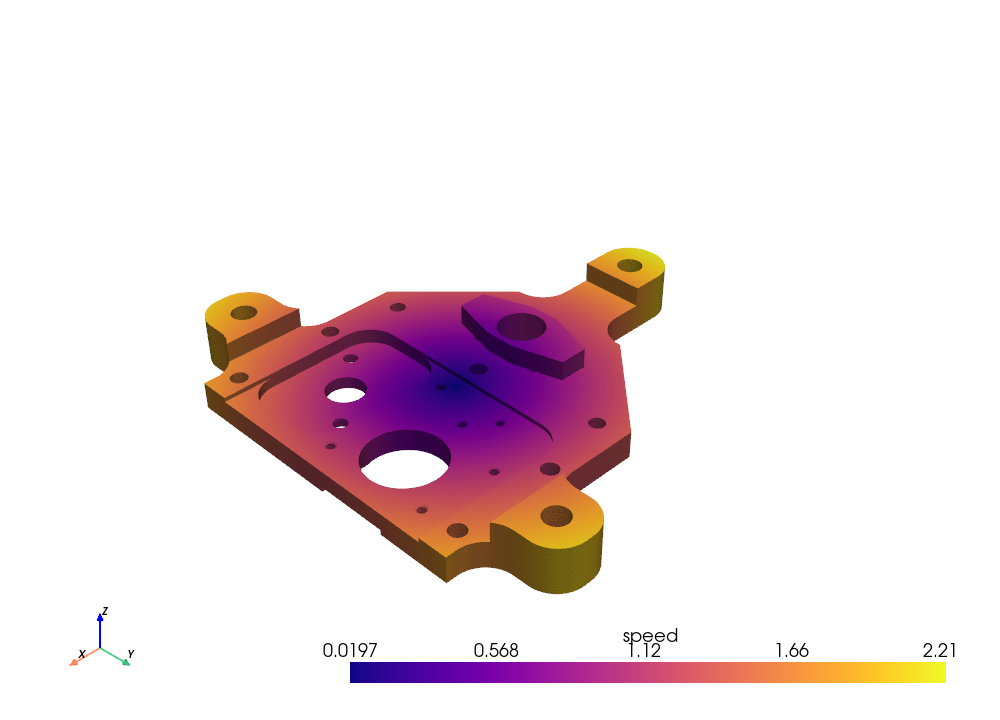
import meshioplusplus as mp

mesh = mp.read("flow.vtu")

mesh = mp.data_calc(mesh, "norm(velocity)", location="point", output="speed")
mesh = mp.data_calc(mesh, "p_new - p_old", location="cell", output="dp")
mesh = mp.data_calc(mesh, "0.5 * rho * speed * speed", location="point",
                    output="dynamic_pressure")
No arbitrary code
The evaluator is a hand-written tokenizer plus recursive-descent parser restricted to the grammar below. There is no external parser library and no evaluation of arbitrary code — an expression that is not built from these tokens is a diagnosed error, never something that executes.
Grammar
expr    := term (('+'|'-') term)*
term    := unary (('*'|'/') unary)*
unary   := ('-'|'+') unary | primary
primary := number | ident | ident '(' expr (',' expr)* ')' | '(' expr ')'
Functions: abs(x), sqrt(x), min(a,b), max(a,b), and norm(v) for the Euclidean magnitude of a vector. Exponentiation is deliberately absent.
Names
An identifier starts with a letter or _ and may then contain letters, digits, _, : and .. The colon is load-bearing: it lets a mesh's own conventional names be referenced directly.
mp.data_calc(mesh, "gmsh:physical + 1", location="cell", output="tag_plus_one")A name containing spaces or operator characters can be written between backticks:
mp.data_calc(mesh, "`my array` * 2", location="point", output="doubled")Values and broadcasting
Every operand is either a scalar (1 component) or a vector/tensor of up to 16 components. Binary operators require matching component counts, except that a scalar broadcasts against a wider operand:
mp.data_calc(mesh, "velocity * 2",  ...)   # (n, 3) -> (n, 3)
mp.data_calc(mesh, "norm(velocity)", ...)  # (n, 3) -> (n,)   norm is always scalar
mp.data_calc(mesh, "velocity - velocity", ...)  # (n, 3) -> (n, 3)
Combining, say, a 3-component with a 9-component array is an error. A result with one component is stored 1-D; otherwise it keeps its (n, ncomp) shape.
Arithmetic is always performed in double and the result is stored as float64. Division by zero yields an IEEE infinity or NaN and is not an error — see the NaN policy.
For location="cell" the expression is evaluated once per cell block, so the produced cell_data always has exactly one array per block.
Errors
Every failure raises ValueError, prefixed meshio++: data_calc: and, where meaningful, carrying the 0-based character position within the expression:
unexpected character '#' at position 7
unexpected end of expression
expected ')' at position 12
trailing input after the expression at position 9
unknown point_data array 'temp' at position 5 (available: T, p, u)
unknown function 'log' at position 0 (known: abs, sqrt, min, max, norm)
'norm' takes exactly 1 argument (got 2) at position 0
'min' takes exactly 2 arguments (got 1) at position 3
cannot combine a 3-component array with a 9-component array in '*' at position 12
array 'u' has 42 rows but point_data needs 100
expression nests deeper than 64 levels
result has 24 components, more than the supported maximum of 16
output name 'T' already exists in point_data (pass overwrite=true to replace it)
The nesting limit guards the recursive-descent parser against a stack overflow from hostile input, since expressions reach this code from the C ABI and both CLIs.
CLI
meshioplusplus data calc in.vtu out.vtu --point "speed = norm(velocity)"
meshioplusplus data calc in.vtu out.vtu --cell  "dp = p_new - p_old"
The value is split on the first = into the output name and the expression. --point, --cell and --field are repeatable, so several arrays can be derived in one invocation; pass --overwrite to allow replacing an existing array. See the CLI reference.
Other languages
- C API —
mio_data_calc(mesh, expression, location, output_name, overwrite)returns a newmio_mesh*, orNULLwithmio_last_error()set. See the C API reference. - Fortran —
m%data_calc('norm(velocity)', 'speed'), with optionallocation=andoverwrite=. See the Fortran reference. - WebAssembly / JavaScript —
dataCalc(mesh, "norm(velocity)", "point", "speed", false); a bad expression throws a catchableError. See the WebAssembly reference.