
Signed distance to a surface
How far a point is from a triangle skin, and which side of it the point is on.
import meshioplusplus as mp

skin = mp.read("bunny.stl")

# distances at arbitrary points
d = mp.sample_distance(skin, [[0.0, 0.0, 0.0], [10.0, 0.0, 0.0]])

# or attached to a mesh, as ordinary data
grid = mp.grid([64, 64, 64], origin=(-1, -1, -1), spacing=(0.05,) * 3)
field = mp.distance_to_surface(grid, skin)
mp.write("field.vtu", field)              # carries sdf:distance as point_data
Negative is inside, by the usual convention. Because the result is ordinary point_data, every writer carries it, --color-by sdf:distance colours it, and isosurface(field, "sdf:distance", [0.0]) reconstructs the surface.
The sign is the hard part
An unsigned distance is a minimisation with no interesting failure mode. A signed one has to decide which side of the surface a query is on, and the standard mistake — taking the sign from the nearest triangle's normal — is exactly right on convex geometry and exactly wrong wherever two nearly-opposite faces meet.
The fix is the angle-weighted pseudonormal (Bærentzen & Aanæs): the sign comes from the normal of the nearest feature, which is the triangle only when the closest point lies in its interior:
| nearest feature | normal used |
|---|---|
| face | the triangle's own normal |
| edge | the sum of the two incident faces' unit normals |
| vertex | the angle-weighted sum of the incident faces' unit normals |
Where this actually matters
A reentrant corner does not expose the difference — at a concave edge both incident faces happen to give the correct sign. The failure needs two incident faces whose normals are nearly opposite, which is a sharp spike, not a notch. tests/cpp/test_surface_distance.cpp uses a sliver prism whose tip subtends about 1.7°, and demonstrates the naive method getting it wrong rather than merely asserting the right answer.
Signs on offer
sign | behaviour | cost |
|---|---|---|
pseudonormal (default) | exact for a watertight, consistently wound surface | free — it reuses the nearest-triangle query |
winding-number | robust to holes, self-intersection and per-component orientation flips | O(triangles) per query |
unsigned | no sign at all; the only meaningful mode on an open sheet | free |
winding-number has no acceleration structure short of a fast-multipole expansion, so max_winding_work (default 2e9 on n_queries × n_triangles) refuses by name rather than silently running for an hour. Pair it with a band.
The worst-case distance between two whole surfaces, both ways, is hausdorff_distance, which samples each surface and reduces this kernel's unsigned distances.
Is your surface even closed?
mp.surface_watertight_check(skin)
# {'boundary_edges': 0, 'non_manifold_edges': 0, 'inconsistent_pairs': 0,
#  'degenerate_triangles': 0, 'watertight': True}
The counts are reported separately because they need different fixes — "your STL has 12 boundary edges" is actionable, "not watertight" is not. watertight_check is "warn" by default, and can be "off" or "error".
The band
band=r clamps distances beyond r and stops the search there, which is what makes a narrow-band field cheap. Clamped values are marked in a mandatory Int64 sdf:band array (1 = computed, 0 = clamped): a clamped value is byte-indistinguishable from a computed one, so without that array a caller cannot tell the difference.
Inside the band, a banded run is byte-identical to a full-field one — the band is an optimization, not a second answer, and a test pins that.
The accelerator cannot change the answer
The nearest-triangle search runs over a bucket grid, and every candidate comparison is totally ordered on (squared distance, triangle id). That makes the accelerator provably unobservable: the same query at any bucket size returns byte-identical distances and the same nearest cell.
Two things follow, and both are load-bearing rather than incidental:
grid_cell_sizeis a public option mainly so a test can prove the invariance (test_the_bucket_size_does_not_change_the_answer). It is also a legitimate tuning knob.- The numpy reference implementation has no accelerator at all — a brute-force scan in ascending triangle order is the same computation, which is why the two are bit-identical.
The bucket-size heuristic was retuned once, after measurement, without re-validating a single distance: sizing buckets by the mean triangle alone made a 64³ inside-fill of the 112k-triangle Stanford bunny take 19 seconds, because a query far from the surface had to expand through hundreds of empty shells. Adding the domain's own extent to the rule cut that to 2.9 seconds with identical output.
Where byte-parity stops
sign="winding-number" sums one atan2 per triangle and compares the total against a threshold. atan2 is not correctly rounded, and its last-ulp behaviour differs between libm and numpy, so the two implementations can genuinely disagree on a near-tangent point. The numpy reference therefore raises NotImplementedError rather than hiding the difference behind a tolerance — the same call _smooth.py makes for its inversion guard and _partition.py for ghost layers. The C++ path is still tested, against analytic fields and against the pseudonormal answer.
Everything else here is + - * /, comparisons and one correctly-rounded sqrt, so it is bit-identical by construction.
What the surface may be
triangle blocks are taken as they are; quad and rectangular polygon blocks are fanned with the same deterministic fan convert_cells(simplexify) uses, so the two cannot disagree about which diagonal a quad is split on. A volume or polyhedron block is refused by name, pointing at extract_surface; a higher-order block is refused pointing at linearize.
sdf:closest_cell (opt-in) names a cell of the mesh you passed in, not of the triangulation you never saw.
compute_sdf: the grid and the field in one call
Everything above needs somewhere to evaluate the field. compute_sdf generates that somewhere itself:
field = mp.compute_sdf(skin, resolution=(128, 128, 128))
mp.write("field.vti", field)
structure="octree" refines only near the surface instead of filling the box:
field = mp.compute_sdf(skin, structure="octree", root_resolution=8, max_depth=4)The octree costs less and contours identically
Against a uniform grid of the same finest resolution, the octree's zero level set is the same contour — same facet count, same points — from far fewer cells. That is the justification for the structure and it is also the test: ComputeSdf.TheOctreeContourEqualsTheUniformGridsFromFewerCells.
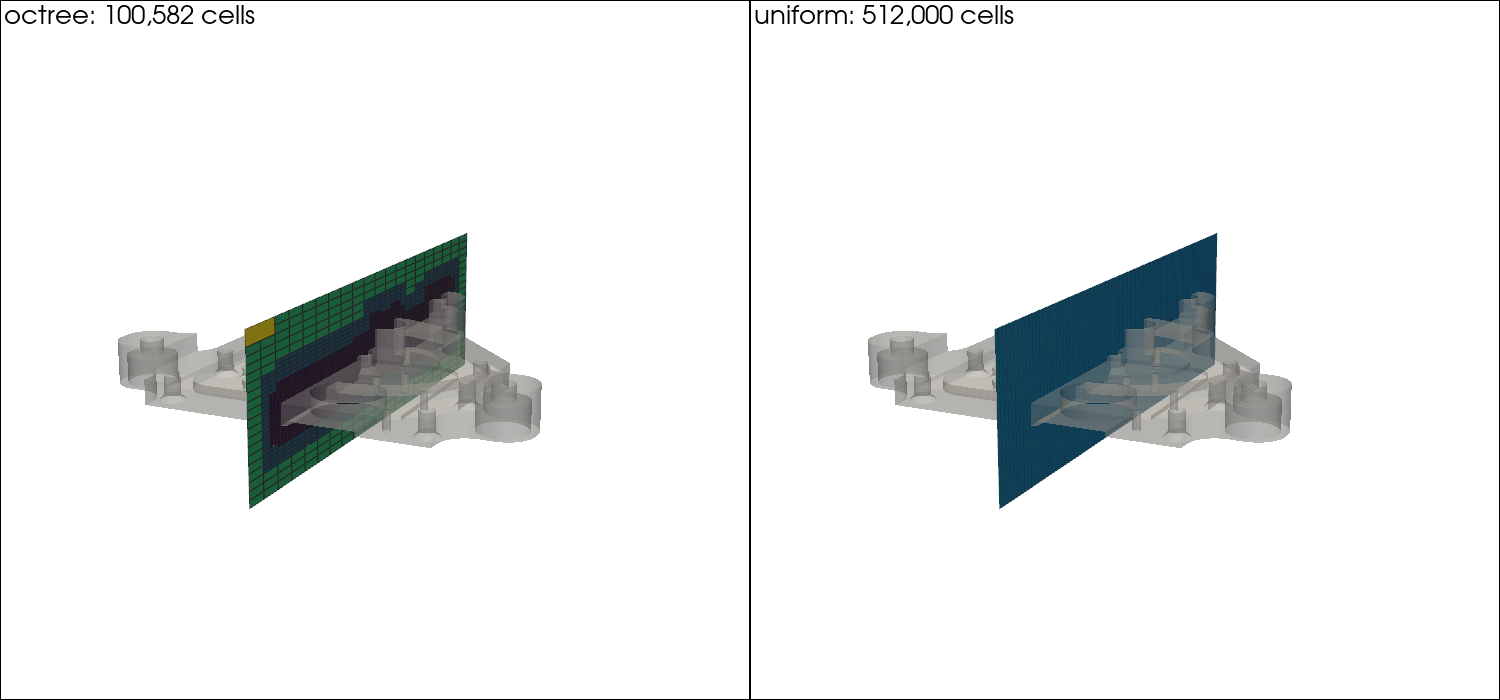
resolution/cell_size size a voxel grid. With structure="octree" they are an error, not a preference: its finest cell is root_resolution / 2**max_depth and is therefore already determined, so accepting either would silently ignore one of the two. A cell is refined while abs(distance) <= band_cells * its own diagonal, and because the diagonal halves every pass the band narrows with it — which is what makes the cost bounded by the surface rather than cubic in the depth.
The octree's output is 1-irregular: it has hanging nodes, exactly as refine's closure="balanced" does, which is the mechanism. Read that page's caveat rather than a restatement of it here. refine:level and refine:hanging ride along.
The field is computed once, on the final mesh
refine interpolates point_data, so a field attached during an octree pass would come out a smooth, plausible interpolation of the coarse values rather than the distance. It still contours, and it still looks like the shape — which is why there is a test whose only job is to prove the oracle above can tell the difference (ComputeSdf.TheContourOracleActuallyFires, and note it needs a curved fixture: a cube's SDF is piecewise linear near its faces, so interpolating it reproduces it exactly and the sabotage changes nothing).
The sdf:* header, and why .vti
The generated mesh carries a field_data header describing itself — sdf:origin, sdf:spacing, sdf:dims, sdf:bounds, sdf:max_depth, sdf:structure. All numeric, so every binding carries it.
No file format persists arbitrary field_data, so a grid written anywhere and read back has lost it. .vti is the answer: its Origin/Spacing/WholeExtent attributes are the same information, so it is the one format that round-trips a generated grid exactly.
Offsetting needs no operation
An offset surface is this page's primitive plus isosurface at a non-zero level — there is no offset_surface() because there is nothing for it to do:
field = mp.compute_sdf(skin, resolution=(128,) * 3, padding_relative=0.3)
shell = mp.isosurface(field, "sdf:distance", [-r, 0.0, r])
inner, original, outer = mp.split(shell, by="region", tag="iso:index").values()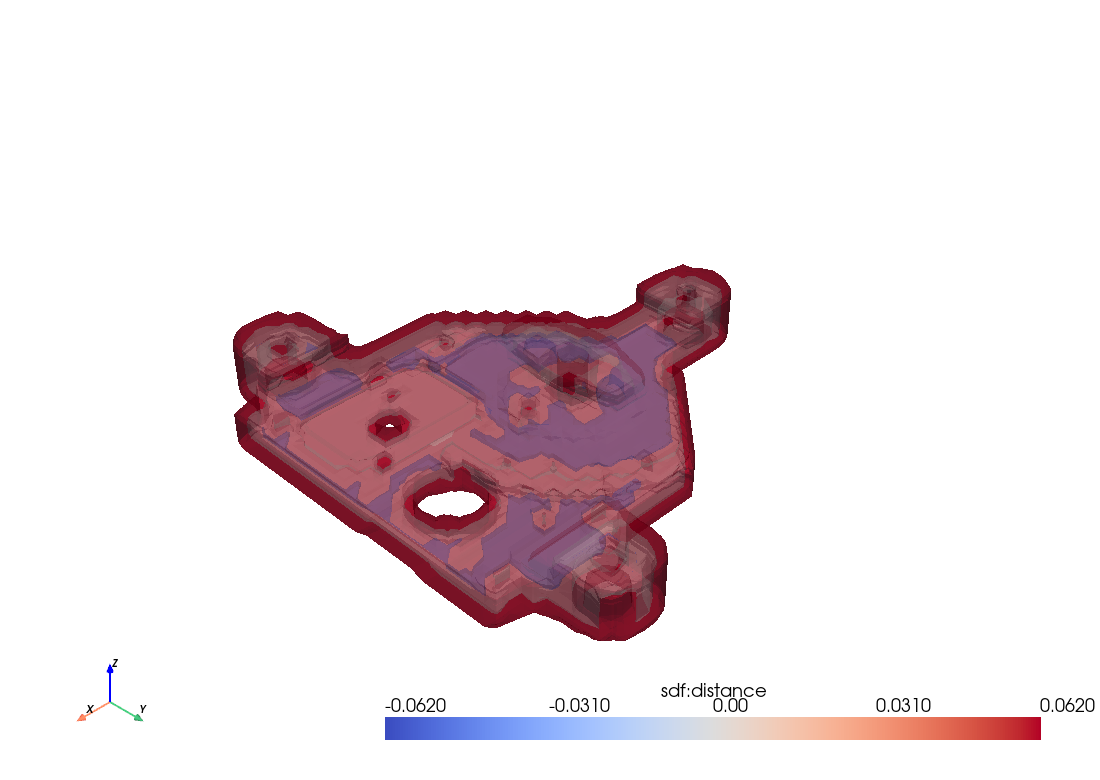
Two things to get right, both of which the composition makes explicit rather than hiding: the padding must exceed r, or the offset is clipped by the box; and the location must stay "corner", since isosurface needs point_data.
Inside/outside is a crop
Likewise there is no inside/outside predicate of its own — a cell-centred field plus crop's general where= does it, and does it for every other field too:
f = mp.distance_to_surface(mesh, skin, location="center")
inside = mp.crop(f, where=("sdf:distance", "<", 0.0))
See also
- Regular grids — where to evaluate the field.
- Isosurfaces — contour it back to a surface.
.vti— the format that keeps a generated grid's geometry.- Cropping —
where=turns the field into a subset.