
Green-element undo (undo_green)
meshioplusplus.undo_green(coarse, fine) restores refine's transitional ("green") cells back to their original parent cell — the standard rule for selective refinement: before a new refinement pass touches a region that was already closed up, restore the transitional cell to its parent and re-split from scratch. refine refines the transitional children directly instead, so repeated selective passes over the same region degrade element quality without bound; undo_green is the missing half.
It is a mesh operation, not a file format, uses only standard C++/numpy, and runs under every mesh backend — and, like interpolate, it is the repo's second two-mesh operation: coarse is the mesh a prior refine(coarse, ..., record_hierarchy=True, record_levels=True) call was run on, fine is that call's output.
import meshioplusplus as mp

coarse = mp.read("bracket.msh")
fine = mp.refine(
    coarse, cells=[123], record_hierarchy=True, record_levels=True
)
# ... later, decide to refine a DIFFERENT / larger region ...
undone = mp.undo_green(coarse, fine)
redone = mp.refine(undone, cells=[456, 789], record_hierarchy=True, record_levels=True)
Design: lookup and substitution, not reconstruction
The obvious approach — invert refine's per-type subdivision tables against a green group's children to reconstruct the parent's connectivity — is genuinely hard: it needs graph-isomorphism-style matching against a few dozen (type, mask, variant) templates. It turns out to be unnecessary. refine() never renumbers or prunes points — its point map is always the identity — so a green parent's exact original connectivity and cell_data are already sitting, byte-for-byte, in the coarse mesh at the row fine's refine:parent_id names (resolved against coarse's own refine:cell_id, or its implicit global-block-major id when it carries none — the same fallback refine's persistent hierarchy itself uses when starting a fresh id space). So "undo" is a lookup and substitution: no template inversion, no winding repair, no discrete sign branch anywhere in it. Unlike subdivide and agglomerate, this operation has a full numpy twin.
Classification: red, green, untouched
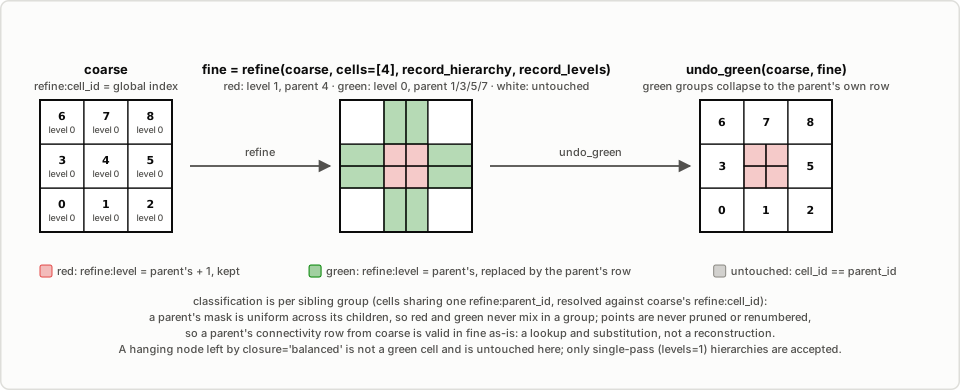
A cell's split mask — and hence its red/green status — is uniform across every one of its children (refine sets it once per parent), so classification is per sibling group (cells sharing one refine:parent_id), not per cell:
- a singleton group (
refine:cell_id == refine:parent_id) is untouched — kept verbatim; - a group whose
refine:levelis one more than its coarse parent's own level is red — a genuine, wanted refinement, passed through unchanged; - a group whose level equals its coarse parent's own level is green — a closure artefact, replaced by one cell copied verbatim from
coarse.
Preconditions
fine must carry one Int64 scalar cell_data array per block for each of refine:cell_id, refine:parent_id and refine:level — i.e. it must come from a refine() call with record_hierarchy=True, record_levels=True (both; record_hierarchy alone does not force record_levels, they are independent flags). coarse must be the exact mesh that call was run on (or an equally-shaped mesh sharing its point/id space); a refine:parent_id that does not resolve against coarse fails by name rather than guessing, as does a sibling group whose level matches neither the red nor the green relationship to its coarse parent's own level.
Output structure
fine's own block structure is preserved exactly — same types, same order — unlike subdivide/agglomerate, which restructure into polyhedron blocks. A green substitution keeps the parent's cell type (green children always share their parent's type), so it only shrinks a block's row count, never its type or position.
Points are never pruned or renumbered: this is what makes the substitution a zero-translation row copy in the first place, since a coarse cell's node ids are already valid indices into fine's own point array. clean(mesh, remove_orphans=True) is the documented follow-up for a caller wanting the orphaned mid-edge nodes (left behind by a substituted green group) pruned.
The six reserved refine:* arrays (refine:parent_cell, refine:level, refine:cell_id, refine:parent_id in cell_data; refine:entity, refine:hanging in point_data) are unconditionally dropped from the output — they describe a hierarchy relationship that is now stale; a subsequent refine(..., record_hierarchy=True) call rebuilds them fresh. Every other cell_data array on fine is carried: untouched/red rows copied from fine as usual, a green group's one output row copied from the same-named array on coarse — if coarse lacks that array, or its shape/dtype does not match, the whole array is dropped with a warning rather than guessing a value for the substituted row. point_data and field_data carry through from fine unchanged.
Regions
Named Side regions survive (since v16.27.0): a green child's facet moves to the substituted parent's facet that contains it, and the removed hanging node must lie on that facet. The split edge between two green children has no counterpart and is dropped, with a warning. See how operations treat regions. Point regions survive trivially (points are never renumbered). Cell regions survive through the first genuinely non-injective CellMapKind::Direct remap in the C++ core — several fine cells collapsing onto the same output row — deduplicated the same way Region's entries are always sorted and de-duplicated.
Limitations
Two honest limitations, not gaps:
- it can only undo the last generation relative to the specific
coarsemesh passed in — the hierarchy setsparent_id == cell_idfor untouched cells, so an older green closure becomes indistinguishable from an original once a later pass has run over it; - it needs the caller to hold both meshes — there is no single-mesh fallback.
It also supports only a single-pass (levels=1) hierarchy: a sibling group whose level is more than one deeper than its coarse parent's own (possible after an mLevels > 1 call, where different branches of one original parent's descendant tree can reach different final depths) is refused by name rather than silently mishandled.
CLI
meshioplusplus undo-green COARSE FINE OUTAvailable in both the Python CLI and the native meshioplusplus binary — see the CLI reference.
Other languages
The operation is exposed on every binding surface — module-level (not type-bound), the same shape interpolate uses for its own two-mesh input:
/* C API: plain mesh + nullable counters, like mio_smooth */
int64_t num_groups_undone, num_cells_removed;
mio_mesh* undone = mio_undo_green(coarse, fine, &num_groups_undone, &num_cells_removed);! Fortran: module-level function (two-mesh input, like mio_interpolate)
undone = mio_undo_green(coarse, fine, num_groups_undone=n, stat=st)u = undo_green(coarse, fine)
u.mesh, u.num_groups_undone, u.num_cells_removedu <- mio_undo_green(coarse, fine)
u$mesh; u$num_groups_undone; u$num_cells_removedconst u = m.undoGreen(coarse, fine);
// u.mesh, u.numGroupsUndone, u.numCellsRemovedBeing a two-mesh operation, undo_green is deliberately not reachable as a settings-pipeline step or a convertSurfaceOps chain entry — the same exclusion Merge/Interpolate/Split/Diff already have, naming the undo-green CLI verb instead.