
Conservative interpolation (mass-preserving field transfer)
meshioplusplus.conservative_interpolate(source, target) mass-preservingly transfers a source mesh's data arrays onto a target mesh: over the region the two meshes share, sum(target value * target measure) equals sum(source value * source measure). This is the property interpolate's "barycentric" mode does not have — a pointwise sampler has no notion of "how much of the source region a target sample stands for". CFD/FEM solver coupling and successive-remeshing workflows need exactly this guarantee; interpolate remains the right tool for genuinely pointwise sampling (probing a field at coordinates, visualisation resampling, ...).
It is a mesh operation, not a file format, deliberately a separate operation from interpolate rather than a third method — a genuinely different algorithm (measure-weighted geometric overlap, not point sampling) with different guarantees, mirroring the decimate / decimate_volume split.
The result is a new mesh that is a copy of the target: geometry, connectivity, the target's own data arrays and its point_sets/cell_sets are preserved exactly, with the requested source arrays remapped onto it. Unlike interpolate, an unset arrays transfers every source point_data AND cell_data array — there is one algorithm regardless of location, so interpolate's "cell_data only when named" special case does not apply here. Output arrays are always Float64 (a measure-weighted mean is not integral).
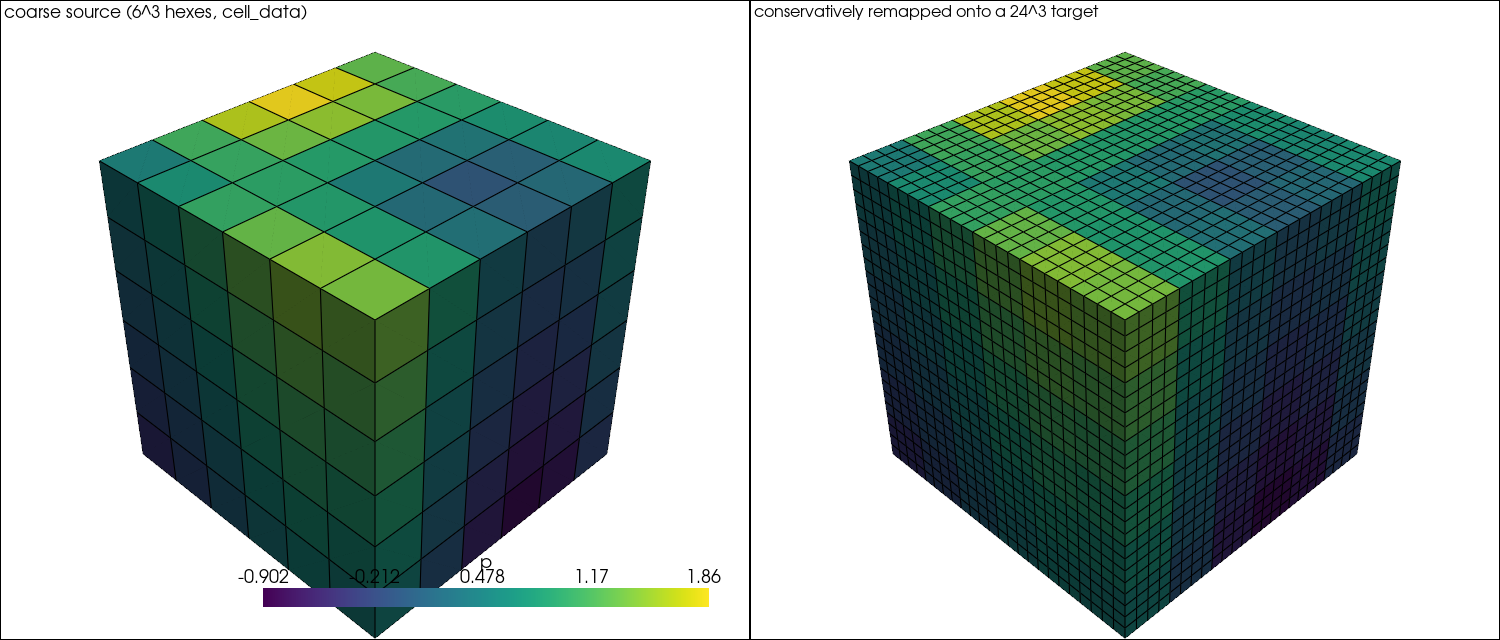
import meshioplusplus

coarse = meshioplusplus.read("solution.vtu")   # carries cell_data "pressure"
fine = meshioplusplus.read("remeshed.vtu")

out = meshioplusplus.conservative_interpolate(coarse, fine)

# name the arrays; uncovered target cells get -1 instead of 0
out = meshioplusplus.conservative_interpolate(
    coarse, fine, arrays=["pressure"], default_value=-1.0
)

meshioplusplus.write("mapped.vtu", out)
Algorithm
Both meshes are first reduced to triangles (2D) or tetrahedra (3D) via convert_cells(mode="simplexify") — the same call interpolate's "barycentric" mode already makes. This is what lets the operation accept ragged and polyhedron blocks for free: Simplexify already fans them into simplices via a shipped, tested path, so no general polygon/polyhedron clipper is needed. source and target must share the same maximum topological dimension; there is no cross-dimension remap.
For every pair of overlapping simplices (found via a bucket-grid spatial hash over bounding boxes, detail/spatial_hash.hpp, the same broad-phase interpolate's barycentric mode already uses), the exact overlap measure is computed:
- 2D: a Sutherland-Hodgman convex polygon clip of the target triangle against the source triangle's three edges, measured with the resulting polygon's area (the same xy-plane assumption
interpolate's barycentric triangle path documents); - 3D: since both operands are always tetrahedra, a bounded (not general-polyhedron) convex-polytope clip — the source tetrahedron's four faces clipped against the target tetrahedron's four half-spaces in turn, each cut capped with a fan-triangulated, angle-sorted polygon — measured via the closed-triangulated-surface divergence theorem.
A target cell's value is the overlap-measure-weighted mean of every source cell it intersects. A target cell whose covered fraction (against its own unclipped measure) falls below a small relative tolerance is filled with default_value; the count is reported through one aggregated warning per call.
cell_data is transferred by this algorithm directly. point_data is transferred by composition: point_data_to_cell_data lumps the source array onto a cell proxy (the unweighted mean of a cell's own corner values), the same overlap algorithm remaps that proxy onto the target's cells exactly, and cell_data_to_point_data(weight="measure") distributes the result back onto the target's points. Conservation is exact only for the middle step — the two lumping steps that sandwich it are each already-documented approximations of their own (an unweighted corner mean, and a measure-weighted point mean) — so the overall point_data path is a layered approximation, not exact nodal/FEM conservation. No dual-cell / control-volume machinery is built.
This operation deliberately reports no integral/conservation diagnostic of its own — measuring how well conservation held on a given mesh is the job of the roadmap's separate field-integration companion, not duplicated here.
There is deliberately no extrapolate flag (unlike interpolate): a silent nearest-source-cell fallback for uncovered cells would break the exact conservation guarantee for precisely the boundary cells a caller is most likely to reach for it, on the one operation whose entire purpose is that guarantee.
Arrays and locations
arrays=None (the default) transfers every source point_data and cell_data array, in sorted name order. A name present in both source locations transfers both; a name present in neither raises.
Name conflicts
If a transferred name already exists on the target, on_conflict decides: "error" (default) raises, "overwrite" replaces the target's array, and "suffix" writes to name + "_interp" — raising if that name is taken too, so nothing is ever silently clobbered.
Determinism
Output is byte-identical across the three mesh backends and across thread counts (the same idioms interpolate/data_average already use):
- independent per-target-simplex work runs in parallel, with each simplex's own candidate accumulation in a fixed (deduplicated, ascending source-simplex index) order;
- the many-to-few scatter from simplices back onto the target's original cells runs serially, in ascending target-simplex index — floating-point addition is not associative, so this cannot be parallelised without making the result thread-count-dependent (the same rule
operations/data_average.cpp's cell-to-point averaging documents); - the 3D clip kernel recentres on the source tetrahedron's own corner average before any arithmetic (the numerical-stability lesson
detail/polyhedron.hpp'spoly_measurealready documents), and its angle-sorted capping ring breaks an exact tie by ascending internal build index rather than insertion order.
There is no pure-Python fallback. The 3D clip kernel is a discrete-branch geometric algorithm (half-space in/out classification, cutting-plane chord deduplication, angle-sorted cap triangulation) of the same class subdivide/agglomerate/decimate_volume already document as unsafe to give a second, independently-written implementation — near a degenerate or tangent overlap the two could silently disagree. meshioplusplus.conservative_interpolate raises NotImplementedError by name when the compiled _core extension is unavailable.
CLI
meshioplusplus conservative-interpolate SOURCE TARGET OUT
meshioplusplus conservative-interpolate coarse.vtu fine.vtu out.vtu --arrays pressure
meshioplusplus conservative-interpolate a.msh b.msh out.vtu --on-conflict suffix
meshioplusplus conservative-interpolate a.msh b.msh out.vtu --default-value=-1
Available in both the Python CLI and the native meshioplusplus binary.
Other languages
The operation is exposed on every binding surface:
/* C API: arrays as char** + count (NULL / count <= 0 = all point_data AND cell_data) */
mio_mesh* out = mio_conservative_interpolate(source, target, NULL, 0, 0.0, "error");! Fortran: module-level function (two-mesh input, like mio_merge/mio_interpolate)
mapped = mio_conservative_interpolate(coarse, fine, stat=st)# Julia
out = conservative_interpolate(coarse, fine; arrays=["pressure"])# R
out <- mio_conservative_interpolate(coarse, fine, arrays = "pressure")// WASM: arrays as a JS string array ([] = all point_data AND cell_data)
const out = m.conservativeInterpolate(coarse, fine, ['pressure'], 0, 'error');The flat surfaces share the Python surface's semantics; as everywhere else on the flat bindings, point_sets/cell_sets never cross (the target's sets are re-attached by the Python shim only).