
Polyhedral coarsening (agglomerate)
meshioplusplus.agglomerate(mesh, target_group_size=8, merge_coplanar_faces=False, coplanar_angle=1.0, min_sphericity=0.0) merges groups of cells into single larger polyhedral cells — the many-to-one counterpart to subdivide. It is a mesh operation, not a file format, uses only standard C++, and runs under every mesh backend.
decimate raises by name on a polyhedron, pointing at convert_cells(mode="simplexify") — its fixed-template QEM edge collapse has no analogue for merging arbitrary polyhedral cells. agglomerate is a genuinely different algorithm: greedy seed-and-grow over the mesh's shared-face dual, then one polyhedron per group whose faces are exactly that group's external boundary.
import meshioplusplus as mp

mesh = mp.read("bracket.msh")
coarse = mp.agglomerate(mesh, target_group_size=8)
mp.write("bracket_coarse.vtu", coarse)
The construction
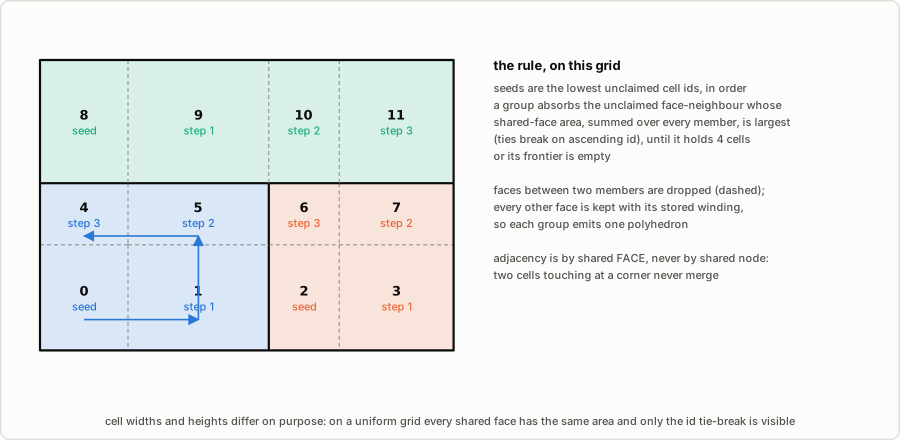
detail::build_global_faces(mesh)re-expresses the mesh's volume cells as a globally deduplicated face list with owner/neighbour pairing — the same machinery the OpenFOAM writer and the CGNSNGON_n/NFACE_nwriter share. A mesh with any non-manifold face (used by three or more cells) is refused: the owner/neighbour classification below is only well-defined on a 2-manifold face, and guessing would silently misclassify a boundary.- Greedy seed-and-grow, serial and deterministic: cells are seeded in ascending order; a group absorbs its unclaimed face-neighbour with the largest accumulated shared-face area (summed over every face the group's current members share with that neighbour) until it reaches
target_group_size, or no unclaimed neighbour remains — a short group at a mesh boundary or pocket is expected, not an error. - Each group emits one polyhedron cell: walk every member's faces. A face whose other side is also in the group is internal and dropped (this happens from both sides, so it is never emitted twice); every other face is the group's own external boundary and is kept, wound exactly as the member's own local orientation already records it — no new orientation logic is needed.
This is deliberately face-adjacency, never node-adjacency (the kind partition's ghost layers and gradient's stencil use): merging on shared-node adjacency could fuse two cells touching only at a single pinch-point vertex, producing a non-manifold union.
Compact groups: the sphericity gate
Greedy growth by shared area favours compact groups, but on a stretched or graded mesh a group can still grow a long arm along the dual. min_sphericity (default 0, off) refuses to absorb a candidate when the union would be less round than that. The measure is the sphericity π^(1/3) (6V)^(2/3) / A: 1 for a ball, about 0.81 for a cube, lower for anything elongated or flat. The group's volume V and external area A are kept incrementally and exactly: absorbing a cell adds its volume, adds its area and subtracts twice the area it shares with the group. A refused candidate is skipped for that group only and can still seed or join another group, so the grouping stays deterministic. Groups may end up smaller than target_group_size. The report's num_rejected counts the refusals.
coarse, report = mp.agglomerate(mesh, target_group_size=8, min_sphericity=0.7, return_report=True)
report["num_rejected"]
Fusing coplanar faces
Without merging, a coarse cell keeps every fine face on its boundary: a flat wall that eight hexahedra tiled stays as eight quads. merge_coplanar_faces=True fuses such faces into one polygon. Faces are grouped by the pair of sides they separate (two groups, or a group and the mesh boundary), so both neighbours get the identical fused polygon (reversed) and the mesh stays conforming. Within a pair, edge-adjacent faces whose normals lie within coplanar_angle degrees (default 1) of the patch's first face fuse when the patch's outline is one simple loop, with no hole and no pinch point. Every polyhedron a fusion touches is checked to remain closed; if a fusion would break that, the patch keeps its original faces. Volume is conserved either way, since the fused polygon covers exactly the faces it replaces. The report's num_faces_merged counts the faces removed (fused faces minus the polygons that replace them, per group side).
Fusing drops the edge-interior nodes of the patch from the face lists. Points are still never renumbered, so the result is valid; clean with remove_orphans=True compacts the point set if a node is no longer referenced at all.
Output structure
Non-volume blocks (2D/1D boundary markers, and any 3D block with no face table) pass through unchanged, in their original relative position. Every volume cell is consumed into one new polyhedron block, emitted at the position the first original volume block occupied — so a mesh whose volume cells already form one contiguous run keeps its overall block order. Cells inside that block have whatever face/node count their own group boundary produces; AddPolyhedronBlock stores genuinely ragged CSR with no same-shape constraint, so there is no grouping-by-size step to do — the same simplification subdivide already established.
Points and data
Points are not compacted: a group can leave an interior node unreferenced — the same never-prune-or-renumber precedent subdivide set for its own orphan case. clean with remove_orphans=True is the documented follow-up for a caller who wants a minimal point set. point_data and field_data therefore need no remapping at all.
cell_data for a pass-through block is copied verbatim. For the merged block, each group's row is its first member's row (ascending order within the group) — the same keep-first convention clean's point weld already uses, since there is no single principled value for an array like a material tag once several cells with (possibly) different values merge. An array whose block count does not match the input mesh is dropped with a warning rather than guessed at.
Volume conservation
Since every surviving face is a face the input mesh already had (just regrouped), a merge conserves volume exactly — checkable to an identity, not a tolerance:
before = mp.compute_stats(mesh)["signed_volume"]
out = mp.agglomerate(mesh, target_group_size=2)
after = mp.compute_stats(out)["signed_volume"]
assert after == before
Regions
Point and Cell regions survive: the carry uses CellMapKind::Global, a single flat map (input global cell → output global cell). Named Side regions survive too (since v16.27.0): a facet of a merged cell moves to the output polyhedron's face containing it, matched by its nodes. With merge_coplanar_faces=True that face may be the merged polygon, and several facets then name the same face. See how operations treat regions.
There is no point map to request: agglomerate never prunes or renumbers an original point.
No numpy fallback
This operation is C++-core only, with no pure-Python reference implementation — the same reasoning subdivide already documents: the emit step depends transitively on a winding repair (a discrete branch on the sign of an enclosed volume) that a second, independently written implementation could disagree with near-degenerate cells. A pure-Python build (meshioplusplus._core unavailable) raises NotImplementedError naming the reason, for any input.
CLI
meshioplusplus agglomerate IN OUT [--target-group-size N] [--merge-coplanar-faces]
                             [--coplanar-angle DEG] [--min-sphericity S] [--json]
--json prints {cells_in, cells_out, num_faces_merged, num_rejected}.
Both CLIs produce byte-identical output (there being only one implementation). See the CLI reference.
Other languages
mio_agglomerate_result* r = mio_agglomerate(mesh, /*target_group_size=*/8);
const mio_mesh* out = mio_agglomerate_result_mesh(r);
/* ... */
mio_mesh* owned = mio_agglomerate_result_take_mesh(r);
mio_agglomerate_result_free(r);mio_agglomerate_opts opts;
mio_agglomerate_opts_init(&opts); /* groups of 8, no merging, no gate */
opts.merge_coplanar_faces = 1;
opts.min_sphericity = 0.7;
int64_t merged = 0, rejected = 0;
mio_agglomerate_result* r = mio_agglomerate_ex(mesh, &opts, &merged, &rejected);type(mio_mesh) :: c
c = m%agglomerate(target_group_size=8_int64, stat=st, merge_coplanar_faces=.true., &
min_sphericity=0.7_real64, num_faces_merged=merged, num_rejected=rejected)a = agglomerate(mesh; target_group_size=8, merge_coplanar_faces=true, min_sphericity=0.7)
a.mesh, a.cell_map, a.num_faces_merged, a.num_rejecteda <- mio_agglomerate(mesh, target_group_size = 8, merge_coplanar_faces = TRUE, min_sphericity = 0.7)
a$mesh; a$cell_map; a$num_faces_merged; a$num_rejectedconst out = await m.agglomerate(mesh, 8);
const r = await m.agglomerate(mesh, 8, true, { mergeCoplanarFaces: true, minSphericity: 0.7 });On the flat ABIs, AgglomerateResult carries a single flat cell map (unlike SubdivideResult's per-block one) — an output cell's index is a function of which group it joined, not which input block it came from. The C API's mio_agglomerate_result_cell_map accordingly takes no block parameter, and there is correspondingly no mio_agglomerate_result_num_cell_maps (there is exactly one array). WASM's agglomerate(mesh, targetGroupSize, returnMaps, options) returns {mesh, cellMap, numFacesMerged, numRejected} (the same flat map) when returnMaps is set.
This operation is also reachable as an Agglomerate step in the settings pipeline (keys TargetGroupSize, MergeCoplanarFaces, CoplanarAngle, MinSphericity) and in the browser viewer's convertSurfaceOps chain ({op: 'agglomerate', targetGroupSize: 8, mergeCoplanarFaces: true}).