
Clean (weld / prune / de-dup)
meshioplusplus.clean(mesh, ...) cleans a mesh in one pass: weld coincident points, drop degenerate cells, drop exact-duplicate cells, and remove orphaned (unused) points — each step individually toggleable — remapping connectivity and data throughout. It is a mesh operation (like merge and reordering), not a file format, and uses only standard C++/numpy, so it runs under every mesh backend.
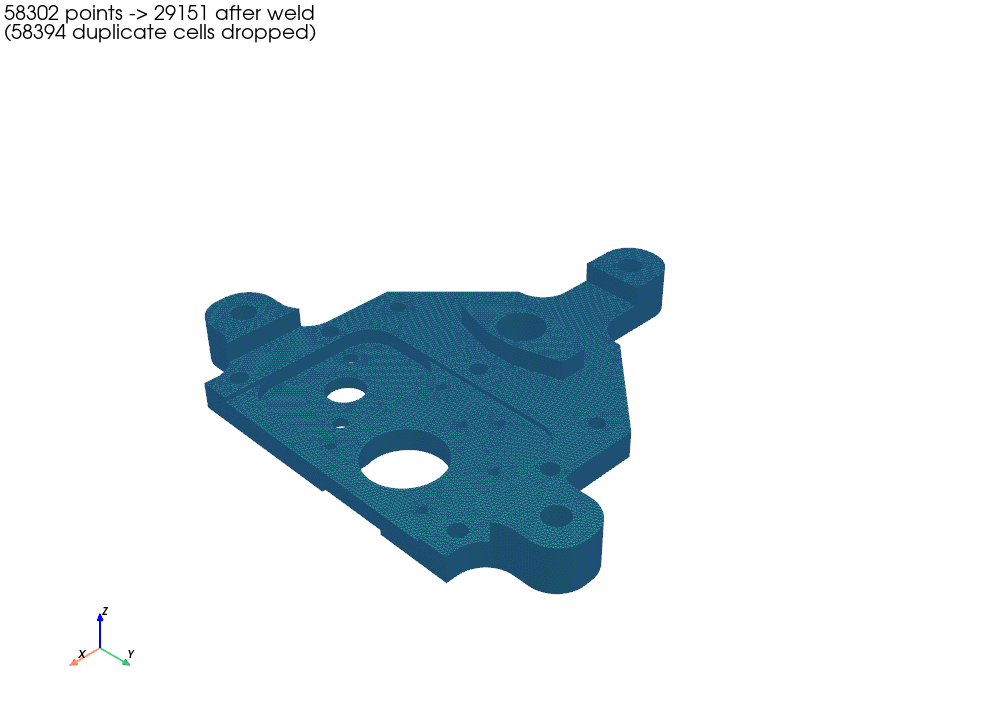
import meshioplusplus

mesh = meshioplusplus.read("messy.vtu")

out = meshioplusplus.clean(mesh)                        # prune + de-dup, no weld
out = meshioplusplus.clean(mesh, weld=True, atol=1e-8)  # also fuse coincident pts

# get a report of what changed
out, report = meshioplusplus.clean(mesh, weld=True, return_report=True)
print(report)   # points_welded / points_removed_orphan / cells_dropped_*
Options
| option | default | effect |
|---|---|---|
weld | False | fuse points within atol (spatial-hash bucket grid, never O(N²)) |
atol | 1e-8 | absolute coincidence tolerance for welding |
remove_orphans | True | drop points referenced by no surviving cell |
drop_degenerate | True | drop cells with a repeated corner node or a near-zero measure |
drop_duplicate_cells | True | drop exact-duplicate cells (keep-first, per block) |
The pass runs weld → drop degenerate → drop duplicate → remove orphans. On a weld, the surviving point keeps the value of the first contributing point (keep-first tie-break).
What changes
- Points are welded/pruned; connectivity is remapped.
point_datafollows the surviving points (keep-first on weld);cell_datafollows the surviving cells;field_datais preserved.point_sets/cell_setsare remapped; entries pointing at removed points/cells are dropped (done in the Python layer).
The numpy fallback handles rectangular cell blocks; ragged/polyhedron blocks are handled by the C++ core only.
CLI
meshioplusplus clean in.vtu out.vtu                     # default set (no weld)
meshioplusplus clean in.vtu out.vtu --weld --atol 1e-6
meshioplusplus clean in.vtu out.vtu --remove-orphans --drop-degenerate
With no step flags the default set runs (remove-orphans + drop-degenerate + drop-duplicates, no weld). Passing any step flag selects exactly the requested steps. A removal summary is printed. See the CLI reference.
Other languages
- C API —
mio_clean(mesh, weld, atol, remove_orphans, drop_degenerate, drop_duplicate_cells, &n_welded, &n_orphan, &n_degen, &n_dup). See the C API reference. - Fortran —
mesh%clean(weld=..., atol=..., points_welded=..., ...). See the Fortran reference. - WebAssembly / JavaScript —
clean(mesh, weld, atol, removeOrphans, dropDegenerate, dropDuplicateCells, returnMaps)returns{mesh, pointsWelded, ...}, pluspointMap/cellMapswhenreturnMapsis set. See the WebAssembly reference.