
ODT remeshing (optimize_volume)
optimize_volume raises a tetrahedral mesh's worst element quality by ODT remeshing — relocating vertices and changing connectivity. It is the genuine "ODT remeshing" the roadmap's volumetric bullet named, and the missing third member of a trio whose other two each do only half the job:
smoothwithmethod="odt"is ODT smoothing: it moves each free interior tet vertex to the volume-weighted circumcenter average of its incident tets, on the mesh's fixed connectivity. It cannot fix a badly connected tetrahedralization — a sliver that no vertex motion removes.remesh_volumegenerates a fresh tet mesh from a signed-distance lattice (surface-in, volume-out); it discards the input's tets entirely rather than improving them.
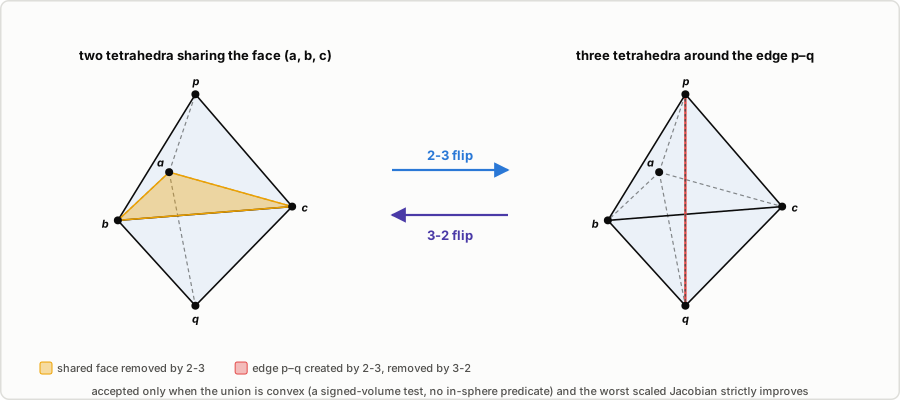
optimize_volume alternates the ODT vertex relocation above with quality-improving topological flips (2-3 and 3-2), so both the vertex positions and the connectivity change — which is what makes it remeshing rather than smoothing, and the resolution-preserving quality optimiser refine/decimate_volume are not (refine subdivides the input's own possibly-bad cells; decimate_volume can only remove them).
Predicate-free by design
The roadmap deliberately rejects the literal Delaunay/ODT-remeshing method because a robust 3D Delaunay kernel needs in-sphere/orientation predicates — exactly where this project's dependency-free posture stops paying (Geogram is a large dependency; TetGen and CGAL's Mesh_3 are AGPL/GPL). optimize_volume needs none of that. A flip is applied only when, using the signed volume of the candidate tets alone (detail::cell_volume_from_corners/detail::det3, never an in-sphere test):
- every new tet is non-degenerate and the local configuration is convex (a pure signed-volume test), and
- the minimum quality (scaled Jacobian) over the new tets strictly exceeds the minimum over the tets it replaces, by
min_improvement.
Criterion 2 is Freitag & Ollivier-Gooch's local-mesh-improvement-by-swapping rule ("Tetrahedral mesh improvement using swapping and smoothing", 1997). Because every accepted flip strictly raises a bounded quantity — the worst incident quality — the process is monotone in worst quality and therefore terminates, with no Delaunay optimality argument and no predicate.
A 2-3 flip replaces the two tets sharing an interior triangular face with three tets around the edge joining their two apexes; a 3-2 flip is its inverse (three tets around an interior edge become two capping the ring). The relocation half is delegated verbatim to smooth's method="odt", reusing all of its boundary/feature/frozen pinning and inversion guard.
Boundary is invariant
A 2-3 flip acts only on an interior face (shared by two tets) and a 3-2 flip only on an interior edge (all its incident faces interior), so neither ever touches a boundary face. Combined with preserve_boundary pinning boundary vertices during relocation, the output's boundary surface is byte-identical to the input's: watertight in ⇒ watertight out, with none of the coincident-edge risk remesh_volume's surface warp carries.
What survives
The point set is invariant — relocation moves points, flips only reconnect them, and no point is ever added or removed — so point_data, field_data and named Point regions carry through unchanged. cell_data has no correspondence across a flip (a 2-3 flip replaces two cells with three) and is dropped with a warning, as are named Cell/Side regions; the output is a single tetra block. This is more generous than remesh_volume (which drops point data too, having a genuinely new point set), and it is honest: what is preserved is exactly what a preserved point set can preserve. To keep cell_data or a field defined on the boundary, compose with interpolate or conservative_interpolate.
Scope and determinism
Tet-only: a non-tetra 3D block raises pointing at convert_cells(mode="simplexify"), a non-3D block alongside the tets raises pointing at split, and a ragged/polyhedron or tet-less mesh raises by name — the same tet-only scope smooth's ODT method and decimate_volume enforce. Per-tet quality and each sweep's face/edge adjacency are built in parallel into disjoint slots; the flip-application loop is serial in a fixed order, so output is byte-identical across the three mesh backends and across thread counts.
Like remesh_volume/subdivide/agglomerate/decimate_volume, this operation is C++-core only, with no numpy fallback — the flip acceptance is a discrete branch on the sign of a volume and on a near-tie quality comparison, so a second independent implementation could land on the other side of such a tie and diverge into a different connectivity. The Python function raises NotImplementedError by name when the compiled core is unavailable.
Usage
import meshioplusplus as mio

mesh = mio.read("volume.vtu")          # a tetrahedral mesh
out, report = mio.optimize_volume(mesh, max_iterations=10, return_report=True)
print(report["num_flips"], report["min_quality_before"], report["min_quality_after"])
mio.write("optimized.vtu", out)meshioplusplus optimize-volume volume.vtu optimized.vtu
# --max-iterations N --no-relocate --no-flip --no-preserve-boundary --min-improvement EBindings mirror the operation on every surface: Python optimize_volume, C mio_optimize_volume, Fortran m%optimize_volume, Julia optimize_volume, R mio_optimize_volume, WASM optimizeVolume, the optimize-volume CLI verb in both CLIs, an OptimizeVolume settings-pipeline step, and an optimize_volume MCP tool. The relocation pin mask (frozen) is exposed on the Python and C++ APIs only — a documented flat-ABI gap of its own, distinct from smooth's (whose frozen reaches every flat binding: C mio_smooth_ex, Fortran, Julia, R, and WASM).
Attribution
The flip-acceptance rule (apply a local transformation only when it strictly improves the worst incident element quality) is the published method of Freitag & Ollivier-Gooch, "Tetrahedral mesh improvement using swapping and smoothing" (Int. J. Numer. Methods Eng., 1997) — implemented from the description only. No external mesh library, and in particular no in-sphere/orientation predicate kernel, is read or vendored. The ODT vertex relocation is this repo's own smooth method="odt" (Alliez et al. 2005; Chen & Xu).