
Distributed and scale
Two different subpackages, two different kinds of parallelism, and confusing them is the usual mistake.
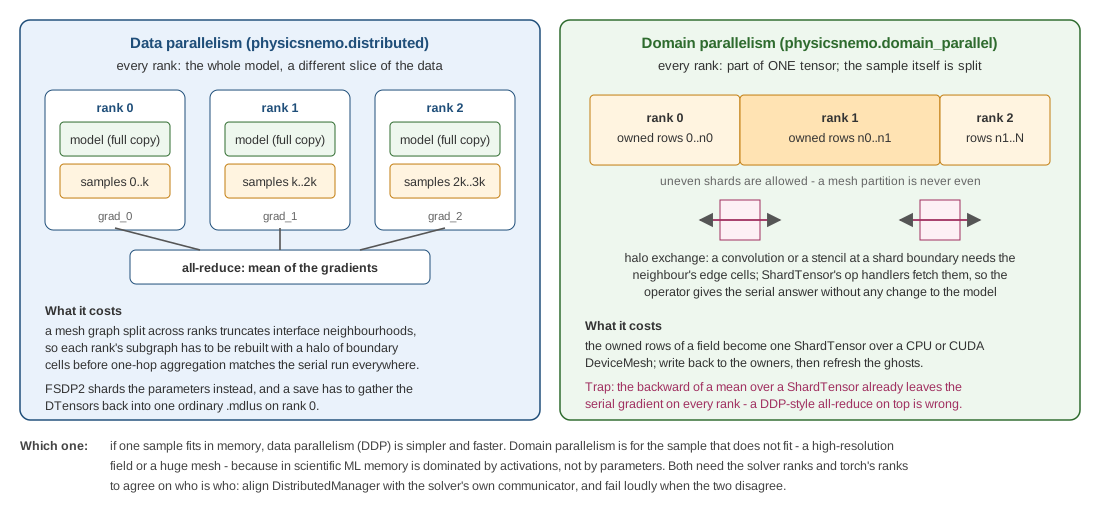
Figure 1: Data parallelism replicates the model and splits the batch; domain parallelism splits the sample itself.
physicsnemo.distributed — data parallelism
Every rank holds the whole model and a different slice of the data. Gradients are averaged across ranks; the model is replicated.
DistributedManager— the singleton that owns rank, world size, device and the backend. Everything else asks it.ProcessGroupConfig,ProcessGroupNode— subgroups of ranks, for models that want more than one axis of parallelism.- Collectives with autograd support:
gather_v,all_gather_v,scatter_v,indexed_all_to_all_v,reduce_loss,fused_all_reduce. mark_module_as_shared— tells the gradient machinery a module's parameters are replicated rather than sharded.distributed.fft— distributed FFTs, for spectral models.
The alignment problem
A solver has its own communicator abstraction, and torch has torch.distributed. If the two disagree about which rank you are, the failure is silent and the results are garbage.
The fix is not subtle — align them at start-up and check loudly when they disagree — but it has to be done deliberately, because nothing in either library will notice on its own.
Halo partitioning
Splitting a mesh graph across ranks naively truncates the interfaces: a node near a partition boundary loses the neighbours that live on another rank, so its one-hop neighbourhood no longer matches a serial run and the message-passing result is wrong at exactly the places that matter.
The remedy is per-rank subgraphs whose owned sets partition the global node set exactly, and whose one-hop neighbourhoods do match — a halo of boundary cells around each partition, with gradients synced by DistributedDataParallel on top.
physicsnemo.domain_parallel — domain parallelism
Every rank holds part of one tensor. The mesh itself is split, not the batch. This is what you want when a single sample does not fit on one GPU.
ShardTensor— a tensor sharded across a device mesh, withshard_tensor,scatter_tensorandsync_module_over_mesh.
Note it moved: ShardTensor lives in physicsnemo.domain_parallel, not in physicsnemo.distributed, as of 2.2.
Two facts about what a CPU-only or single-GPU machine can test here, because they are easy to get wrong in both directions. ShardTensor itself needs only a torch DeviceMesh, which init_device_mesh("cpu", ...) provides, and upstream's operator handlers register on a CUDA-less host once asked to — so the semantics are testable over gloo. What is not testable is the NCCL transport, plus a handful of genuinely CUDA-only remnants: sharding_shapes="infer", ring attention, and the sharded kNN and radius search.
The trap worth pinning: the backward of a mean over a ShardTensor already leaves the serial gradient on every rank, so a DDP-style all-reduce on top is wrong by the rank count. It produces a plausible number, which is why it needs an assertion rather than a reading.
Sharded checkpoints
An FSDP2 model's parameters are DTensors — each rank holds a shard. Saving them directly produces a checkpoint that reports success and cannot be loaded, with each rank having written only its own piece. Gather them to full tensors and write from rank 0.
In meshio++
Nothing here is implemented, and the reason is worth stating precisely rather than as a gap: meshio++ is a library, not a process. It has no communicator, launches nothing, and has no opinion about ranks. What it has instead is the piece a distributed training run needs from a mesh library, which is the decomposition itself:
partition splits a mesh into exactly N balanced pieces — by a space-filling curve always, or by KaHIP's edge-cut minimization when it is built in — and ghost_layers=N grows each piece by that many shared-node breadth-first layers. That halo is exactly the one the graph-partitioning paragraph above describes, and shared-node rather than shared-facet adjacency is the conservative choice: it is what a node-based assembly needs, and it is a superset of what message passing on a mesh-edge graph needs.
partition_labels gives the same decomposition as a flat per-cell array instead of N meshes, which is the form to hand a distributed data loader. It refuses a nonzero ghost_layers rather than ignoring it, because a flat label array is the ownership map and a cell can be a ghost of several parts at once — there is no honest single label for it.
The rest — aligning two communicators, gathering DTensor shards, choosing NCCL over gloo — belongs to whatever process owns the training loop.
Next: Companion packages.