
Tetrahedra from a skin — tetrahedralize
tetrahedralize fills a closed triangle surface with tetrahedra: a mesh_cad_surface result, a boundary layer's cap, any watertight skin. It has two backends. Netgen keeps the surface's triangles exactly: every input triangle is a facet of the result and every input point a point of it at its index, so the volume conforms to the skin and to whatever else shares it. The octree backend is native and always built: octree_mesh's isosurface stuffing, whose boundary is fitted to the skin within a measured distance rather than kept, with dihedral angles bounded where the stuffing's guarantee holds. backend="auto", the default, takes Netgen when the build has it (-DMESHIOPLUSPLUS_WITH_NETGEN=ON) and the octree backend otherwise, with a warning saying so; backend="netgen" in a build without it throws Unsupported naming the flag. So tetrahedralize works in every wheel, CLI and WebAssembly build, and Netgen is the upgrade that keeps the skin. The installed TetGen and Gmsh programs are two more backends that keep it (backend="tetgen", "gmsh"): tetrahedralize writes each region's surface, runs the program as a separate process and reads the tetrahedra back (external meshers).
import meshioplusplus as mp

model = mp.read("part.cad.json")
skin = mp.mesh_cad_surface(model, 0.2, min_angle=25)
volume, report = mp.tetrahedralize(skin, max_size=0.2, return_report=True)
print(report["num_tetrahedra"], report["boundary_preserved"], report["min_dihedral_deg"])
Input
The input is a closed, manifold, consistently oriented triangle surface. Line and vertex blocks are skipped (a mesh_cad_surface result's edges); a quad, polygon, higher-order or volume block is refused by name, so an all-quad or curved surface is meshed from its linear triangle result, and a quad cap is split first. An open, non-manifold, misoriented or degenerate surface is refused with the counts of the watertightness check, the same counts mesh_cad_surface reports. A self-intersecting surface passes that check and fails in the backend, reported as an error rather than meshed wrong; find_intersections finds the crossing triangles beforehand.
Regions
The surface's connected shells are oriented outward (a shell whose triangles face in is turned), and each shell bounds a region: the inside of the shell minus the shells directly inside it, found by the winding number of one of their points. A box inside a box gives two regions, the shell between them and the inner box. Each region is meshed on its own, from its shell and its inner shells turned inward. With Netgen neighbouring regions share the inner shell's triangles exactly and the tetrahedra conform across it; the octree backend fits each region to its own shells, so two regions do not share points across their interface, which it warns.
The result holds the points, a tetra block (positively oriented, region by region) and a triangle block. With Netgen the input's points come first, unchanged and at their indices, then the new interior points, and the triangles are the surface's as given; with the octree backend every point is new and the triangles are the tetrahedra's boundary facets, outward. The cell data tetrahedralize:region names each tetrahedron's region (-1 on the triangles), and Cell regions region:<k> hold them. When the surface carries face_array (cad:face, one value per CAD face), that array is carried to the triangles (-1 on the tetrahedra; an octree boundary facet takes the value of the surface triangle nearest its centroid) and each value becomes a Side region face:<v> on the facets the triangles are.
Netgen: the skin kept
Netgen (J. Schöberl, 1997) meshes the volume by an advancing front with Delaunay insertion and then optimises it: its volume mesher keeps the surface mesh it is given, which tetrahedralize checks (boundary_preserved, with hausdorff_to_surface zero when it holds), and optimize_steps passes of its volume optimisation follow. max_size bounds the tetrahedra's edges, max_volume adds the edge of a regular tetrahedron of that volume, (6 √2 V)^(1/3), to the bound, and grading sets how fast the size grows away from the surface; with neither bound the surface's triangles size the inside. nglib keeps global state, so calls into it are serialised behind one lock and a region is meshed in one thread: the result is deterministic, the same bytes run after run.
Netgen is LGPL-2.1. Natively it is linked dynamically, never vendored, and not in the base wheel or the CLI binaries (third-party notices): the PyPI route is the meshioplusplus-netgen add-on wheel (pip install "meshioplusplus[netgen]", has_netgen() reports it), and the CLI and C API can load it as a plugin; build/configure.sh --with-netgen (or --netgen-root <prefix>) enables it against a distribution's libnglib-dev or an install of its own. In the browser the full WebAssembly artifact links Netgen 6.2.2401 statically (hasNetgen() is true there), built from source by build/build-wasm-deps.sh --full; the lean artifact has none, so tetrahedralize there is the octree backend.
External meshers: TetGen and Gmsh
A tetrahedral mesher is a provider, and besides the default one (Netgen) any number can be registered by name and chosen with backend="<name>" (C++ TetrahedralizeBackend::Named and TetrahedralizeOptions::mProvider; tetrahedralize_backends() lists them). Two come with every native build and register themselves when their programs are installed, found on PATH or named by MESHIOPLUSPLUS_TETGEN and MESHIOPLUSPLUS_GMSH (MESHIOPLUSPLUS_NO_EXTERNAL_MESHERS=1 turns both off):
tetgenwrites the region's surface as a TetGen.smesh(its inner shells as holes, a point inside each) and runstetgen -pYQ: a constrained tetrahedralisation that adds no point on the boundary (-Y), with quality (-q) whenoptimize_stepsis positive and a volume bound (-a) frommax_size, the volume of a regular tetrahedron of that edge. It reads back.1.nodeand.1.ele.gmshwrites the surface as a full-precision ASCII STL, onesolidper shell, with a.geothat makes each shell a surface loop of one volume, and runsgmsh -3(-clmaxfrommax_size;optimize_steps0 turns its optimisation off). It reads back the MSH 4.1 output's tetrahedra.
The core checks what either returns, as it checks Netgen and any provider since: every input point back, matched to the program's copy of it within 1e-9 of the region's diagonal (a text round trip rounds the last digit) and then given the input's exact coordinates, and the faces of exactly one tetrahedron the input's triangles. A program that moves the boundary is refused naming it, so boundary_preserved is true and hausdorff_to_surface zero whenever the call returns. grading is Netgen's alone. The programs run in a fresh temporary directory, removed afterwards (MESHIOPLUSPLUS_KEEP_TEMP=1 keeps it), with no shell, their output in a log whose last lines a failure quotes. They never run in WebAssembly, where the names are not registered.
Running them as programs, never linking them, is what their licences leave open: TetGen is AGPL-3.0 and Gmsh GPL-2.0-or-later, and meshio++ neither ships nor links either (the decision on them stands for linking). On Ubuntu apt install tetgen gmsh provides both, and CI's netgen job runs the tests against them.
Octree: the skin fitted
The octree backend meshes each region with octree_mesh under uniform skin grading at the surface's own size (its mean edge length, or max_size when that is smaller): a body-centred cubic lattice stuffed to the skin, its vertices warped onto it and the result fitted, untangled and optimised for optimize_steps rounds (F. Labelle and J. R. Shewchuk, Isosurface stuffing, 2007). Where the report of octree_mesh says its guarantee holds the dihedral angles lie between 10.7 and 164.8 degrees by construction; the boundary is within hausdorff_to_surface of the skin, the two-sided distance between them, and boundary_preserved is false. The inside grows to max_size or an eighth of the region's diagonal; grading is Netgen's alone. It is native, deterministic across parallel backends and thread counts, and in every build.
Measured
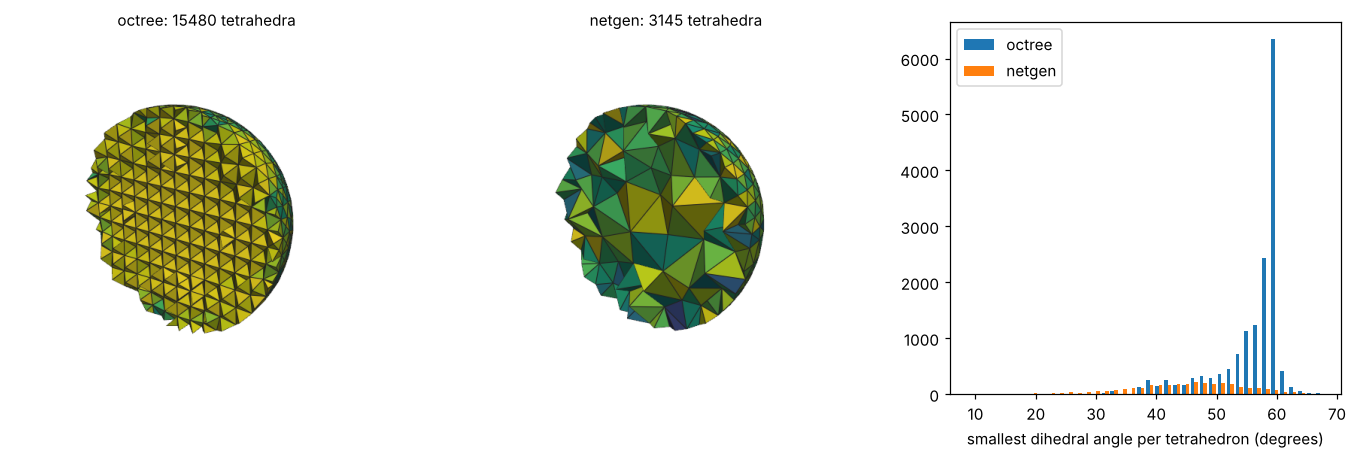
On the unit sphere meshed by mesh_cad_surface at h = 0.2 and 25 degrees, tetrahedralize makes 3,145 tetrahedra whose boundary is the skin itself, with dihedral angles of 8.5 to 164.7 degrees (3,680 and 8.9 to 164.4 with max_size=0.2); their volume, 4.1500, is the skin's enclosed volume to rounding, 0.9% under 4/3 π, the skin's own chordal error. A box inside a box gives two regions that share the inner box's triangles. The octree backend fills the same sphere with 15,480 tetrahedra whose dihedral angles lie between 21.4 and 134.3 degrees, its boundary within 0.0097 (0.05 h) of the skin and its volume, 4.1252, 0.6% under the skin's; the unit cube's skin it fills exactly, with angles of 45 to 98 degrees. The two trade as their names say: Netgen keeps the skin with a fifth of the tetrahedra and wider angle extremes, the octree backend bounds the angles and moves the boundary. tests/cpp/test_tetrahedralize.cpp and tests/python/test_tetrahedralize.py pin these, and CI's netgen job runs the Netgen tests against Ubuntu's Netgen.
optimize_volume takes the tetrahedra once the triangle block is dropped. Its ODT energy objective (ODT relocation with 2-3 and 3-2 flips, Alliez et al. 2005; objective="energy", the only one up to v18.0.0) was measured on Netgen's output (October 2026): ODT relocation lowers an energy summed over the cells, not the worst one, so it trades extremes for the average.
skin (h) | Netgen, optimize_steps | Netgen's dihedrals | slivers under 15° | after optimize_volume | slivers |
|---|---|---|---|---|---|
| sphere (0.2) | 0 | 0.84 – 177.5 | 138 | 0.18 – 179.6 | 70 |
| sphere (0.2) | 3 | 8.5 – 164.7 | 5 | 1.65 – 176.0 | 39 |
| sphere (0.1) | 0 | 0.05 – 179.8 | 1,111 | 0.05 – 179.8 | 518 |
| sphere (0.1) | 3 | 5.2 – 167.7 | 48 | 2.0 – 174.1 | 336 |
| capped cylinder (0.2) | 0 | 1.7 – 176.3 | 133 | 6.6 – 169.3 | 23 |
| capped cylinder (0.2) | 3 | 13.0 – 160.3 | 2 | 2.0 – 176.8 | 6 |
| unit cube (0.2) | 3 | 23.5 – 137.3 | 0 | 16.2 – 149.3 | 0 |
On Netgen's raw output the energy objective halves the slivers; after Netgen's three passes it makes the extremes worse on every skin. The default objective since, worst (guarded relocation, edge removal, multi-face removal and worst-cell smoothing; Klingner and Shewchuk 2007, Freitag and Ollivier-Gooch 1997), never lowers the least dihedral angle and raises it past Netgen's own passes: 17.4 to 32.4 degrees on the sphere and 13.3 to 19.6 on the capped cylinder, with no tet left under 15 degrees (measured).
Options and report
| option | meaning |
|---|---|
backend | auto (Netgen when built in, else the octree backend, with a warning), netgen, octree, or a registered mesher's name (tetgen, gmsh; tetrahedralize_backends()) |
max_size | the largest edge asked of the tetrahedra (0: none) |
max_volume | the largest volume asked of a tetrahedron (0: none) |
grading | how fast the size grows away from the surface, in [0, 1] (0.3; Netgen) |
optimize_steps | passes of the backend's volume optimisation, 0 to 100 (3) |
max_cells | refuse a result of more tetrahedra (50,000,000) |
face_array | the cell data naming each triangle's CAD face (cad:face) |
The report has num_tetrahedra, num_points (every point), num_new_points (of those, not the input's: every point with the octree backend), num_regions, num_boundary_triangles, boundary_preserved, hausdorff_to_surface, min_dihedral_deg and max_dihedral_deg, volume (the tetrahedra's total), backend (the one that ran) and warnings.
Other backends
Geogram (BSD-3) was the first candidate and was rejected: its mesh_tetrahedralize, the constrained tetrahedralisation of a closed surface, creates its Delaunay kernel as Delaunay::create(3, "tetgen"), and TetGen is AGPL-3.0, which this repository excludes from what it links, with CGAL's Mesh_3 and Gmsh (GPL); TetGen and Gmsh are reachable as external meshers instead. Two candidates stay recorded for another backend under the same contract (a named TetMesherProvider):
- fTetWild (MPL-2.0; Hu et al. 2020) meshes within an envelope around the surface, so it survives dirty input and does not keep the triangles exactly: it would report
boundary_preservedfalse and a Hausdorff distance. It depends on Geogram's Delaunay kernel (without TetGen) and libigl. - The exact constrained Delaunay tetrahedralisation of Diazzi, Panozzo, Vaxman and Attene (2023), on Attene's indirect predicates (Attene 2020), recovers every input triangle without approximation and meshed all valid Thingi10K models in its authors' tests. Its reference code is LGPL only when built with
-DLGPL=ON(its default links GPL components), and it ships as an executable, so it would be a file route like the vendor routes, not a link.
A native constrained tetrahedralisation stays a non-goal: the Delaunay kernel is short, but boundary recovery with Steiner points is where the robust libraries spend their years (non-goals).
Bindings
| surface | entry |
|---|---|
| Python | meshioplusplus.tetrahedralize(mesh, *, backend="auto", max_size=0.0, max_volume=0.0, grading=0.3, optimize_steps=3, max_cells=50_000_000, face_array="cad:face", return_report=False); has_netgen(), tetrahedralize_backends(); no numpy twin |
| C++ | tetrahedralize(const Mesh&, const TetrahedralizeOptions&) → TetrahedralizeResult, tetrahedralize_has_netgen(), tetrahedralize_backends() (operations/tetrahedralize.hpp); add_tet_mesher, tet_mesher(name), tet_mesher_names() (providers.hpp) |
| C | mio_tetrahedralize(mesh, &opts, &report) with mio_tetrahedralize_opts (through mio_tetrahedralize_opts_init; MIO_TETRAHEDRALIZE_BACKEND_NAMED with provider) and mio_tetrahedralize_report (backend_name); mio_has_netgen(), mio_tet_mesher_count(), mio_tet_mesher_name(i) |
| Fortran | mio_tetrahedralize(...), mio_tet_mesher_count(), mio_tet_mesher_name(i), mio_tetrahedralize_backend_name(report), see Fortran |
| Julia | tetrahedralize(mesh; backend, max_size, max_volume, grading, optimize_steps, max_cells, face_array), tetrahedralize_backends() |
| R | mio_tetrahedralize(mesh, ...), mio_tetrahedralize_backends() |
| WASM | tetrahedralize(mesh, {backend, maxSize, maxVolume, grading, optimizeSteps, maxCells, faceArray}): Netgen in the full artifact (hasNetgen() is true), the octree backend in the lean one, where backend: "netgen" throws naming the full artifact; no external mesher |
| CLI | tetrahedralize INFILE OUTFILE [--max-size H] [--max-volume V] [--grading G] [--optimize-steps N] [--max-cells N] [--face-array NAME] [--backend NAME] [--json], both CLIs; meshioplusplus --version lists the backends |
| MCP | tetrahedralize(input_path, output_path, ...), reporting netgen_available and backends_available |
| Pipeline | Tetrahedralize with Backend, MaxSize, MaxVolume, Grading, OptimizeSteps, MaxCells, FaceArray |
References
- J. Schöberl, "NETGEN: an advancing front 2D/3D-mesh generator based on abstract rules", Computing and Visualization in Science 1 (1997).
- F. Labelle and J. R. Shewchuk, "Isosurface stuffing: fast tetrahedral meshes with good dihedral angles", ACM Transactions on Graphics 26 (2007).
- B. M. Klingner and J. R. Shewchuk, "Aggressive tetrahedral mesh improvement", Proceedings of the 16th International Meshing Roundtable (2007).
- P. Alliez, D. Cohen-Steiner, M. Yvinec and M. Desbrun, "Variational tetrahedral meshing", ACM Transactions on Graphics 24 (2005).
- L. A. Freitag and C. Ollivier-Gooch, "Tetrahedral mesh improvement using swapping and smoothing", International Journal for Numerical Methods in Engineering 40 (1997).
- Y. Hu, T. Schneider, B. Wang, D. Zorin and D. Panozzo, "Fast tetrahedral meshing in the wild", ACM Transactions on Graphics 39 (2020).
- L. Diazzi, D. Panozzo, A. Vaxman and M. Attene, "Constrained Delaunay tetrahedrization: a robust and practical approach", ACM Transactions on Graphics 42 (2023).
- M. Attene, "Indirect predicates for geometric constructions", Computer-Aided Design 126 (2020).
- Q. Zhou and A. Jacobson, "Thingi10K: a dataset of 10,000 3D-printing models", arXiv:1605.04797 (2016).