
Mesh quality metrics
meshioplusplus.compute_quality(mesh) scores every cell of every block on a fixed set of geometric quality metrics and returns an aggregate report; meshioplusplus.attach_quality(mesh) returns a copy of the mesh with those metrics attached as cell_data (ready to write out and visualise). Metrics are evaluated on each cell's corner nodes (quadratic variants reduce to their linear parent), using only standard C++/numpy math, so they run under every mesh backend.
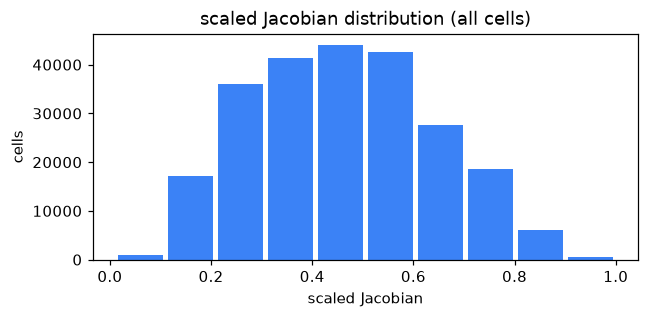
import meshioplusplus

mesh = meshioplusplus.read("part.vtu")
report = meshioplusplus.compute_quality(mesh)
print(report["num_inverted"], "inverted cells")
print(report["metrics"]["quality:scaled_jacobian"]["min"])

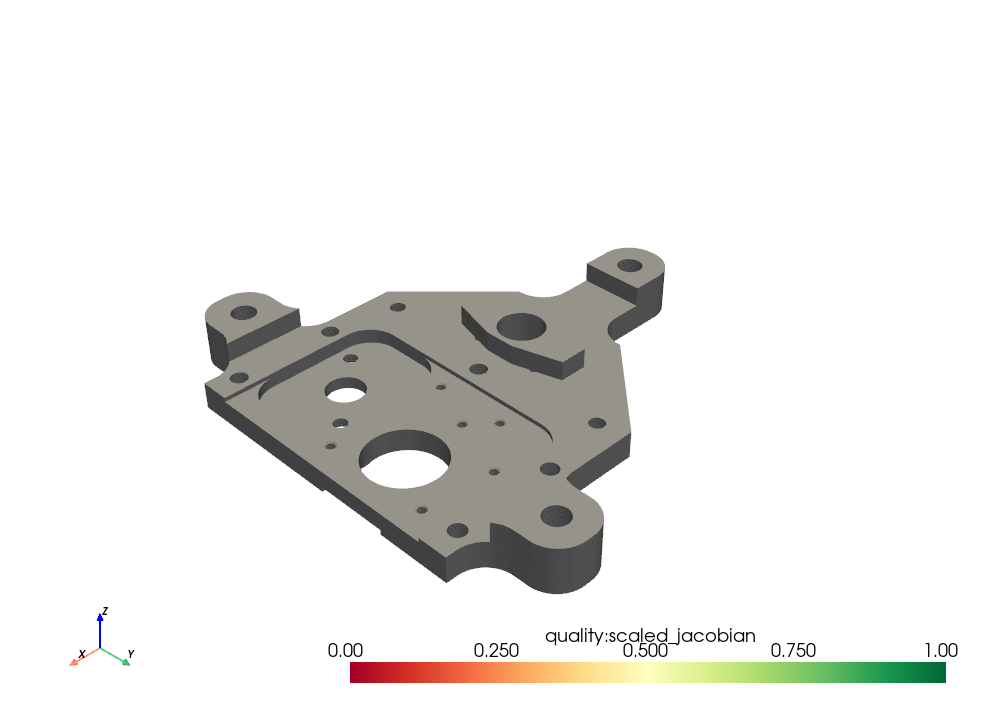
annotated = meshioplusplus.attach_quality(mesh)   # metrics as cell_data
meshioplusplus.write("part_quality.vtu", annotated)
Metrics
| metric | triangle | quad | tetra | hexahedron | wedge | pyramid |
|---|---|---|---|---|---|---|
quality:volume (area in 2D) | ✓ | ✓ | ✓ | ✓ | ✓ | ✓ |
quality:scaled_jacobian | – | – | ✓ | ✓ | ✓ | ✓ |
quality:aspect_ratio | ✓ | ✓ | ✓ | – | – | – |
quality:skewness | – | ✓ | – | ✓ | – | – |
quality:min_angle / quality:max_angle | ✓ | – | – | – | – | – |
quality:warpage | – | ✓ | – | – | – | – |
quality:min_dihedral / quality:max_dihedral | – | – | ✓ | – | – | – |
quality:inverted / quality:degenerate | ✓ | ✓ | ✓ | ✓ | ✓ | ✓ |
A metric that does not apply to a cell type is NaN for that cell. Ideal (perfectly regular) elements give the ideal value: scaled_jacobian = 1, aspect_ratio = 1, skewness = 0, warpage = 0, triangle angles = 60°, tetra dihedral ≈ 70.53°.
quality:invertedis1.0when the signed volume/area is negative (a 2D triangle/quad embedded in 3D is unsigned, so never flagged).quality:degenerateis1.0when the cell is near-zero (collapsed volume/area, a zero-length edge, or a vanishing Jacobian); its divide-prone metrics are thenNaN.
Quadratic and higher-order variants (tetra10, hexahedron20/27, quad8/9, triangle6, wedge15, pyramid13/14) are scored on their corners. Polyhedron blocks get a reduced set since v9.16.0 — volume, inverted and degenerate, computed through detail/polyhedron.hpp; every metric defined against a reference element the cell does not have stays NaN, and inverted there means unorientable rather than negative-volume (see Polyhedra). Ragged polygon and other unsupported blocks contribute all-NaN arrays and are excluded from the summaries and counts.
The report
compute_quality returns a dict:
num_cells,num_inverted,num_degenerate— integer counts.metrics—metric name → {min, max, mean, count, histogram}(a 10-bin histogram over[min, max];countis the number of cells with a finite value).cell_arrays—metric name → list of arrays(one(n, 1)array per cell block,NaNwhere the metric does not apply) — the arraysattach_qualitywrites intocell_data.
Quality gate
check_quality(mesh, require) (v16.24.0) turns the metrics into a pass/fail answer — the check a CI job over meshes scripts. Each threshold is tested against the per-cell values, not the report's histograms, whose bins span each metric's own data range and so cannot say how many cells fall below a bound.
import meshioplusplus as mp

r = mp.check_quality(mesh, "scaled_jacobian >= 0.2; aspect_ratio <= 5 @ 1%")
r["passed"]                    # every check passed
for c in r["checks"]:
    print(c["name"], c["violations"], c["evaluated"], c["worst"], c["worst_cell"])
The specification text, which every surface reads the same way: clauses separated by ;, , or newlines (# starts a comment, so a gate file is one clause per line), each METRIC >= VALUE or METRIC <= VALUE, optionally followed by @ FRACTION — the fraction of evaluated cells allowed to violate the bound, a number in [0, 1] or a percentage (@1%). METRIC is any metric above, with or without its quality: prefix. A structure works too in Python and C++: {"metric", "min", "max", "max_fraction"} / QualityThreshold.
Which cells. A cell where the metric does not apply (NaN — min_angle on a quad, say) is not evaluated; a threshold that applies to no cell at all passes vacuously and says so in a warning. Inverted and degenerate cells are gated by count: max_inverted and max_degenerate default to 0, and a negative limit disables the check.
Each check reports its name, metric, bounds, how many cells it evaluated and how many are violations (and the fraction), the worst value — the one closest to, or furthest beyond, the bound — with its global block-major worst_cell, and whether it passed.
meshioplusplus check part.vtu --require "scaled_jacobian >= 0.2" --require "aspect_ratio <= 5 @ 1%"
meshioplusplus check part.vtu --gate quality.gate --json
The check verb (both CLIs) exits 0 when every check passes, 1 when one fails and 2 when the check could not run (an unreadable file, a malformed specification) — so a CI job can tell "the mesh is bad" from "the gate is broken". It is also the pipeline step {"Op": "QualityGate", "Require": ["scaled_jacobian >= 0.2"], "MaxInverted": 0, "MaxDegenerate": 0}, which leaves the mesh untouched and stops the pipeline with the summary as its error, and the MCP tool check_quality. The flat bindings take the specification text and return the pass/fail and counts plus the summary text both CLIs print: C mio_check_quality(mesh, spec, max_inverted, max_degenerate, &report, buf, len), Fortran m%check_quality(spec, …), Julia check_quality(m; require=…), R mio_check_quality(m, require), WASM checkQuality(mesh, require) (which also returns every check).
Cross-language
Available in every binding surface: Python (compute_quality/attach_quality), the C API (mio_attach_quality + mio_quality_counts), Fortran (mesh%attach_quality() / mesh%quality_counts(...)), and WASM (attachQuality), plus the CLI verb meshioplusplus quality.
Implementation
The metrics are in src/cpp/src/operations/quality.cpp (over the uniform mesh API, with the per-cell loop parallelised) with reusable vector math in src/cpp/include/meshioplusplus/detail/geometry.hpp. A pure-numpy twin (meshioplusplus._quality._compute_quality_py) mirrors the formulas and is checked against the C++ core in tests/python/test_quality.py.