
Interpolation (field transfer)
meshioplusplus.interpolate(source, target) samples a source mesh's data arrays onto a target mesh — the repo's first cross-mesh operation that transfers data (diff compares two meshes, merge concatenates them; neither resamples). It is a mesh operation, not a file format, uses only standard C++/numpy, and runs under every mesh backend.
The result is a new mesh that is a copy of the target: geometry, connectivity, the target's own data arrays and its point_sets/cell_sets are preserved exactly, with the requested source arrays sampled onto it. Source point_data is sampled at the target's points; source cell_data at the target's cell centroids. Source sets are not transferred, and mesh.info/gmsh_periodic are not carried.
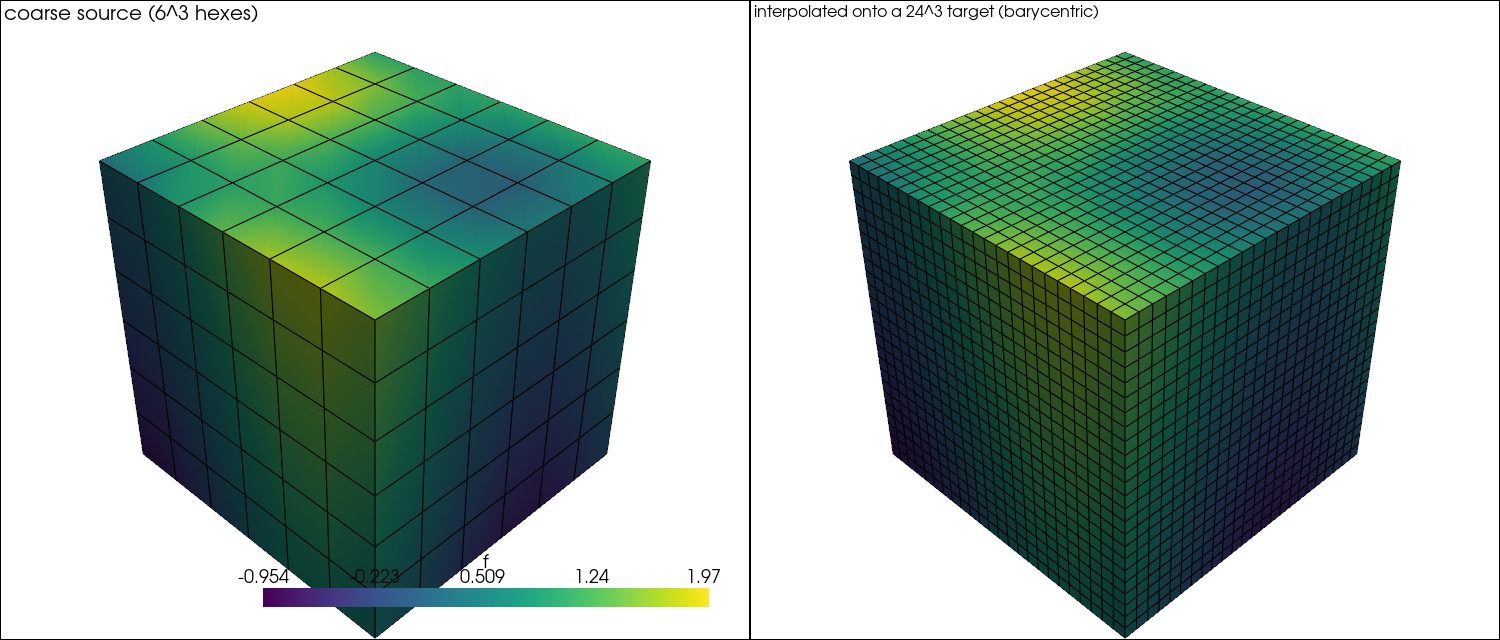
import meshioplusplus

coarse = meshioplusplus.read("solution.vtu")   # carries point_data "T"
fine = meshioplusplus.read("remeshed.vtu")

# nearest source point (robust, any cell type, dtype-preserving)
out = meshioplusplus.interpolate(coarse, fine)

# linear interpolation, exact on a linear field
out = meshioplusplus.interpolate(coarse, fine, method="barycentric")

# name the arrays; points outside the source keep -1 instead of erroring
out = meshioplusplus.interpolate(
    coarse, fine, method="barycentric", arrays=["T"], default_value=-1.0
)

meshioplusplus.write("mapped.vtu", out)
Two methods
| method | value at a target sample | dtype | needs |
|---|---|---|---|
nearest (default) | the nearest source point's value, copied bit-for-bit | preserved | source points only |
barycentric | linear interpolation in the containing source simplex | Float64 | triangle/tetra cells (after simplexify) |
Nearest is piecewise constant and never fails: every target sample finds some nearest source point (tie-break: smallest squared distance, then lowest source point index). Values are copied as raw bytes, so integer tags — including int64 payloads beyond 2⁵³ — survive exactly.
Barycentric first simplexifies the source with convert_cells so containment and weights are exact and uniform. Two caveats follow directly from that:
- on a quad/hex source the result is the simplex-linear interpolant, not true bi-/trilinear — exact on a linear field either way, and the difference on smooth data is second order;
- only the source's maximum topological dimension is sampled (tetrahedra when any exist, else triangles), and triangle barycentrics are computed in the xy-plane. For a curved surface embedded in 3D, use
nearest.
cell_data always transfers by nearest source-cell centroid, whatever the method — there is no meaningful barycentric interpolation of a piecewise constant field.
Arrays and locations
arrays=None (the default) transfers every source point_data array, in sorted name order. cell_data transfers only when named explicitly in arrays; a name present in both source locations transfers both, and a name present in neither raises. Cross-location transfer (point → cell and back) is deliberately out of scope — compose with the data operations: data to-cell / to-point.
Outside the domain
Under barycentric, a target point contained in no source simplex receives default_value (in every component), and one warning names how many points that was. Pass extrapolate=True to fall back to the nearest source point's value instead. nearest has no outside — the nearest point always exists.
Name conflicts
If a transferred name already exists on the target, on_conflict decides: "error" (default) raises, "overwrite" replaces the target's array, and "suffix" writes to name + "_interp" — raising if that name is taken too, so nothing is ever silently clobbered.
Determinism
The output is byte-identical across the three mesh backends, across thread counts, and across the C++-core / numpy-fallback boundary (pinned by tests/python/test_interpolate.py::test_cpp_matches_python):
- both search grids (source points, simplex bounding boxes) are bucket-grid spatial hashes (
detail/spatial_hash.hpp, shared with merge's weld) built by a parallel key fill and a serial ascending insert — no O(N²) anywhere; - the grid cell size is derived without
cbrt: the smallest integerRwithR·R·R ≥ n, then one division of the largest bbox extent — an integer loop plus one IEEE division, bit-reproducible in numpy; - the nearest search expands Chebyshev shells and stops once
((r−1)·cell)²exceeds the best squared distance; ties break to the lowest source index; - barycentric containment takes the first containing simplex in ascending simplex index (weights ≥ −10⁻¹² — a dimensionless volume ratio, hence scale-invariant), and weights are applied corner by corner in connectivity order, never through
np.sum.
Every target value is computed independently from the immutable source, so the parallel loops write disjoint slots and thread count cannot affect the result.
CLI
meshioplusplus interpolate SOURCE TARGET OUT
meshioplusplus interpolate coarse.vtu fine.vtu out.vtu --method barycentric
meshioplusplus interpolate a.msh b.msh out.vtu --arrays T,v --on-conflict suffix
meshioplusplus interpolate a.msh b.msh out.vtu --extrapolate --default-value=-1
Available in both the Python CLI and the native meshioplusplus binary — see the CLI reference.
Other languages
The operation is exposed on every binding surface:
/* C API: arrays as char** + count (NULL / count <= 0 = all point_data) */
mio_mesh* out = mio_interpolate(source, target, "barycentric",
NULL, 0, /*extrapolate=*/0, 0.0, "error");! Fortran: module-level function (two-mesh input, like mio_merge)
mapped = mio_interpolate(coarse, fine, method='barycentric', stat=st)// WASM: arrays as a JS string array ([] = all point_data)
const out = m.interpolate(coarse, fine, 'barycentric', ['T'], false, 0, 'error');The flat surfaces share the Python surface's semantics; as everywhere else on the flat bindings, point_sets/cell_sets never cross (the target's sets are re-attached by the Python shim only).