
Machine-learning data handling
Turn meshes into the shapes an ML pipeline consumes — graphs, feature matrices, datasets, and framework tensors — without a bespoke glue script per project:
import meshioplusplus as mio

mesh = mio.read("bracket.msh")

ei = mio.edge_index(mesh)                     # (2, E) int64 — PyG / DGL layout
fm = mio.feature_matrix(mesh, "point")        # (N, F) float64 + recorded columns
mio.write_dataset("out_*.vtu", "dataset/")    # partitioned Parquet, mesh_id keyed
t  = mio.to_torch(mesh)                       # torch tensors, adopted zero-copy
Everything here is pure Python over existing machinery — the interop table payload, the smoothing layer's edge topology, the sequence machinery — and the C++/WASM/C/Fortran core is untouched. Together with the v9.26.0 pandas/polars frames and the GPU handoff, this closes the roadmap's machine-learning section.
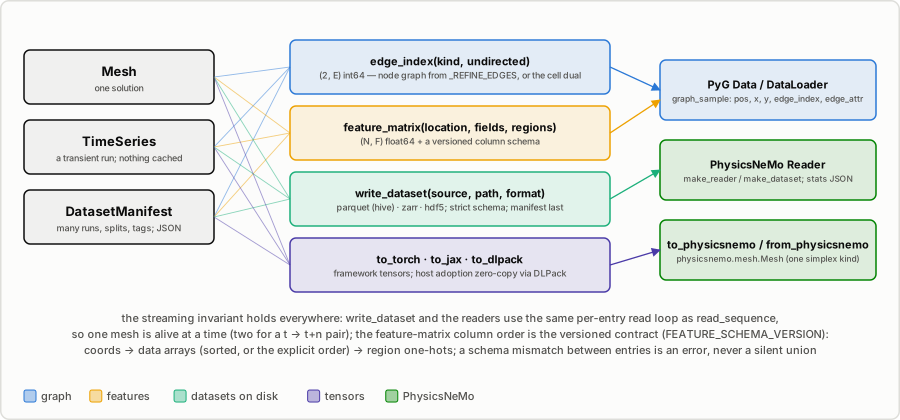
Graphs for GNNs: edge_index
ei = mio.edge_index(mesh)                     # node graph, both directions
ei = mio.edge_index(mesh, undirected=False)   # unique pairs, source < target
ei = mio.edge_index(mesh, kind="cell")        # facet-sharing cell dual
Returns a (2, E) C-contiguous int64 array — rows are source and target indices, exactly what PyTorch Geometric's and DGL's edge_index expect.
kind="node"(default): vertices are mesh points, edges are the unique cell edges — the same edge topologysmoothrelaxes over (the Python twin of the C++detail/node_adjacency.hppEdge kind). Ragged and rectangularpolygonblocks contribute their closed rings (routed by type name — a uniform n-gon block stores rectangularly). Cell types with no known edge topology (the higher-order family, VTK-Lagrange,custom,polyhedron) contribute nothing, with one warning naming them — linearize withconvert_cellsfirst to keep their corners.kind="cell": vertices are cells in the global block-major numbering (the one regions andpartition_labelsuse), edges join cells sharing a facet — faces in 3D, edges in 2D. Ragged/polyhedron blocks raiseNotImplementedError.
undirected=True (default) emits both directions of every edge — the PyG convention for undirected graphs — sorted lexicographically by (source, target), so the output is deterministic and byte-identical across runs.
A graph built from connectivity is the wrong graph for a particle state, which has positions and no cells: there the interaction radius decides what a neighbour is. proximity_graph builds that one — radius or k-nearest-neighbour, with a periodic minimum-image mode — through the same canonicalization, so its output is byte-identical to edge_index's for the same pair set.
import torch
from torch_geometric.data import Data

fm = mio.feature_matrix(mesh, "point")
data = Data(
    x=torch.from_numpy(fm.matrix),
    edge_index=torch.from_numpy(mio.edge_index(mesh)),
)
The feature matrix and its contract: feature_matrix
fm = mio.feature_matrix(mesh, "point")
fm.matrix      # (N, F) float64, C-contiguous
fm.columns     # ('x', 'y', 'z', 'T', 'v_0', 'v_1', 'v_2', 'region:inlet')
fm.schema      # JSON-serializable: version, columns, per-column sources
fm is a FeatureMatrix: a frozen dataclass over exactly those three fields, so it is the whole reproducibility contract rather than a bag of extra state — columns (or the whole schema) is what to record at training time and re-assert at inference time before the model sees a row.
The column order is the whole value. Training and inference silently disagreeing about which column is which is the classic mesh-ML failure mode, so the order is a stated, versioned rule (FEATURE_SCHEMA_VERSION, currently
- and the payload records it:
- coordinates —
x/y/z(as many as the mesh has); point location only;coords=Falseskips them; - data arrays —
fields=Nonemeans every array at that location in sorted-name order; an explicitfields=[...]list is honoured in the given order (and recorded either way). Multi-component arrays expand into the same suffixed columns the pandas export uses (v→v_0/v_1/v_2) — one rule repo-wide; - region one-hots — 0/1 columns
region:<name>for each region of the matching kind, in the deterministicRegion.keyorder;regions=Falseskips them, a list of names selects.
Everything is float64. The cell table's structural columns (block/cell_type/cell) are identifiers, not features, and are never included.
At training time, store fm.schema (it is plain JSON). At inference time:
fm = mio.feature_matrix(new_mesh, "point")
assert list(fm.columns) == trained_schema["columns"], "feature drift"
Derived quantities compose rather than being re-implemented: attach them first, then select them —
mesh = mio.attach_quality(mesh)                       # quality:* cell_data
mesh = mio.gradient(mesh, "T", location="cell")       # T:gradient cell_data
fm = mio.feature_matrix(mesh, "cell", fields=["mat", "quality:skewness"])
A token budget composes the same way: a point-cloud model that wants 4096 tokens gets mio.select_points(mesh, 4096).take(fm.matrix), the budget's rows of the full matrix with the column contract intact — see point-cloud budgets.
Dataset export: write_dataset
manifest = mio.write_dataset("out_*.vtu", "dataset/", location="point")Exports a set of meshes — a glob (natural-numeric ordering), a list of paths, or a multi-step transient file — as one on-disk dataset keyed by mesh_id. Sources go through the sequence machinery, so ordering, time metadata and the streaming invariant (one mesh in memory at a time) are inherited, not re-implemented.
Two rules apply to every layout:
- The schema is strict. The first mesh defines the column names and dtypes; a later mesh that disagrees is a named error, never a silently widened union. A dataset where every row group means the same thing is the entire point.
mesh_idis stable."stem"(default) uses each file's stem (multi-step files append_<step>; duplicates are a named error),"index"uses the zero-padded entry index.
has_zarr() reports whether zarr is installed (pip install meshioplusplus[zarr]), the way to check before requesting format="zarr" below.
Parquet layout (format="parquet", needs [arrow])
dataset/
├── meshioplusplus_dataset.json      # layout version, columns, entries
├── mesh_id=case_0/data.parquet
└── mesh_id=case_1/data.parquet
Hive-partitioned — the layout every Parquet engine discovers natively. Each file is exactly what to_arrow builds (same columns, same meshioplusplus:* schema metadata) plus a mesh_id string column and per-file meshioplusplus:mesh_id / meshioplusplus:time metadata. Read it back with anything:
import pyarrow.dataset as ds
table = ds.dataset("dataset/", partitioning="hive").to_table()

import pandas as pd
df = pd.read_parquet("dataset/")     # mesh_id arrives as a column
The JSON manifest records the layout version, the column order, and one entry per mesh (mesh_id, source path, time, time source, row count). A run that fails partway leaves no manifest — a partial dataset must not look complete.
Chunked Zarr / HDF5 layouts (format="zarr" / format="hdf5")
For datasets too large to hold in memory: one root group, one subgroup per mesh_id, one chunked dataset per column, written streaming.
dataset.zarr/                        # or dataset.h5
├── attrs: meshioplusplus_dataset    # the same manifest, as JSON
├── case_0/
│   ├── x, y, z, T                   # one chunked array per column
│   └── attrs: time, num_rows, cell_types
└── case_1/ …
Not the zarr mesh format, which writes one mesh in PhysicsNeMo's own store layout: this is a training table, one subgroup per mesh, and the two are told apart by a root attribute so neither reader half-reads the other's output.
Zarr needs the [zarr] extra (pip install meshioplusplus[zarr]; both zarr-python 2.x and 3.x work here, though the mesh format's writer needs 3.x); HDF5 rides h5py from the [all] extra. Numeric columns only: the object-dtype cell_type column of a cell table is dropped with a warning — its information is in each group's cell_types attr — which keeps the layout clear of variable-length-string dtype portability problems.
CLI and MCP
meshioplusplus data export-dataset 'out_*.vtu' dataset/ --location cell
meshioplusplus data export-dataset a.vtu b.vtu ds.zarr --format zarr
A sub-verb of the data group (Python CLI only, like data export), and an export_dataset MCP tool with the same sandboxed glob handling as the sequence tool.
PyTorch / JAX tensors: to_torch, to_jax
t = mio.to_torch(mesh)               # torch tensors, host, zero-copy
t = mio.to_torch(mesh, device="cuda")  # + one bus transfer per array
j = mio.to_jax(mesh)                 # jax arrays on JAX's default device
Both return the same DevicePayload the GPU handoff uses — points, per-block connectivity, data dicts, block_bases, regions as index arrays — with every array adopted through DLPack. On the host, to_torch's adoption is genuinely zero-copy (the tensors share memory with the mesh; measured in the tests, not assumed). device= then moves each tensor with .to(device), which per the GPU honesty rule is one bus transfer per array, recorded in the payload's derived list.
to_jax has no device= parameter: placement belongs to JAX (jax.default_device, jax.device_put), and JAX puts adopted arrays on its default device. One JAX-specific note: under JAX's default configuration (jax_enable_x64=False) 64-bit arrays cannot exist, so meshio++'s canonical float64/int64 arrays fall back to jnp.asarray — a copy plus JAX's own 32-bit demotion, counted and warned once. Pass float32=True/int32=True to make the narrowing explicit on the meshio++ side, or enable x64 in JAX.
Packaging: deliberately no [torch] / [jax] extra
The CuPy precedent, applied again: torch's default Linux wheel bundles CUDA at roughly 900 MB, and JAX's accelerator story lives in its own extras (jax[cuda12], …). A meshioplusplus[torch] extra pinning either would surprise far more people than it would help (the same reasoning that keeps Open3D's ~400 MB wheel out of the interop extras). Install the framework directly — pip install torch / pip install jax — and has_torch() / has_jax() answer availability without raising; a missing install raises a named error pointing here.
CI note: like the CuPy device tests, the torch/jax adoption tests importorskip and are not exercised by public CI — the frameworks are too heavy for the runners. The payload construction they share with to_dlpack is fully covered.
From here to PhysicsNeMo
Everything above is per-mesh. For a collection of solution outputs — splits, tags, per-case metadata — the dataset manifests page is next, and the PhysicsNeMo adapter builds directly on this page's contracts: graph_sample composes feature_matrix + edge_index into the MeshGraphNet tensor set, and the manifest replaces the ad-hoc glob in every training script.