
Skin to CAD
A triangle skin — an STL from a scan or a 3-D-printing download, the output of extract_skin or isosurface — is thousands of flat facets nobody can select, dimension or edit in a CAD tool. Reverse engineering it means recovering the surfaces it was made of: planes, cylinders, cones, spheres and tori, then freeform patches, sewn into a solid. meshio++ does the mesh-side half of that work with no CAD kernel in the loop, and the CAD half through an optional OpenCASCADE backend:
segmentgroups the facets into smooth patches bounded by the feature edges, with a curvature test that separates a fillet from its tangent planes;fit_primitivesfits a plane, sphere, cylinder, cone or torus to each patch and reports the residual, refusing any fit outside the tolerance;- the
stepwriter hands the closed skin to CAD as a faceted solid; fit_cad, with OpenCASCADE, turns the fitted patches into analytic CAD faces trimmed by the patch boundaries, and a patch no primitive explains into a freeform B-spline face, sews them into a checked solid and writes STEP a CAD tool can edit, or Kratos CAD JSON for isogeometric analysis; a patch it cannot build comes back faceted.
import meshioplusplus as mp

skin = mp.repair(mp.read("part.stl"))                 # closed and consistently wound
seg = mp.segment(skin, curvature_tolerance=1.0, min_patch_cells=20)
fit, report = mp.fit_primitives(seg, tolerance=2e-3, return_report=True)

fd = fit.field_data
for pid, t, p in zip(fd["fit:patch_id"], fd["fit:patch_type"], fd["fit:patch_params"]):
    if t == 3:                                          # a cylinder: a hole or a boss
        print(f"patch {pid}: radius {p[6]:.3f} along {p[3:6]}")

mp.write("part.step", skin)                            # opens in CAD as a faceted solid
solid, rep = mp.fit_cad(fit, "part_cad.step", return_report=True)  # analytic faces (OpenCASCADE)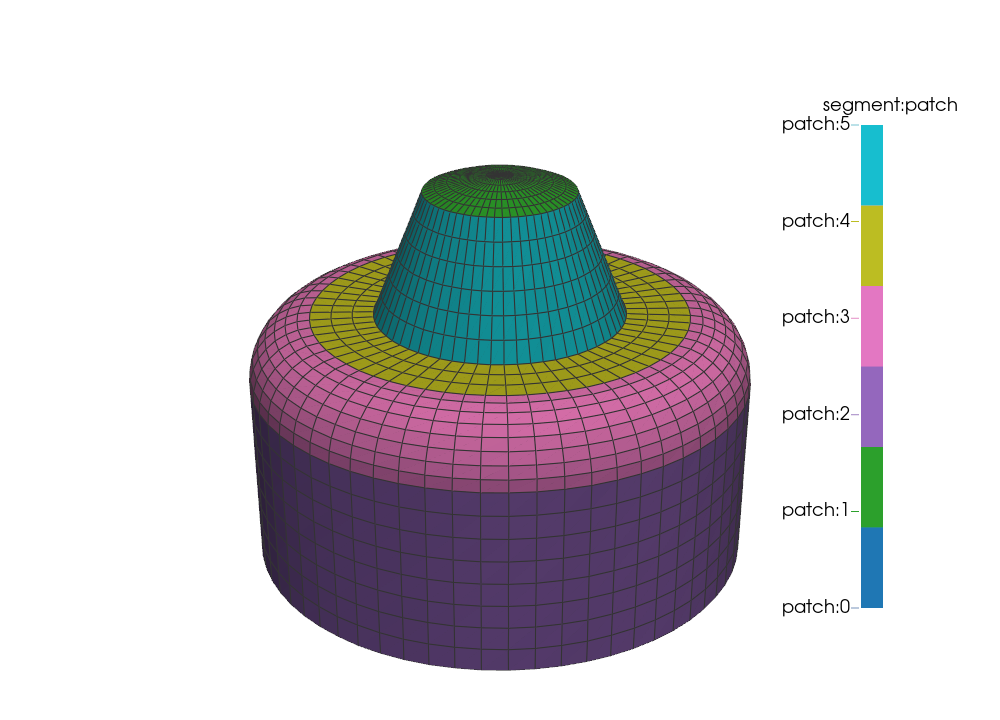
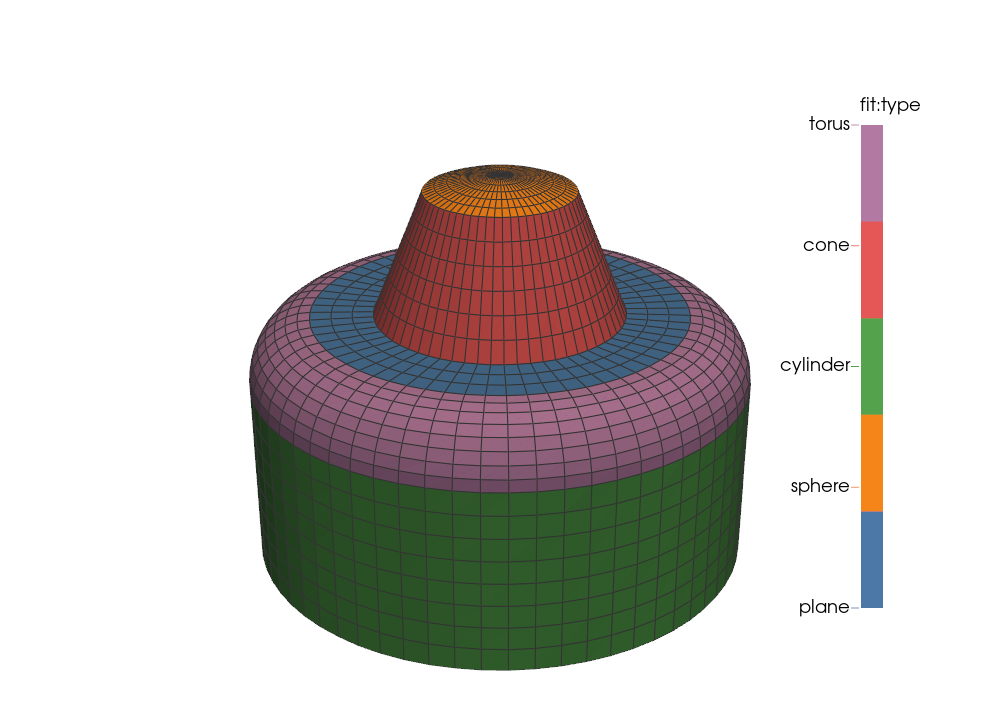
The part above is a turned part tessellated into 2,240 facets with every point moved by up to 1e-3. Its base, shoulder, cone and dome meet their neighbours at creases, but the toroidal fillet is tangent to the wall and to the shoulder: the feature edges alone find four patches, and the curvature test finds the six. Each patch then fits its primitive within 2e-3 of its size — the wall a cylinder of radius 2.0000, the fillet a torus of radii 1.5001 and 0.4998, the cone a half-angle of 21.80 degrees, the dome a sphere of radius 1.5006:
The same chain is a pipeline — [{"Op": "Segment"}, {"Op": "FitPrimitives"}] — and three verbs of both CLIs (segment, fit-primitives, and convert to a .step file); every language surface and the MCP server expose it. Notebook 34 builds that part, segments it, fits it, writes it as STEP and, where the core carries OpenCASCADE, builds its analytic solid.
Analytic faces
With a core built -DMESHIOPLUSPLUS_WITH_OCCT=ON, fit_cad writes the fitted surfaces themselves: on the turned part above, the base and the shoulder become planes, the wall a cylinder, the fillet a torus, the cone a cone and the dome a sphere, six faces in one valid solid within 1e-2 of the skin. Where a fillet meets its wall tangentially the edge between them is a B-spline; elsewhere it is the exact circle where the two surfaces meet. The same chain runs as the pipeline step FitCad and as the to-cad verb of both CLIs, and every surface but WASM exposes it.
Fillets, threads and curled patches
A patch no primitive explains is not given up on: fit_cad tries it as a constant-radius rolling-ball fillet between its two analytic neighbours (a pipe around the spine the two surfaces meet along once each is offset by the radius, so a fillet swept along a curved edge works as well as a straight one), as a straight-flank thread about the axis of a neighbouring cylinder or cone (a ruled helicoid), and otherwise as a freeform B-spline face; a patch no plane or unrolled cylinder parametrises is split into pieces that one does first. See fillets and threads. Variable-radius fillets, blends between freeform faces and rounded thread profiles still come back freeform or faceted. The same backend reads STEP and IGES models as their triangulation and NURBS B-rep. The findings record how the backend was decided.
The reference for the whole pipeline is stl2curves (MIT), a CLI and FreeCAD add-on built on OpenCASCADE; meshio++ read its README only, and no code was taken from it.