
Cell Types
meshio++ uses its own canonical type names. Every format reader maps native element names to these; every writer maps them back.
Node ordering follows the VTK convention where available. The figures below are generated from the code's own topology tables (_convert_cells._ELEVATE for mid-edge nodes, _skin._CELL_FACES and _refine_templates.QUAD_FACES for face and body centres), so they cannot drift from what the readers, writers and operations actually assume; corner nodes are drawn solid, mid-edge nodes blue, face centres orange and the body centre violet. One convention is worth stating: pyramid14 is pyramid13 plus a base-centre node 13, the order every consumer in the core (detail/cell_faces.hpp, the CGNS table) uses; the gmsh reader/writer permutes both pyramid14 and wedge18 (gmsh's own edge-lexicographic types 14 and 13) to and from this convention, derived from gmsh's own edge/face tables and verified geometrically (every mid-edge/face-centre node lands at the exact midpoint/centroid of the corners it should).
0-D
| Type | Nodes |
|---|---|
vertex | 1 |
1-D (line elements)
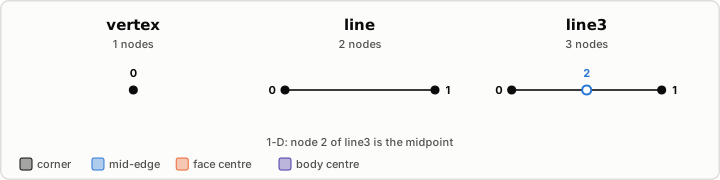
| Type | Nodes | Description |
|---|---|---|
line | 2 | Linear line |
line3 | 3 | Quadratic line |
line4 | 4 | Cubic line |
line5 | 5 | Quartic line |
line6 | 6 | |
line7 | 7 | |
line8 | 8 | |
line9 | 9 | |
line10 | 10 | |
line11 | 11 |
2-D surface elements
Triangles
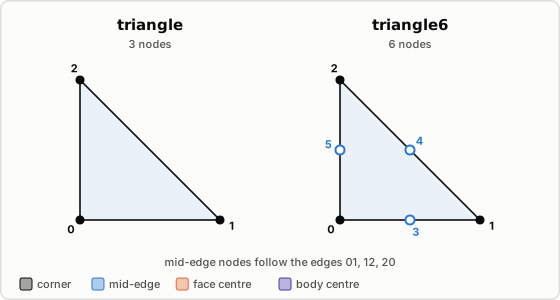
| Type | Nodes |
|---|---|
triangle | 3 |
triangle6 | 6 |
triangle7 | 7 (triangle6 plus a centre node, VTK 34; Code_Aster TRIA7, MED TR7) |
triangle10 | 10 |
triangle15 | 15 |
triangle21 | 21 |
triangle28 | 28 |
triangle36 | 36 |
triangle45 | 45 |
triangle55 | 55 |
triangle66 | 66 |
Quadrilaterals
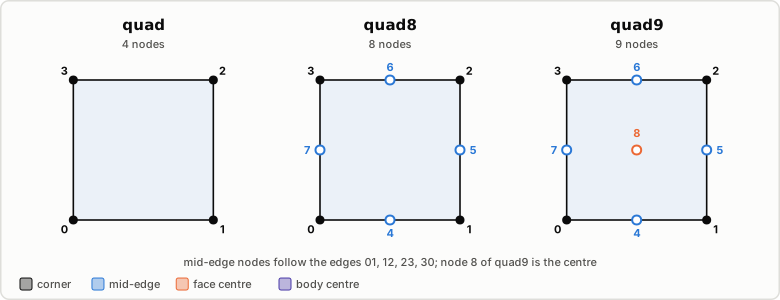
| Type | Nodes |
|---|---|
quad | 4 |
quad8 | 8 |
quad9 | 9 |
quad16 | 16 |
quad25 | 25 |
quad36 | 36 |
quad49 | 49 |
quad64 | 64 |
quad81 | 81 |
quad100 | 100 |
quad121 | 121 |
Arbitrary polygons
| Type | Nodes |
|---|---|
polygon | variable |
For polygon cells, all cells within a CellBlock must have the same number of nodes (the array shape determines this). Multiple CellBlock entries with type polygon but different node counts are permitted.
3-D volume elements
Tetrahedra
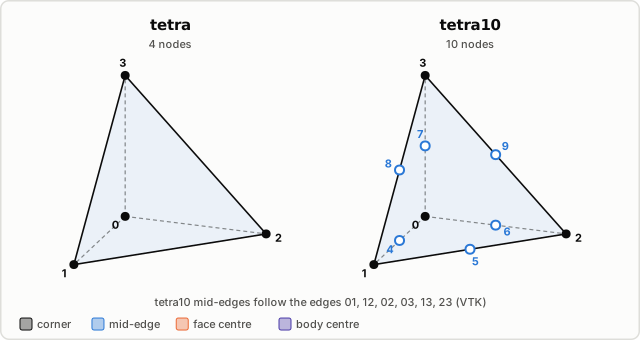
| Type | Nodes |
|---|---|
tetra | 4 |
tetra10 | 10 |
tetra20 | 20 |
tetra35 | 35 |
tetra56 | 56 |
tetra84 | 84 |
tetra120 | 120 |
tetra165 | 165 |
tetra220 | 220 |
tetra286 | 286 |
Hexahedra
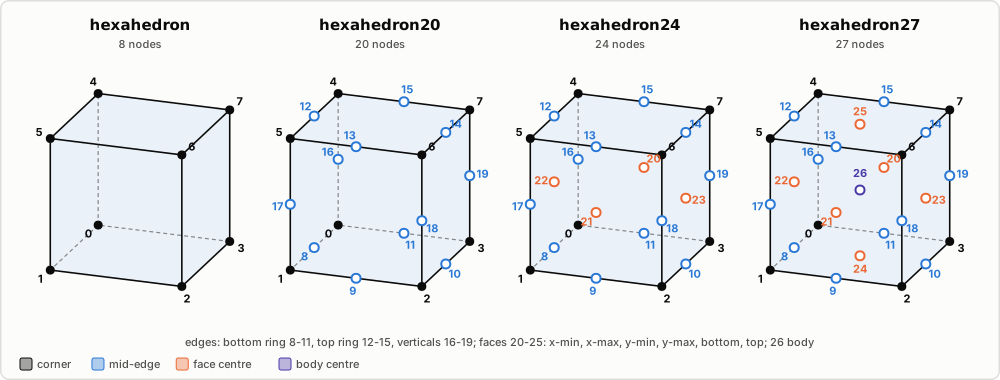
| Type | Nodes |
|---|---|
hexahedron | 8 |
hexahedron20 | 20 |
hexahedron24 | 24 |
hexahedron27 | 27 |
hexahedron64 | 64 |
hexahedron125 | 125 |
hexahedron216 | 216 |
hexahedron343 | 343 |
hexahedron512 | 512 |
hexahedron729 | 729 |
hexahedron1000 | 1000 |
hexahedron1331 | 1331 |
Wedges (prisms)
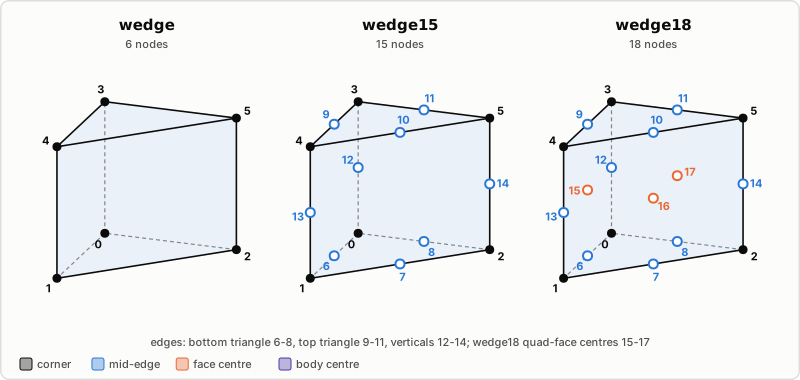
| Type | Nodes |
|---|---|
wedge | 6 |
wedge15 | 15 |
wedge18 | 18 |
wedge40 | 40 |
wedge75 | 75 |
wedge126 | 126 |
wedge196 | 196 |
wedge288 | 288 |
wedge405 | 405 |
wedge550 | 550 |
Pyramids
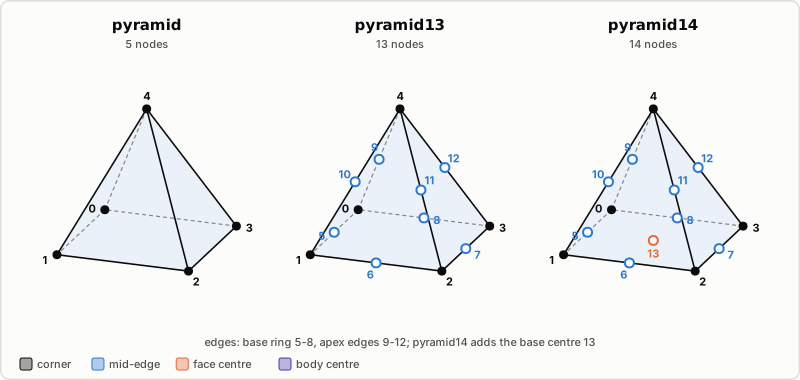
| Type | Nodes |
|---|---|
pyramid | 5 |
pyramid13 | 13 |
pyramid14 | 14 |
Arbitrary polyhedra
| Type | Description |
|---|---|
polyhedron4 | Tetrahedron as polyhedron |
polyhedron5 | Pyramid as polyhedron |
polyhedronnN | N-faced polyhedron |
Polyhedron cells store their face connectivity as a list of lists (ragged), not a rectangular numpy array. The type name encodes the number of faces: polyhedron4 has 4 faces.
VTK Lagrange types
Higher-order VTK Lagrange elements (arbitrary polynomial order, controlled at runtime):
| Type |
|---|
VTK_LAGRANGE_CURVE |
VTK_LAGRANGE_TRIANGLE |
VTK_LAGRANGE_QUADRILATERAL |
VTK_LAGRANGE_TETRAHEDRON |
VTK_LAGRANGE_HEXAHEDRON |
VTK_LAGRANGE_WEDGE |
VTK_LAGRANGE_PYRAMID |
These are read and written by the VTK/VTU readers/writers, and read and written by the MFEM reader and writer for meshes and fields of order 3 and up (v16.11.0; VTK_LAGRANGE_PYRAMID excepted). They are ragged blocks: the node count follows from the order, which is not stored in the type.
VTK Bézier types
VTK's rational Bézier elements (since v16.40.0), the same seven shapes:
| Type |
|---|
VTK_BEZIER_CURVE |
VTK_BEZIER_TRIANGLE |
VTK_BEZIER_QUADRILATERAL |
VTK_BEZIER_TETRAHEDRON |
VTK_BEZIER_HEXAHEDRON |
VTK_BEZIER_WEDGE |
VTK_BEZIER_PYRAMID |
A Bézier cell lists its control points in the node order of the Lagrange cell of the same shape and degree, so it is a ragged block in the same way; but only its corners lie on the geometry, so operations do not treat it as a Lagrange cell, and drawing it (render) goes through its corners. VTK/VTU, VTKHDF and the legacy VTK format read and write them; a VTU's rational weights and per-cell degrees travel as the RationalWeights point data and the HigherOrderDegrees cell data (VTU).