
Merge / combine (merge & weld)
meshioplusplus.merge([mesh_a, mesh_b, ...], ...) combines an ordered list of two or more meshes into a single mesh. It is a mesh operation (like reordering, comparison, surface extraction and quality metrics), not a file format, and uses only standard C++/numpy — no third-party dependencies — so it runs under every mesh backend.
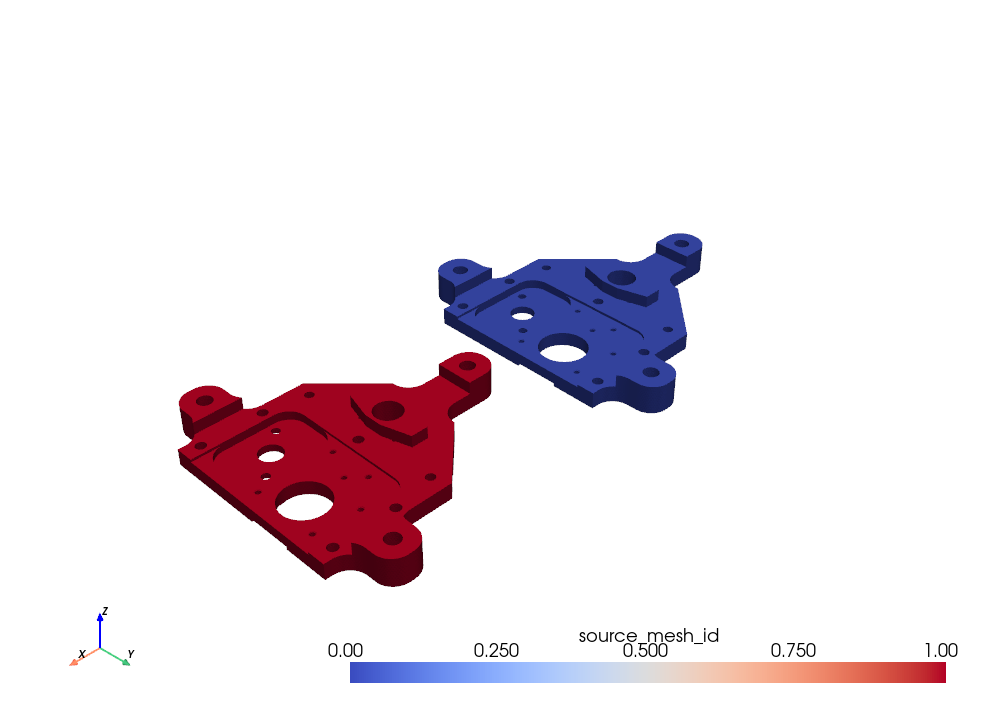
import meshioplusplus

a = meshioplusplus.read("block_a.vtu")
b = meshioplusplus.read("block_b.vtu")

# concatenate (default)
combined = meshioplusplus.merge([a, b])

# weld coincident nodes on the shared interface
welded = meshioplusplus.merge([a, b], weld=True, atol=1e-8)
Concatenate vs. weld
Concatenation (the default) is a pure, O(N) append:
- all points are appended; each input's connectivity is offset by the running point count so indices stay valid;
- cell blocks of the same cell type are merged into one block, in input order;
point_data/cell_dataare combined per the data policy;- a per-cell
source_mesh_idcell_data records each cell's originating input (see provenance).
Welding (weld=True) additionally detects points that are coincident across all inputs within an absolute tolerance and merges them into one, remapping connectivity. Coincidence is found with a spatial-hash bucket grid (coordinates quantized to atol-sized cells, then a 3×3×3 neighbourhood search) — never an O(N²) scan. This is the standard way to stitch adjacent blocks that share an interface into a watertight mesh.
# two adjacent bricks sharing a face -> one mesh, interface nodes fused
mesh = meshioplusplus.merge([left, right], weld=True, atol=1e-9)
Tolerance
atol (default 1e-8) is the absolute coincidence distance: two points are welded when the Euclidean distance between them is <= atol. Points farther apart than atol are kept distinct. Pick atol well below your smallest real feature size and above floating-point/round-trip noise.
Data policy
A point_data / cell_data key present in only some inputs is handled by data_policy:
data_policy | behaviour |
|---|---|
"intersection" (default) | keep only keys present in every input (with matching column count); partial keys are dropped (with a warning) |
"fill" | keep every key; rows contributed by inputs lacking it are filled with NaN (the array is emitted as float64) |
A key present in all inputs is concatenated into one array. When inputs disagree on a key's dtype the result is promoted to float64.
Weld tie-break
When welding fuses points that carry point_data, the surviving point keeps the value of the first contributing point — the earliest input, lowest original index (a fixed, deterministic keep-first rule).
Provenance tag
By default merge attaches an int64 source_mesh_id cell_data whose value is the index (0-based, in input order) of the mesh each output cell came from. Turn it off with source_tag=False (CLI --no-source-tag).
Dropping duplicate cells
With drop_duplicate_cells=True (only meaningful together with weld), cells that become identical after welding — same connectivity as an earlier cell in the same output block — are removed, keeping the first. Useful when overlapping inputs share not just an interface but whole coincident elements.
Sets, regions and field data
Overlapping names from different inputs are namespaced by source id: on a collision the name is prefixed with the input index ("0:boundary", "1:boundary"); a name unique to one input is kept as-is. This applies to point_sets, cell_sets and field_data keys, so nothing is silently overwritten. point_sets / cell_sets live only on the Python Mesh, so they are remapped in the Python layer (using the point/cell index maps the core returns) and are not carried by the C / Fortran / WebAssembly bindings.
What is carried through
Points, cells (rectangular and ragged/polyhedron blocks), point_data, cell_data, field_data, point_sets and cell_sets. mesh.info and gmsh_periodic are not.
CLI
The last positional argument is the output; everything before it is a variadic list of inputs:
meshioplusplus merge a.vtu b.vtu c.vtu out.vtu               # concatenate
meshioplusplus merge a.vtu b.vtu out.vtu --weld --atol 1e-8  # weld coincident nodes
meshioplusplus merge a.vtu b.vtu out.vtu --data-policy fill  # keep partial data (NaN fill)
meshioplusplus merge a.vtu b.vtu out.vtu --no-source-tag     # skip provenance cell_data
Unless --quiet, a short summary is printed (total points/cells in, points welded, points/cells out). See the CLI reference.
Other languages
The operation is exposed across every binding surface:
- C API —
mio_merge(meshes, count, weld, atol, source_tag, data_policy, drop_duplicate_cells)takes an array of mesh handles and returns a new mesh handle (data_policy0= intersection,1= fill; free withmio_mesh_free). See the C API reference. - Fortran —
mio_merge(meshes, weld=..., atol=..., source_tag=..., data_policy=..., drop_duplicate_cells=...)takes an array oftype(mio_mesh)and returns a newtype(mio_mesh). See the Fortran reference. - WebAssembly / JavaScript —
merge([meshA, meshB, ...], weld, atol, sourceTag, dataPolicy, dropDuplicateCells, returnMaps)returns a new mesh object, or{mesh, pointMaps, cellMaps}(one array per input mesh, not per input block) whenreturnMapsis set. See the WebAssembly reference.