
Geometric statistics
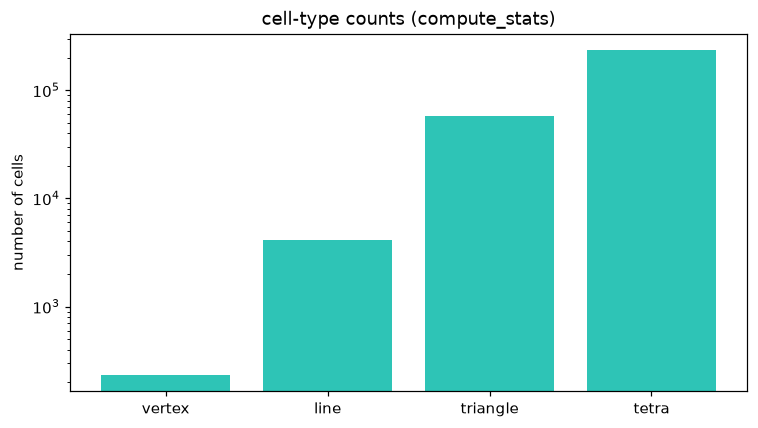
meshioplusplus.compute_stats(mesh) reports geometric statistics of a mesh — the geometric complement to the topological info verb. It computes the bounding box + extents, centroid, per-cell-type counts, total surface area (of 2D cells plus the boundary of 3D cells), total signed & unsigned volume of 3D cells, and the count of inverted (negative signed-volume) cells — without modifying the mesh. It is a mesh operation (like quality metrics), not a file format, and uses only standard C++/numpy, so it runs under every mesh backend.
import meshioplusplus

mesh = meshioplusplus.read("part.vtu")
s = meshioplusplus.compute_stats(mesh)

print(s["bbox_min"], s["bbox_max"], s["extent"])
print(s["centroid"])
print(s["cell_type_counts"])          # {"tetra": 1234, ...}
print(s["total_area"], s["signed_volume"], s["unsigned_volume"])
print(s["num_inverted"])              # cells with negative volume
compute_stats returns a dict with keys num_points, num_cells, bbox_min/bbox_max/extent/centroid (3-tuples), cell_type_counts ({type: count}), total_area, signed_volume, unsigned_volume, and num_inverted.
What is measured
- Bounding box / extent / centroid — over all points (a parallel reduction).
- Per-cell-type counts — the number of cells of each type.
- Total area — the area of 2D cells (triangles, quads) plus the boundary surface area of 3D cells (computed via surface extraction).
- Signed & unsigned volume — of 3D cells (tetra / hex / wedge / pyramid), via the divergence theorem over each cell's outward-wound faces.
signedsums the volumes;unsignedsums their magnitudes. - Inverted cells — 3D cells with negative signed volume (wrong orientation).
Since v9.16.0 the volume comes from the shared polyhedral kernel, so:
polyhedronblocks are measured rather than skipped. Their faces are oriented first (winding is repaired, not required — see Polyhedra), so they never report as inverted; a cell that is not a closed orientable surface is excluded from the totals and warned about.- Ragged
polygonblocks contribute their area, which they previously did not. - A cell with non-planar faces measures slightly differently than before v9.16.0: each face is fanned about its corner average rather than its first node, so the answer no longer depends on where the face's node list happens to start. Planar faces are unaffected.
CLI
meshioplusplus stats mesh.vtu             # human-readable table
meshioplusplus stats mesh.vtu --json      # machine-readable JSON
See the CLI reference.
Other languages
- C API —
mio_stats(mesh, &report)fills amio_stats_reportstruct (the scalar measures; per-cell-type counts are not carried across the flat ABI). See the C API reference. - Fortran —
report = mesh%stats()returns amio_stats_reportderived type. See the Fortran reference. - WebAssembly / JavaScript —
stats(mesh)returns an object withnumPoints,bboxMin/…,cellTypeCounts,totalArea,signedVolume, etc. See the WebAssembly reference.