
Octrees and quadtrees from a skin — octree
octree fills a skin with an adaptive lattice: leaves are small where the skin is and large everywhere else. A surface gives an octree of hexahedron leaves, a planar closed polyline gives a quadtree of quad leaves. It is voxelize's adaptive sibling and, like it, replaces its input's geometry.
import meshioplusplus as mp

skin = mp.read("bunny.stl")
tree = mp.octree(skin, max_level=6)                      # fine only near the surface
solid = mp.octree(skin, max_level=6, fill="inside")      # the interior, adaptively
band = mp.octree(skin, max_level=6, sample_distance=0.05)  # refine within 0.05 of the skin
mp.write("tree.vtu", tree)
A uniform tree (min_level == max_level) is exactly the lattice voxelize builds, so the 3-D voxel grid is the degenerate octree.
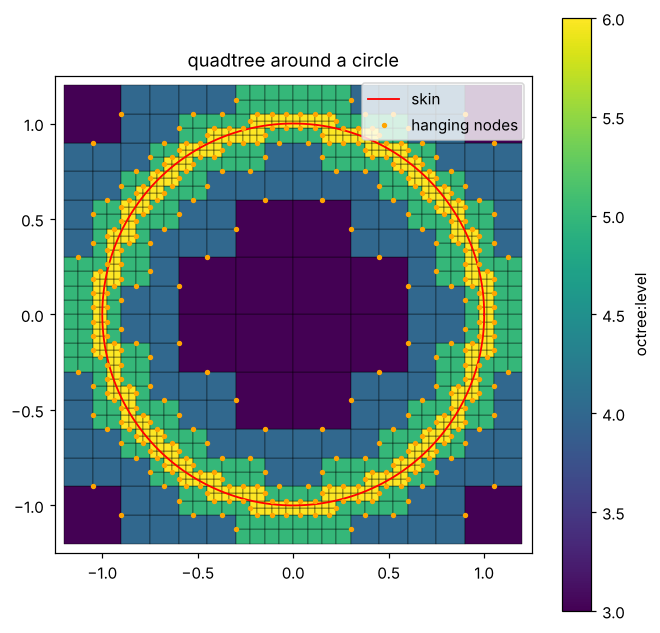
The output is an ordinary mesh
Leaves are one hexahedron block (quad in 2-D), so every writer, viewer and operation already works on them. Three arrays describe the tree:
| array | where | meaning |
|---|---|---|
octree:level | cell_data, Int64 | 0 for a root cell, max_level for the finest leaves |
octree:cut | cell_data, Int64 | 1 when the skin passes through the leaf |
octree:hanging | point_data, Int64 | 1 for a node on the interior of a face or edge of a leaf rather than at its corners |
attach_distance=True adds the signed distance at leaf centres as sdf:distance.
How the tree is built
- Root. The padded bounding box (or
bounds) is covered byroot_cellscubic root cells, one tree each; the default is a single root. The root edge is the largest ofextent / root_cellsover the active axes. - Refinement. A leaf is split while its level is below
max_leveland either the skin cuts it (exact triangle–box overlap in 3-D, segment–box in 2-D) or lies withinsample_distanceof it; every leaf is split down tomin_level. - Balance.
balance="face"(the default) keeps neighbours across faces (edges in 2-D) within one level of each other,"full"also across edges and corners,"none"leaves the tree as refined. Balancing ripples to a fixed point. - Fill.
fillkeepsvoxelize's meaning:"all"leaves, only the leaves the skin"surface"cuts, or only the leaves whose centre is"inside".
Planar skins: the quadtree
A mesh of line cells (a closed polyline) selects the 2-D variant automatically; dimension=2 forces it for a mesh of triangle/quad cells, whose boundary edges become the skin. The skin lies in the plane of its points (z), the leaves are quad cells at that z, and padding applies to the two in-plane axes. fill="inside" uses the winding number of the polyline (even_odd=True selects the even-odd rule for self-overlapping input) and refuses a polyline that does not close, naming its open ends.
Transitions: transition=
Where a fine leaf meets a coarse one there are three outputs.
"hanging"(the default): plain hexahedra (quads in 2-D) with hanging nodes, flagged inoctree:hangingand counted in the report (num_hanging). This is what adaptive-mesh-refinement, lattice-Boltzmann, immersed-boundary and cut-cell solvers and octree learning models consume. A node is flagged relative to the leaves actually kept, so asurfaceorinsidefill does not report nodes that a dropped neighbour would have hung."polyhedra": conforming with no new points. A leaf next to a finer one becomes apolyhedron(apolygonin 2-D) whose faces are split into the fine faces, the split-hex representation snappyHexMesh produces; every other leaf stays ahexahedron/quad. It is readable by every format and finite-volume solver that takes polyhedra (OpenFOAM, Fluent, CGNSNGON_n, EnSightnfaced, VTU). A face with a hanging node on an edge gets that node as an extra vertex, so two leaves sharing a face always see the same polygon."templates": conforming and hex-dominant, for a finite-element code. A leaf with hanging nodes is coned to its centroid: plain quad faces give pyramids, and faces with hanging nodes are fanned from a new face-centre point into tetrahedra (triangles from the centroid in 2-D). New points (face centres, then leaf centroids) are appended after the lattice points; every other leaf stays a hexahedron/quad. Every cell has a positive volume and the volumes add up to the leaves' (the tests check this, and that each interior face is shared by exactly two cells, on random trees and on every neighbour pattern around a cell).
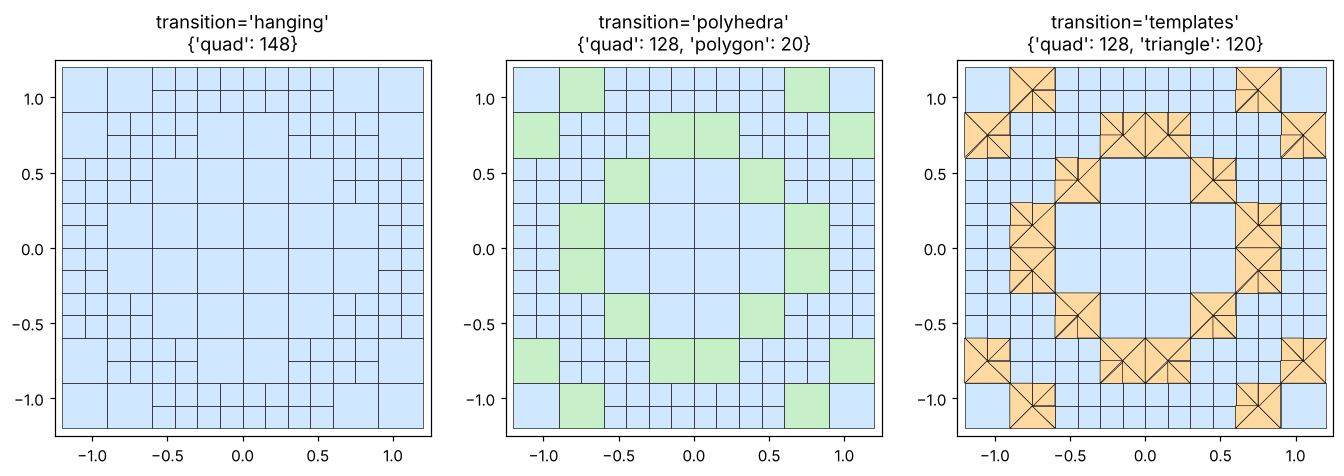
Both conforming outputs need a balanced tree (balance face or full), carry octree:leaf (the leaf, in the hanging output's order, each cell was cut from) beside octree:level/octree:cut and sdf:distance, and have no octree:hanging array (num_hanging is 0). The cells are in blocks (the untouched leaves first, then the transition cells), in leaf order within a block.
Snapping: snap=True
Moves the outer nodes of the kept leaves — the corners of faces with no kept leaf on the other side, except hanging nodes — onto the skin, for a body-fitted rather than stair-stepped boundary. In 3-D it is shrinkwrap's projection; in 2-D the nearest point of the polyline. A leaf is never left inverted: any leaf with a non-positive corner Jacobian gets its moved nodes put back, repeatedly, and the report says how many were moved (num_snapped) and how many were put back (num_refused). It needs fill surface or inside (with all there is no outer boundary). 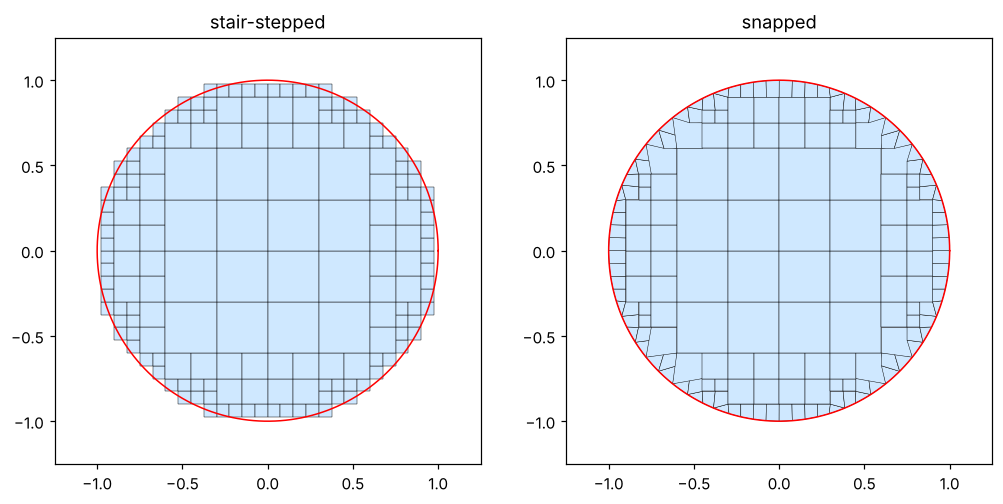
Boundary-layer inflation stays a non-goal.
Refinement criteria
By default every leaf the skin cuts is split down to max_level. surface_level stops cut leaves earlier, and the criteria take them further, up to max_level:
| option | refines where |
|---|---|
sample_distance | the skin is within this distance of the leaf (also pulls in leaves it does not cut) |
curvature_threshold | a triangle has a vertex whose |curvature:mean| exceeds this (3-D) |
feature_angle | a sharp, open or non-manifold feature edge (dihedral above this many degrees) crosses the leaf (3-D) |
size_array | the leaf edge exceeds the smallest value of this point_data array over the skin primitives reaching it |
Planes: plane=
A 2-D skin lies in the plane of zero extent by default (z, then y, then x); plane "xy", "xz" or "yz" chooses it. Leaves are emitted in that plane. The report's origin is in the skin's frame (the two in-plane axes first, the normal last). 2-D voxelize picks the plane the same way automatically.
Determinism
Every point is an integer coordinate on the finest level's lattice (2^max_level per root cell), so shared corners are deduplicated arithmetically, with no hash and no tolerance, and coordinates are origin + spacing * index, never accumulated. Leaves come out in Morton order and points in lattice order, so the result is byte-identical across parallel backends, thread counts and the C++ core and the numpy reference implementation. max_level is at most 20, and root_cells << max_level must stay below 2²¹ on every axis. max_cells (default 20 000 000) refuses a tree with more leaves.
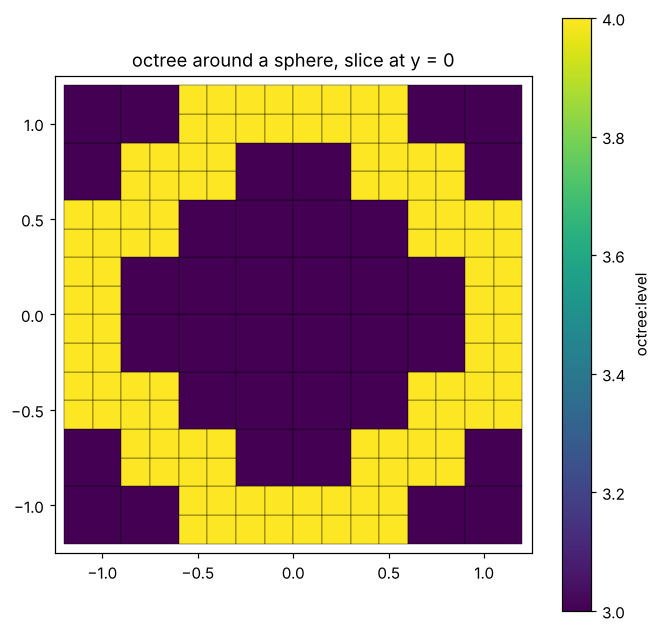
Report
return_report=True returns dimension, origin, root_size, num_leaves, num_hanging, finest_level, num_snapped and num_refused.
Core only
transition other than "hanging", snap, surface_level, curvature_threshold, feature_angle and size_array run in the compiled core; the numpy reference implements the hanging-node octree (and plane in 2-D) and says so by name rather than answering differently.
Bindings
Python mp.octree, C mio_octree, Fortran mesh%octree, Julia octree, R mio_octree, WASM octree, the pipeline step Octree, the CLI verb octree and the MCP tool octree all take the same options; see C API, Fortran, Julia, R, WASM, pipelines, CLI and MCP.