
Split (partition into multiple meshes)
meshioplusplus.split(mesh, by=...) partitions one mesh into several submeshes — by cell type, by connected component, by region (a named cell_sets group, or an integer cell_data tag), or by named Cell regions (by="regions", plural) — each pruned to its own points with connectivity and data remapped. It is a mesh operation (like crop and merge), not a file format, and uses only standard C++/numpy, so it runs under every mesh backend.
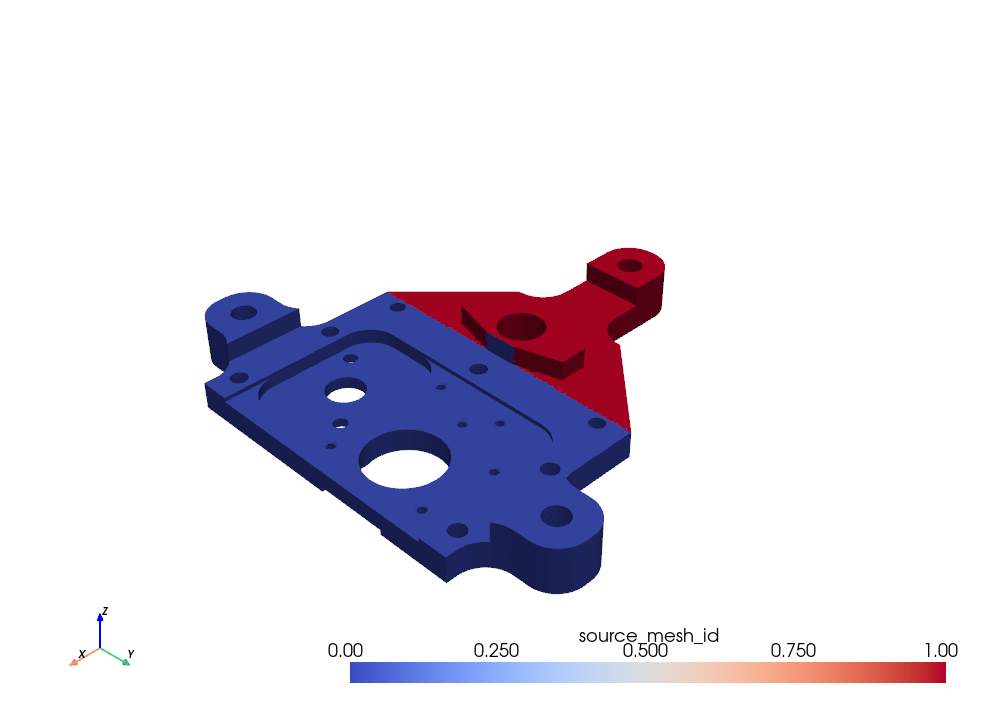
import meshioplusplus

mesh = meshioplusplus.read("mixed.vtu")

pieces = meshioplusplus.split(mesh, by="type")        # {"triangle": ..., "quad": ...}
pieces = meshioplusplus.split(mesh, by="component")   # {"0": ..., "1": ...}
pieces = meshioplusplus.split(mesh, by="region")      # by cell_sets / tag
pieces = meshioplusplus.split(mesh, by="regions")     # one piece per named Cell region

for key, piece in pieces.items():
    meshioplusplus.write(f"part_{key}.vtu", piece)
split returns an ordered dict {key: Mesh}.
Criteria
by | partitions by | keys |
|---|---|---|
"type" | cell type (one piece per type) | the meshio type name ("triangle", …) |
"component" | connected components (flood-fill over node-sharing adjacency) | "0", "1", … |
"region" | named cell_sets if present, else an integer cell_data tag | set name / tag value |
"regions" | named Cell regions (cross-binding — runs in the C++ core, not just the Python shim) | region name |
For by="region", if the mesh carries cell_sets they define the pieces (one per set, keyed by name); otherwise the split falls back to an integer cell_data tag — tag="name" selects it, or the first integer cell_data is auto-detected. Connected components use a union-find over cells sharing a node (never O(N²)).
by="regions" (plural) is the odd one out: it is not a partition. Each named Cell region is processed independently, so a cell belonging to two regions lands in both output pieces, and a cell in no region lands in none. Point/Side regions produce no piece at all — there is no sound default for turning "these facets" or "these points" alone into a whole submesh without first deciding which surrounding cells to pull in, so split does not guess. Unlike by="region", this criterion runs in the C++ core and so reaches every binding uniformly (see Other languages), not just Python; --tag is unused by it. Use meshioplusplus regions first to see what a mesh's regions are before splitting by them.
What changes
Each piece is pruned to only its own points, with connectivity remapped and point_data / cell_data subset to it (field_data carried through). point_sets / cell_sets are remapped into each piece (done in the Python layer). The numpy fallback handles rectangular cell blocks; ragged/polyhedron blocks are handled by the C++ core only.
CLI
meshioplusplus split in.vtu 'out_{key}.vtu' --by type
meshioplusplus split in.vtu 'out_{key}.vtu' --by component
meshioplusplus split in.vtu 'out_{key}.vtu' --by region --tag gmsh:physical
meshioplusplus split in.vtu 'out_{key}.vtu' --by regions
The output pattern must contain {key}, which is replaced by each piece's key. The number of pieces and their sizes are printed. See the CLI reference.
Other languages
The C++ core returns the pieces (the file-writing pattern is a caller concern). by="region" there means the integer cell_data tag (cell_sets are Python-only); by="regions" (plural) means named Cell regions, and reaches every binding below identically, since split's by string is resolved once by the shared split_by_from_name:
- C API —
mio_split(mesh, by, tag_name)returns amio_split_result(mio_split_result_count,..._key,..._mesh/..._take_mesh,..._free). See the C API reference. - Fortran —
mesh%split(by, tag_name=..., keys=...)returns an array of meshes. See the Fortran reference. - WebAssembly / JavaScript —
split(mesh, by, tagName, returnMaps)returns an array of{key, mesh}, each piece also carryingpointMap/cellMapswhenreturnMapsis set. See the WebAssembly reference.