
Provenance
Record where a written file came from, what ran on it, and what conversion assumptions were accepted on the way — as a block a writer renders alongside the one-line credit every writer has emitted since v10.15.0. On by default since v10.17.0: an ordinary write() records the assumptions raised while it ran, with no scope needed.
import meshioplusplus as mp
from meshioplusplus import _provenance

with _provenance.scope(_provenance.Mode.BEST_EFFORT) as s:
    _provenance.set_source("bracket.msh", "gmsh")
    mesh = mp.read("bracket.msh")
    mesh = mp.clean(mesh, weld=True)
    _provenance.add_operation("clean(weld=true)")
    mp.write("bracket.vtu", mesh)
    print(s.get())  # everything recorded, whether or not the file could hold it
<!--
Written by meshio++ v10.19.0
Converted from bracket.msh (gmsh)
Operation: clean(weld=true)
Timestamp: 2026-08-24T15:00:00Z
-->With no scope open a writer still renders any conversion assumptions raised while it ran. The richer fields — source, target, operation chain, timestamp — need a scope or a driver to set them, so a plain write() of a mesh that loses nothing is byte-for-byte what v10.15.0 wrote. This page is the design note doc/roadmap.md section 1 asked for, and the reference for the mechanism itself. Section 1 is now closed in full: v10.15.0 normalized the credit line, v10.16.0 added the record, v10.17.0 added read-back and the remaining language bindings.
The gap this closes, and the one it does not
Section 1's audit-and-normalize bullet (v10.15.0) fixed the drift in the one line every writer already emitted. It said nothing about what a file was converted from, what ran on it, or which of this library's many documented per-format compromises — Side regions with no equivalent, a permuted node order, a 2D point silently padded to 3D — were accepted while writing it. That is the gap this page closes: bullets 2 ("where the record lives"), 3 ("what it contains"), 4 ("the operation chain"), 5 ("determinism and the timestamp"), 6 ("round-trip safety") and 7 ("formats that admit no comment").
v10.17.0 closed the read side too (bullet 8), so §1 is now complete and the section has been removed from the roadmap. See Reading a block back below.
Two decisions the roadmap's own wording left in tension
The roadmap bullets, read together, ask for two things that cannot both hold.
Bullet 3 asks the file to record "which surface actually wrote it (C++ core, numpy fallback, or a named binding)." Bullet 5 requires the C++ core and its Python fallback to emit character-identical bytes — the same invariant that drove the whole v10.15.0 change, since a (C++ core)-vs-v{version} split in the old per-writer strings was exactly what made the fallback boundary visible in output bytes. An engine marker is that same mistake with a different name. This page resolves the tension in favour of byte-identity: which engine ran is a fact about the process, not the mesh, and it costs nothing to report through current_record()/scope.get() instead — see Reading the live record below. Nothing in the file distinguishes the two engines.
The record is on by default (v10.17.0; it shipped opt-in in v10.16.0). What is on is the part that needs no caller cooperation: the conversion assumptions a writer raises while it runs. The fields that require someone to supply them — source, target, operation chain — stay absent without a scope, and no timestamp is added, so a write that loses nothing still reproduces v10.15.0's bytes exactly and every byte-pinned test (test_io_baseline.py, test_tikz.py, test_svg.py, test_gmsh.py, test_mdpa.py) is untouched. Turn it off with MESHIOPLUSPLUS_PROVENANCE=off or set_default_provenance_mode(Off).
Where the record lives
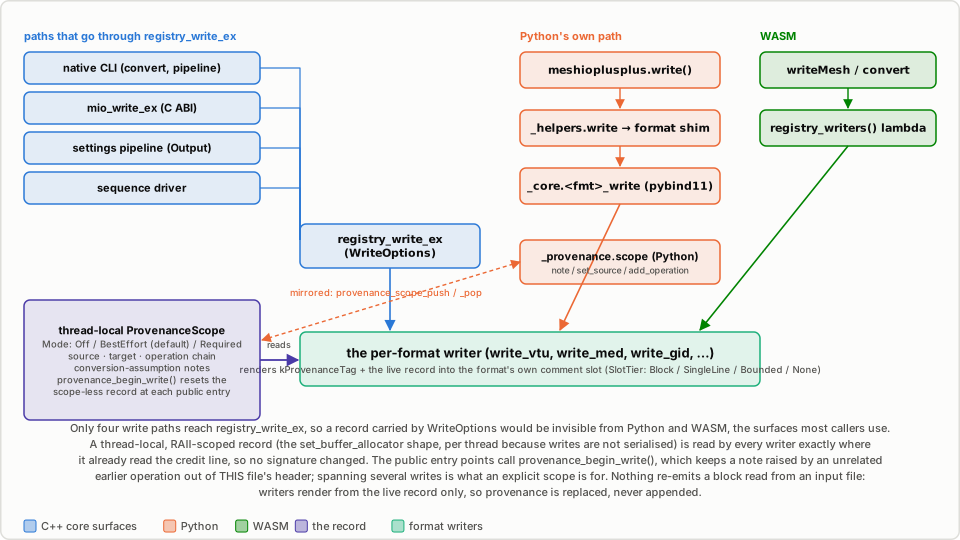
The roadmap names two candidate homes and reconnaissance ruled out the more obvious one.
registry_write_ex — write_options.hpp's documented "single owner of write-this-format-with-these-parameters" — is reached by the native CLI, mio_write_ex, the settings pipeline, the sequence driver, and (since v11.2.0) WASM's writeMesh/convert. Python's own path (_helpers.write → the per-format shim → _core.<fmt>_write → the format's free function) never touches it; neither does plain mio_write, nor WASM's convertSurface/convertSurfaceOps (both fixed-default, no options bag of their own). A record grown onto WriteOptions would therefore still be invisible from Python, the primary user surface most callers actually use. It is also structurally the wrong shape: growing WriteOptions is a Tier A ABI change (it is pinned at 48 bytes in tests/cpp/test_abi_layout.cpp), and the C mirror mio_write_opts only preserves sizeof across an appended field where sizeof(void*) == 8 — the exact hazard the roadmap bullet already flagged.
The record instead lives in a thread-local, RAII-scoped context, the shape meshioplusplus::set_buffer_allocator already established for a similar problem (ndarray.hpp), with one deliberate difference: thread-local, not process-global. Writes are not serialized against each other, so a global record would let one thread's provenance leak into a concurrent write on another. Every writer this page touches reads the active record exactly where it already read kProvenanceTag — inside its own body — so no function signature anywhere had to change to add this.
// C++
meshioplusplus::detail::ProvenanceScope scope(
    meshioplusplus::detail::ProvenanceMode::BestEffort);
meshioplusplus::detail::provenance_set_source(path, format);
meshioplusplus::write_vtu(out_path, mesh, /*binary=*/true, /*zlib=*/true);# Python -- the exact twin
with _provenance.scope(_provenance.Mode.BEST_EFFORT):
_provenance.set_source(path, fmt)
mp.vtu.write(out_path, mesh, binary=True)The Python ↔ C++ bridge
Python's _provenance.scope does not only manage a Python-side stack — when the compiled extension is present, opening it also pushes a matching ProvenanceScope on the C++ side (bindings/python/_core.cpp's provenance_scope_push/_pop), and every note()/set_source()/set_target()/add_operation() call mirrors into both. Without this, a scope opened from Python would be invisible to the ~68 of the 72 writable formats whose write goes through the compiled C++ writer, and the feature would silently do nothing for the surface most callers use. lines() — what the pure-Python fallback writers call to render — reads back through the same bridge, so a Python writer running under a scope agrees with a C++ writer byte for byte: one rendering engine, not two independently-maintained ones. The bridge degrades to a pure-Python thread-local stack when the extension is absent, the same fallback posture every other part of this library takes.
What the record contains
ProvenanceRecord {
    source_path, source_format          -- where the mesh came from, if a single call spans read+write
    target_format, encoding, codec, float_format   -- what was actually used, not what was requested
    operations: [str]                    -- the chain, in order, each rendered "op(key=value, ...)"
    notes: [(category, detail)]          -- conversion assumptions accepted; duplicates collapsed
    timestamp                            -- ISO-8601 UTC, or empty when suppressed
}source_path/source_format and the four target_* fields are set explicitly (provenance_set_source/provenance_set_target) by whichever call spans both the read and the write — the pipeline and sequence drivers do this automatically; a bare read() then write() two calls apart has nothing to set them from unless the caller does so themselves. operations accumulates one entry per step a driver ran. notes is the conversion-assumptions list described next.
Sourcing the operation chain
Reused, not reinvented: the settings pipeline already models a chain as PipelineStep{op, params} objects run in order (operations/pipeline.hpp), so run_pipeline opens nothing itself — a caller wraps the call in a scope — but every step it runs calls provenance_add_operation with the step rendered as Op(Key=value, ...), keys sorted. _pipeline.py, documented elsewhere as a genuinely separate pure-Python engine (not a wrapper over the C++ one), renders the same shape from the same step dictionaries and is pinned to agree with the C++ engine byte for byte for the common bool/int/string parameter cases; a step carrying an unusual float value can render with a different textual form between str() and ostream's default formatting, a known, minor, documented gap rather than a design goal.
The honest limit is the in-memory API path. A caller doing mesh = mp.read(...), then mesh = mp.refine(mesh, ...), then mp.write(...) as three separate calls has given nothing a way to know the three belong together — there is no mesh-carried history the data model holds, and inventing one would mean tracking every mutation of every Mesh regardless of whether anyone asked. The escape hatch is that the scope itself is public API: a caller who wants the chain recorded opens one and calls add_operation themselves around their own steps, exactly as the pipeline driver does internally.
Conversion assumptions
The category of information the roadmap calls out as having "no substitute elsewhere" — node-order permutations, data dropped for want of a target concept, 2D point padding, dtype promotions, ragged-to-tessellated fallbacks — is captured by one call, provenance_note(category, detail) (note(category, detail) in Python), placed beside an existing log::warn/warn() call at the site the assumption is made. It is a no-op outside a scope, so it costs nothing to call unconditionally, and identical (category, detail) pairs collapse — a warning that would otherwise fire once per cell must not produce one record per cell.
Two call sites are wired as the reference pattern for the rest: detail::warn_regions_dropped (detail/region_remap.hpp), the single choke point nine operations already share for "the output cells have no correspondence with the input's," now also records a "regions-dropped" note; and the OFF writer's cell-type-skip warning, wired in both engines with matching wording so the rendered note is character-identical whichever one produced the file (tests/python/test_provenance.py::test_off_writer_records_dropped_cell_types pins this). Extending coverage to the ~60-80 remaining log::warn/warn() sites across the format writers is mechanical from here — the same one-line addition at each site — and is recorded as follow-up work rather than attempted exhaustively in this change; the mechanism, the cross-engine parity guarantee, and the two worked examples are what this page commits to.
Determinism and the timestamp
ProvenanceScope's constructor stamps mTimestamp once, at open, honouring SOURCE_DATE_EPOCH (the reproducible-builds convention — provenance_timestamp()/timestamp() read it directly) so a byte-comparable build can pin an exact instant, and MESHIOPLUSPLUS_PROVENANCE_TIMESTAMP=off suppresses it to an empty string (dropped from the rendered block entirely) when neither reproducibility nor a wall-clock record is wanted. SOURCE_DATE_EPOCH wins when both are set — a caller exporting both wants the pinned epoch, not silence. Host and user are never recorded; these files get shared.
Because the block is opt-in, this needed no exemption anywhere: test_io_baseline.py's pinned hashes, and the C++/Python byte-parity suites for tikz/svg/gmsh/mdpa, all exercise the default (no scope) path, which is unconditionally what v10.15.0 wrote.
How long a note lives
A note has no natural lifetime without a scope, and getting this wrong writes a false statement into a file. Before the bounding below existed, extract_surface(A) dropping a region left its note in place, and the next write() — of an unrelated mesh B — put Note [regions-dropped]: extract_surface: ... into B's header.
So the public write entry points bound it: meshioplusplus.write(), registry_write_ex, mio_write, and WASM's writeMesh/convert/convertSurface/convertSurfaceOps each call provenance_begin_write(), which resets the scope-less record so only notes raised by this write can be rendered. It is a no-op while a scope is open — the caller's scope owns the lifetime then, and spanning more than one write is the whole point of opening one. writeMesh/convert get the reset for free since v11.2.0 (they now go through registry_write_ex itself, see above); convertSurface/convertSurfaceOps still write through the raw registry_writers() lambdas directly (a fixed-default, no-options-bag path), so the reset is called explicitly at the JS binding layer for those, the same way meshioplusplus.write() calls it despite _core.<fmt>_write bypassing registry_write_ex too — without it, a note left by an earlier scope-less operation (or a prior convertSurfaceOps pipeline) silently attached itself to the next unrelated write.
Two consequences worth stating plainly:
- A note raised before the write begins is dropped, not misattributed. That covers the operation-side sites (
warn_regions_droppedand friends). To capture those, open a scope spanning the operations and the write — which is exactly the example at the top of this page. - The low-level C++ writers do not bound notes for themselves. Calling
meshioplusplus::write_vtu(...)directly skips the public path, so notes from earlier work are still in scope-less storage. That is the same contract the rest of that layer has: it is the API where the caller manages state. Go throughregistry_write_ex, or open a scope.
Round-trip safety
No reader in this library retains any slot a provenance-bearing writer uses. The legacy VTK reader discards its title line outright (vtk_read.cpp); Exodus never reads its own title netCDF attribute back; OBJ/OFF/PLY/FLAC3D/MDPA all skip a comment line generically by its marker, never inspecting its content. "Replace, never append" is therefore structural rather than a rule a writer has to remember: every writer renders the block fresh from whatever the live record holds, never by reading and appending to what the input file already carried, so converting a file through N provenance-opted-in steps produces one block, not N.
Slot tiers, and the Mode/Required interaction
doc/formats.md's Provenance table records, per format, the comment syntax admitted and where a header may sit; SlotTier is that same classification made machine-readable, at the granularity a writer's own call site actually has (which can be narrower than what the format's grammar in general allows — Ansys admits a genuine (0 "...") multi-line comment section, for instance, but that writer stays at SingleLine here because populating it with arbitrary rendered text risks corrupting the reader's own paren-balance parsing on a note containing literal parentheses):
| Tier | Meaning | Formats |
|---|---|---|
Block | Arbitrarily many lines | abaqus, ansys*, avsucd, code_aster, elmer (in mesh.names), exodus, febio, flac3d, flux, gltf, lsdyna, mfem, mphtxt, nastran, netgen, obj, off, permas, ply, svg (an XML comment), tetgen, tikz (% lines), triangle, vti, vtp, vtu |
SingleLine | Exactly one line | ansys, femap (block 100's title), tecplot, vtk/vtk42/vtk51, z88 (the end of z88i1.txt's header line) |
Bounded | One line, hard byte cap | ensight, openfoam, patran (the 80-column title card), stl (binary only) |
None | No slot at all | every format doc/formats.md's table marks "—" (mphbin among them: its writer still asks, so Mode::Required fails there) |
* ansys's own comment grammar would support Block; the writer is pinned to SingleLine for the reason in the parenthetical above.
svg and tikz also write one Drawing: … line right after the tag, under every mode including Off: it is the marker their readers require (see SVG), not provenance, so the read-back scanner below does not report it.
Mode::Off (the default) always renders just the tag, at every tier. Mode::BestEffort renders the full block at Block and degrades silently to the tag everywhere else — a SingleLine/Bounded slot cannot structurally hold more, and a None slot cannot hold even the tag (which is why no writer at that tier calls this machinery at all; nothing changed there since v10.15.0). Mode::Required is identical to BestEffort at every tier except None, where it raises WriteError naming the format. This is the resolution of write_options.hpp's standing rule — "an option a format cannot honour is an error, never silently ignored" — that keeps Required from being unusable: degrading to the honest maximum a structurally smaller slot can hold is not a failure to report; having nothing to write at all is.
Reading the live record, mid-write
A scope's Get()/get() returns the live record at any point while it is open — including the one fact this page deliberately keeps out of every file, which engine rendered it:
with _provenance.scope(_provenance.Mode.BEST_EFFORT) as s:
    mp.write("out.vtu", mesh)
    print(s.get())  # Record(source_path=..., operations=[...], notes=[...], ...)
Reading a block back
A file's own block comes back through the ordinary summary call — no second entry point, no second file open:
meta = mp.read_metadata("bracket.vtu")
meta["provenance"]              # ['Written by meshio++ v10.19.0', 'Converted from ...', ...]
meta["provenance_recognised"]   # True when the first line is our own tag format
$ meshioplusplus info --fast bracket.vtu
...
Provenance:
Written by meshio++ v10.19.0
Converted from bracket.msh (gmsh)
Operation: Clean(Weld=true)
Timestamp: 2026-08-24T15:00:00ZOne scanner, not forty-four parsers
The block's content lines are format-independent by construction — only the comment punctuation wrapping them differs — so recovery is a single pass over the file's head bytes rather than a parser per format: strip whatever marker the format uses (#, !, *, $, %, //, PLY's comment , an XML <!--), then keep the lines matching the six shapes the renderer emits. detail::read_provenance_lines lives beside the renderer it inverts, which is what stops the two drifting.
Three wrapping shapes need more than a leading-marker strip, and each earns its place: a keyword slot that wraps the text (Tecplot's TITLE = "…", Ansys's (1 "…")), where the closing punctuation is removed only because that opener put it there — never unconditionally, since Converted from x (fmt) and Operation: Clean(Weld=true) both end in a legitimate ); a box-drawn banner (OpenFOAM), whose credit sits in an interior |-delimited cell rather than at the line's start; and a NUL-padded fixed-width binary slot (STL's 80-byte header, EnSight's str80), handled by treating NUL as a line break so the same line-oriented scan finds it.
Exodus is the one format the scanner does not serve: its block rides a netCDF title attribute rather than the head bytes, so read_exodus_metadata reads it there — it already has the file open for mTimeValues — and hands it to the same scanner, so the two paths cannot disagree about what counts as a block.
Raw lines, not a re-parsed record
Read-back deliberately returns the block's lines as found, plus a recognised flag, rather than re-parsing them into a ProvenanceRecord. A block can have been hand-edited, truncated by a Bounded slot, or written by a later release carrying fields this build has never heard of; handing back what is actually there — and saying separately whether it starts like ours — cannot silently drop or mis-attribute any of those. recognised is false both for a file with no block and for one carrying a comment that merely looks like a header, which is the honest distinction between "meshio++ wrote this" and "something left a comment here".
Never re-emitted
Nothing carries a read block into a write: writers render from the live record only. That is what makes round-trip safety structural rather than a rule each writer must remember — converting a file through N provenance-opted-in steps leaves one block, not N, and the first file's source never leaks into the second.
Language surfaces
| Surface | Entry points |
|---|---|
| C++ | meshioplusplus::detail::ProvenanceScope, provenance_note, provenance_set_source, provenance_set_target, provenance_add_operation, current_provenance() (detail/provenance.hpp) |
| Python | meshioplusplus._provenance.scope, .note, .set_source, .set_target, .add_operation, .current_record() |
| C API | mio_provenance_scope_begin/_end, mio_provenance_note, mio_provenance_set_source, mio_provenance_set_target; read-back via mio_read_metadata_num_provenance_lines/_provenance_line/_provenance_recognised |
| Fortran | mio_provenance_begin/_end, mio_provenance_note, mio_provenance_source, mio_provenance_target, and the MIO_PROVENANCE_* mode constants |
| Julia | provenance(f, mode) (a do-block form; the scope closes even if f throws), provenance_note, provenance_source, provenance_target |
| R | mio_with_provenance(expr, mode) (paired with on.exit), mio_provenance_note, mio_provenance_source, mio_provenance_target |
| WASM | withProvenance(mode, fn) (a callback form; the scope closes even if fn throws), plus provenanceNote/provenanceSetSource/provenanceSetTarget and readProvenance(path) |
A scope cannot cross an ABI boundary as RAII, so every non-C++ surface has to give the begin/end pair a lifetime of its own. Each does it in its own idiom rather than exposing the raw pair: Julia a do-block, R an on.exit-paired wrapper, WASM a callback — all three close the scope even when the body throws, which is the whole reason they exist. Fortran keeps the explicit pair, matching this module's own explicit m%free() convention. The C ABI itself is backed by a thread-local stack of owned scopes on the binding side, the identical shape the Python bridge uses.
What this page does not cover
Instrumenting every conversion-assumption call site. The mechanism and the category vocabulary are settled, and the sites where both engines share a lossy path are wired (OFF, PLY, STL, UNV, CGNS) along with the C++-only ones (MDPA, MED, OpenFOAM). What is not done is a format-by-format sweep of the rest.
Two findings from doing this much are worth carrying into that work. First, most
warn()calls are not conversion assumptions — the majority are reader-side diagnostics or user-error messages, and sweeping them in indiscriminately would fill a block with things that are not assumptions at all. Second, some are simply stale:avsucd's "can only write one cell data array" fires while both engines demonstrably write every array, so wiring it would have recorded a loss that does not happen. Each site needs checking, not translating.tests/python/test_provenance.py::test_engines_record_the_same_notesis the guard for that work: it asserts that wherever both engines write a given mesh, they record the same notes, so a one-sided addition fails at the format that caused it.