
Regular grids — grid and voxelize
grid builds a regular hexahedron lattice from nothing. voxelize builds one around a mesh and, optionally, keeps only the cells its surface passes through or encloses.
import meshioplusplus as mp

background = mp.grid([32, 32, 32])                      # a lattice, from nothing
shell = mp.voxelize(mp.read("bunny.stl"), resolution=[64, 64, 64], fill="surface")
solid = mp.voxelize(mp.read("bunny.stl"), resolution=[64, 64, 64], fill="inside")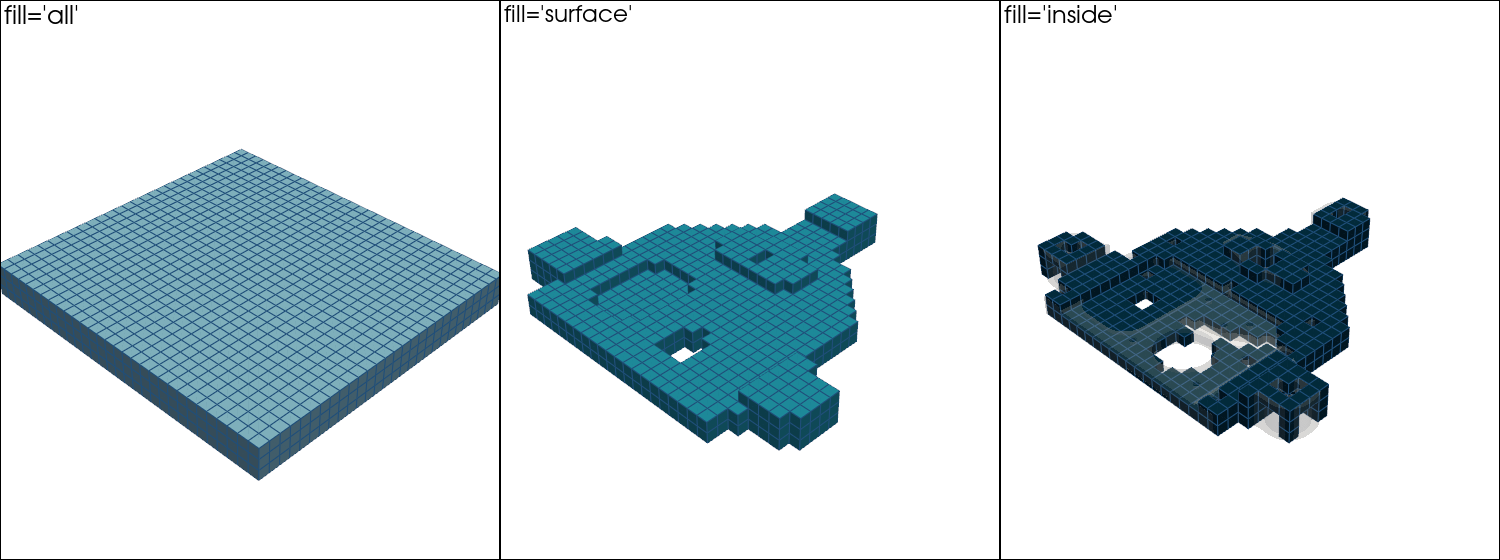
The output is an ordinary mesh, and that is the whole design
A voxel grid here is one hexahedron cell block over a shared corner lattice — not a bespoke object with its own accessors. Once it is a Mesh, everything already works on it:
mp.write("grid.vtu", solid)                             # every writer
mp.write("grid.svg", solid, color_by="sdf:distance")    # colouring
mp.view(solid)                                          # both viewers
mp.crop(solid, bbox=...)                                # every operation
mp.isosurface(field, "sdf:distance", [0.0])             # contouring
None of that needed a line of new code, and none of it would have been available from a dedicated grid type. Two alternatives were considered and rejected:
customcells (for a future adaptive octree).CellType::Customreports −1 nodes and −1 dimension, which makes the block invisible tostats,quality,extract_surface,gradientandrefineand unwritable by most formats — forfeiting exactly the property that motivates the choice.- A new
voxelcell type. VTK's type 11 is deliberately unmapped in this codebase; adding it would mean a row in all 79 format tables to buy an implicit node ordering nothing needs.
Numbering
Points run x fastest, then y, then z, and cells run in the same order:
vid(i, j, k) = (k * (ny + 1) + j) * (nx + 1) + i
cid(i, j, k) = (k *  ny      + j) *  nx      + i
with each cell's eight nodes in the meshio/VTK hexahedron winding. That ordering is inherited, not chosen: it is what this repository's existing C++/Python byte-identity fixtures already agree on, and it is VTK ImageData's own layout, so cell_data reshapes to arr[z, y, x] — the C-order tensor voxel tooling expects.
Two consequences worth stating as contracts:
- Shared corners are deduplicated arithmetically. Neighbouring cells reference the same node because the index formula says so — no hash, no tolerance, no welding pass. Conformity and determinism here are structural.
- Every cell is a right parallelepiped, so
attach_qualityreports a scaled Jacobian of exactly1.0. That is a free correctness check: a transposed axis shows up as an inverted cell rather than as a picture that looks slightly wrong, and the test suite uses it as one.
Fill rules
fill | keeps | needs |
|---|---|---|
all (default) | every cell of the bounding box | nothing — the mesh contributes only its extent |
surface | cells a surface triangle passes through | a surface; works on an open sheet |
inside | cells whose centre is inside the surface | a surface closed enough for the chosen sign |
surface uses exact triangle/box overlap (the separating-axis theorem), not a bounding-box test — a long diagonal triangle overlaps far more boxes than it enters. A triangle lying exactly on a cell face marks both neighbouring cells; picking one side would need a tie-break with no geometric justification, and marking both keeps the occupied set a closed cover of the surface.
A selective fill prunes the points no kept cell references, numbering the survivors in ascending original order.
Sizing
Give exactly one of resolution and cell_size. Defaulting one of them would silently pick a grid you did not choose, and the cost is cubic in that choice:
| grid | cells | points + connectivity |
|---|---|---|
| 128³ | 2.1 M | 0.19 GB |
| 256³ | 16.8 M | 1.48 GB |
| 512³ | 134 M | 11.8 GB |
max_cells (default 20 000 000, a little above 256³) refuses by name above that rather than letting the allocation fail. cell_size covers the box: each axis gets ceil(extent / cell) cells, so the lattice may extend slightly past the requested bounds rather than clipping them.
padding and padding_relative grow the box on every side — the latter as a fraction of the bounding-box diagonal.
CLI
meshioplusplus voxelize bunny.stl shell.vtu --resolution 64,64,64 --fill surface
meshioplusplus voxelize bunny.stl solid.vtu --cell-size 0.5 --fill inside
meshioplusplus voxelize bunny.stl box.vtu   --resolution 32,32,32 --padding-relative 0.1
A negative bound needs the --bounds= form, as everywhere else in the CLI.
Pipeline
{ "Op": "Voxelize", "Resolution": [64, 64, 64], "Fill": "surface" }Unlike every other step this one replaces its input's geometry rather than transforming it, which is exactly what makes it useful in a chain: read a skin, voxelize it, write a grid.
grid as a primitive constructor
Every other operation transforms a mesh you already have; grid is the first that creates one. It takes cell counts, an origin and a spacing, and it is the same lattice voxelize builds:
mp.grid([4, 4, 4], origin=(-1.0, -1.0, -1.0), spacing=(0.5, 0.5, 0.5))A zero cell count on any axis yields an empty mesh — a legal, if useless, request rather than an error.
Determinism
Output is byte-identical across the three mesh backends, across thread counts, and across the C++/numpy boundary (tests/python/test_voxelize.py::test_cpp_matches_python). The lattice is index arithmetic, and the fill rules are a totally ordered search; neither has an ordering question to answer.
See also
- Signed distance — what
fill="inside"uses, and the distance field itself. - Isosurfaces — contour a field on the grid.