
Interfaces and contact
Region adjacency
region_adjacency(mesh, regions=None) returns a mesh containing the conforming facets shared by different selected Cell regions. Facets are matched by their sorted corner-node ids, so this is exact topology matching rather than geometric proximity; separately numbered coincident surfaces do not match.
When regions is omitted or empty, every Cell region is selected in canonical (kind, name, dim, tag) order. If fewer than two Cell regions exist and the mesh has at least two cell blocks, each block is treated as a group in block order. Otherwise, pass an ordered sequence of region names or selector dictionaries such as {"name": "solid", "dim": 3, "tag": 4}; a selector must resolve to exactly one Cell region.
Each matching facet is emitted once for each selected-region pair. A 3-D source cell contributes faces; a 2-D source cell contributes edges. Facets are identified by corner nodes, including for higher-order cells; polygon and polyhedron faces are supported. For a facet used by multiple cells on either side, the parent cell/facet metadata names the first owner in block-major order and interface:shared_count records the number of distinct participating source cells across both sides.
The output keeps the source points, point data, field data and Point regions. Cell data records interface:region_a/interface:region_b (indices into the selected-group order), interface:parent_cell_a/interface:parent_cell_b, interface:parent_facet_a/interface:parent_facet_b, interface:shared_count and interface:measure. The measure is edge length in 2-D and fan-triangulated area in 3-D. Region Cell groups named adjacency:<a>:<b> identify output facets by selected-group index; their entry count and the sum of interface:measure give the shared-facet count and area for that pair. Source Cell and Side regions are not copied because their entity indices refer to the input mesh.
interfaces = meshioplusplus.region_adjacency(mesh, ["part_a", "part_b"])
length_or_area = interfaces.cell_data["interface:measure"][0].sum()
The Python CLI writes the resulting facet mesh and reports the total facet count and measure:
meshioplusplus region-adjacency input.vtu interfaces.vtu --regions part_a part_b --jsonThe operation is also available through the C++/C APIs, Fortran, Julia, R, WebAssembly, the native CLI, the pipeline (RegionAdjacency with a Regions list), and MCP. See the MCP tool and the pipeline schema.
Find an interface
find_interface(mesh, region_a, region_b, *, mesh_b=None, mode="conforming", master="a", gap_tolerance=0.0, angle_tolerance=30.0, overlap_tolerance=0.0, return_report=False) accepts two Cell-region names, Region objects, or selector dictionaries. With mesh_b=None, both parts are selected from one mesh; otherwise B is selected from a second mesh. A selector can pin dim and tag when names are ambiguous, and block:<index> selects a cell block.
In conforming mode, a boundary facet of A matches a boundary facet of B exactly when their corner-node sets agree; separate meshes must therefore already share node ids. In proximity mode, the operation projects each A-facet centroid to B, requires opposing facet normals within angle_tolerance, and accepts a facet only when its centroid and every corner are within gap_tolerance + overlap_tolerance of B. A zero gap_tolerance derives one percent of the mean boundary-edge length. The search runs from the master side (master=), so every master facet with a partner is reported even when the two meshes have different resolutions: with the coarse part as master each coarse facet picks the closest fine facet, and with the fine part as master every fine facet is returned. The closest partner facet wins, with distance then global cell/facet ids as the deterministic tie-break. This is a proximity query, not a mortar overlap or a boolean intersection.
The returned mesh contains the selected master side's facets and interface:parent_cell, interface:parent_facet, interface:partner_cell, interface:partner_facet, interface:gap, and interface:measure cell data. interface:gap is signed along the selected master facet's normal. When return_report=True, the function returns (mesh, report); the report includes num_pairs, area (length for 2-D interfaces), max_gap, unmatched boundary-facet counts, and side_a/side_b Side regions. Each Side region's (global_cell, local_facet) entries refer to its own source mesh and can be passed to split_interface on that mesh. The facet mesh, report and Python CLI are available through Python, C++, the pipeline, and MCP.
interface, report = meshioplusplus.find_interface(
    mesh, "left_part", "right_part", mode="proximity", return_report=True
)
print(report["num_pairs"], report["area"], report["max_gap"])
Contact pairs
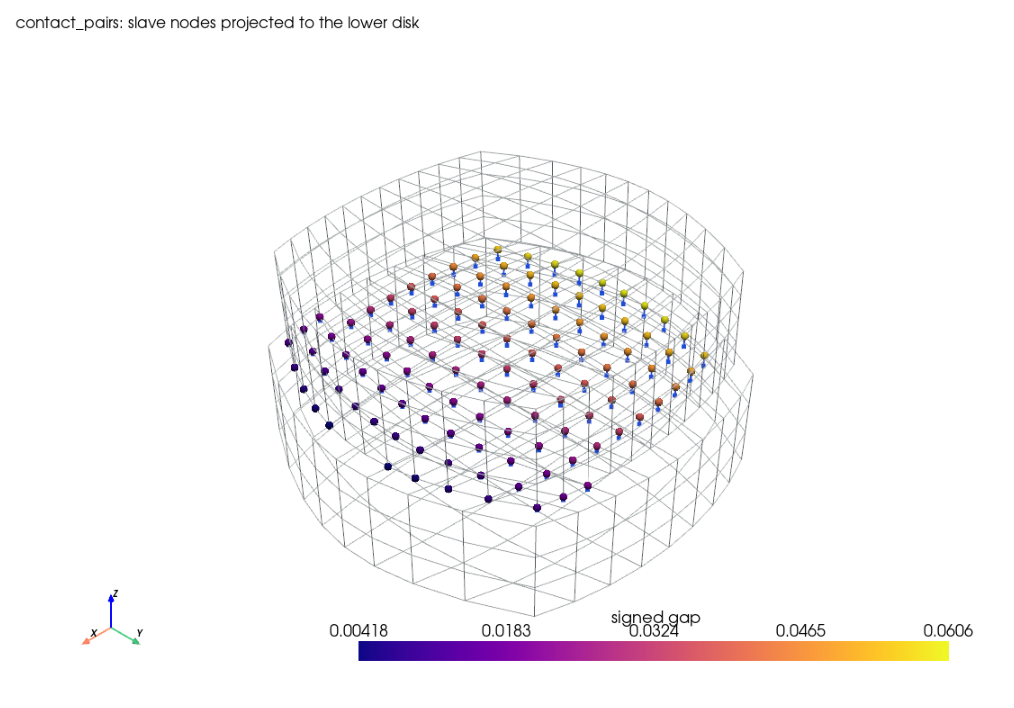
contact_pairs(slave_mesh, slave_points, master_cells, *, master_mesh=None, tolerance=0.0, require_complete=False) projects every point in the named Point region to the closest queryable master facet in the selected Cell region. A 3-D volume region contributes its boundary; a 3-D surface-cell region contributes its cells; a 2-D planar mesh contributes boundary edges. A zero tolerance derives one percent of the master's mean facet-edge length. require_complete=True raises if any slave point has no facet within tolerance.
The result is a dictionary of arrays: slave_point, master_cell, master_facet, master_subfacet, local_coordinates, closest_point, signed gap, unit normal, and unmatched. Triangle coordinates are three barycentric weights; for a polygon triangulated as a fan, master_subfacet is the zero-based fan-triangle ordinal needed to interpret those weights. Edge coordinates use the first two slots as endpoint weights and report subfacet zero. Unmatched rows use -1 ids and zero-valued geometric fields. Equal-distance facets tie by global cell id then local facet id.
Split an interface
split_interface(mesh, side, *, add_cohesive=False, return_report=False) accepts a Side Region or the name/selector of one already on the mesh. It removes selected facets from the node-local cell dual graph, labels the remaining incident-cell fans, and duplicates each point for every additional fan. The component containing the most cells named by the selected Side entries keeps the original point; ties go to the component with the lowest global cell id. Copies are appended in original-point then component order. Point data is copied to each duplicate, Point regions include their duplicate points, and existing cell/field data and regions are retained.
With add_cohesive=True, each selected two-owner edge/face adds a zero-thickness line, wedge, or hexahedron from 2-D edges, triangles, or quads. A 2-D cohesive line's connectivity is trace A; its two trace-B point ids are stored in Int64 cell data cohesive:trace_b with two components. Other newly added cell-data values are zero initialized. Polyhedron inputs are rejected. When the Side region includes both owners of a facet, only one cohesive cell is inserted.
split_mesh, split_report = meshioplusplus.split_interface(
    mesh, report["side_a"], add_cohesive=True, return_report=True
)
Both CLIs provide region-adjacency, find-interface, contact-pairs, and split-interface; find-interface can read B from a second file, while split-interface --side-entries accepts the JSON (cell, facet) rows from its report. The pipeline supports RegionAdjacency, FindInterface, and SplitInterface for one-mesh operations. MCP and the C, Fortran, Julia, R and WebAssembly bindings expose all four operations.