
Crop (bounding box / half-space / data predicate)
meshioplusplus.crop(mesh, ...) extracts part of a mesh — the part inside an axis-aligned bounding box, inside a half-space (a plane, keeping one side), or the cells whose value in one of the mesh's own cell_data arrays satisfies a comparison — pruning the now-unused points and remapping connectivity and all data. It is a mesh operation (like split and merge), not a file format, and uses only standard C++/numpy, so it runs under every mesh backend.
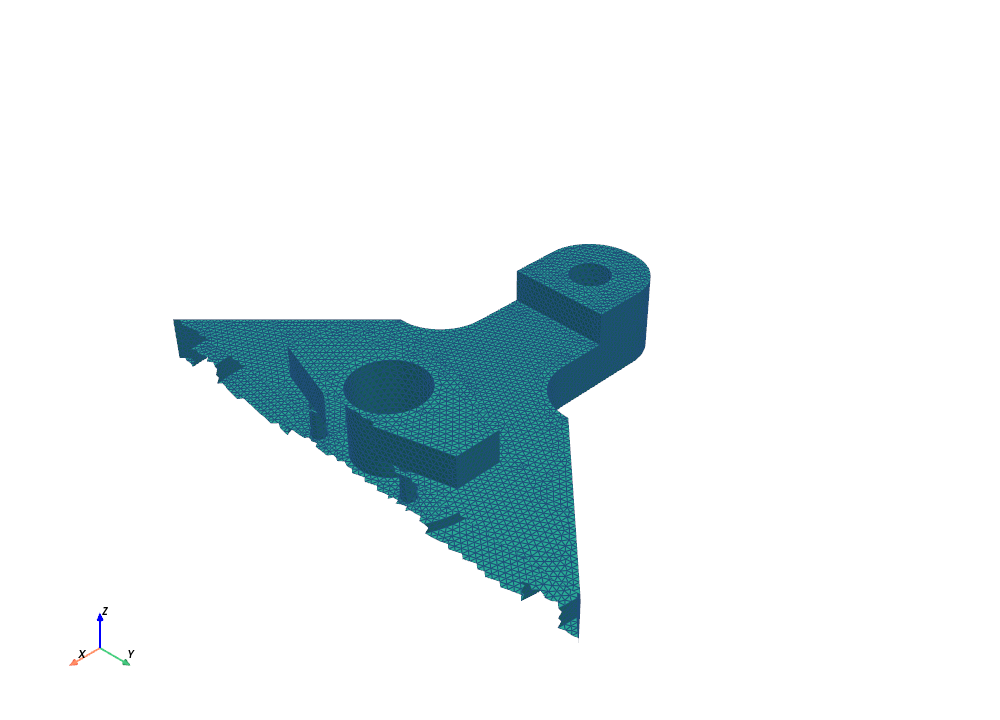
import meshioplusplus

mesh = meshioplusplus.read("domain.vtu")

# axis-aligned bounding box
inside = meshioplusplus.crop(mesh, bbox=[0, 0, 0, 1, 1, 1])

# half-space: keep the side where (p - point) . normal >= 0
half = meshioplusplus.crop(mesh, plane=([0.5, 0, 0], [1, 0, 0]))

# keep a cell if ANY node is inside (default is ALL)
loose = meshioplusplus.crop(mesh, bbox=[0, 0, 0, 1, 1, 1], mode="any")

# a predicate on the mesh's own cell data
bad = meshioplusplus.crop(mesh, where=("quality:scaled_jacobian", "<", 0.3))

meshioplusplus.write("cropped.vtu", inside)
Region and mode

| argument | meaning |
|---|---|
bbox | (xmin, ymin, zmin, xmax, ymax, zmax) or (lo3, hi3) |
plane | (point3, normal3) — keeps the side where (p − point) · normal ≥ 0 |
where | (array_name, comparison, value) — keeps cells whose value in a scalar cell_data array satisfies the comparison, one of <, <=, >, >=, ==, != |
mode | "all" (default) keeps a cell only if every node is inside; "any" keeps it if any node is inside. bbox/plane only — see below |
record_ids | attach crop:original_point_id point_data and crop:original_cell_id cell_data of the source indices |
A point is inside the bbox when lo ≤ p ≤ hi component-wise. The point-inside test is parallelized; exactly one of bbox/plane/where must be given.
The predicate crop
where= is deliberately general rather than inside/outside-a-surface specific. Inside/outside then composes:
f = meshioplusplus.distance_to_surface(mesh, skin, location="center")
inside = meshioplusplus.crop(f, where=("sdf:distance", "<", 0.0))
and the same one mode also crops by quality:*, by a material id, by partition:part, or by anything data calc can produce. A dedicated crop-by-surface would have served exactly one of those.
The comparison is refine's vocabulary, evaluated by the same function, so the two operations cannot drift on the boundary cases. In particular a non-finite cell value never matches, whatever the comparison — including !=, where IEEE says NaN != 1.0 is true. compute_quality deliberately reports NaN where a metric does not apply, and predicating over quality:* on a mixed mesh is the headline use case.
mode does not apply
bbox and plane test points, and then need a rule for reducing a cell's several nodes to one verdict. A cell_data predicate is already one value per cell and has nothing to reduce, so passing mode= alongside where= is an error rather than being silently ignored.
point_data is likewise refused by name rather than averaged onto the cells: data to-cell is the explicit way to move it, and doing it implicitly would make the kept set depend on an averaging rule nobody asked for.
What changes
- Only the kept cells remain; unused points are pruned and connectivity is remapped so it stays valid.
point_data/cell_dataare subset to the kept points/cells;field_datais preserved.point_sets/cell_setsare remapped, dropping entries outside the kept region (done in the Python layer).
The numpy fallback handles rectangular cell blocks; ragged/polyhedron blocks are handled by the C++ core only.
CLI
meshioplusplus crop in.vtu out.vtu --bbox 0,0,0,1,1,1
meshioplusplus crop in.vtu out.vtu --plane 0.5,0,0,1,0,0 --mode any
meshioplusplus crop in.vtu out.vtu --bbox 0,0,0,1,1,1 --record-ids
meshioplusplus crop field.vtu inside.vtu --where "sdf:distance < 0"
--where takes NAME OP VALUE as one argument, scanned longest-operator-first so <= is not read as < plus a stray =. Array names routinely contain a colon (sdf:distance, quality:scaled_jacobian) and never an operator, so the split is unambiguous.
Values that begin with - (e.g. a negative bbox corner) need the --bbox=-1,-1,-1,1,1,1 form so argparse doesn't read them as a flag. See the CLI reference.
Other languages
- C API —
mio_crop_bbox(mesh, lo, hi, mode, record_ids),mio_crop_plane(mesh, point, normal, mode, record_ids)(mode: 0 = all, 1 = any) andmio_crop_predicate(mesh, array, compare, value, record_ids)(compare: amio_refine_compare). See the C API reference. - Fortran —
mesh%crop_bbox(lo, hi, mode=...),mesh%crop_plane(point, normal, mode=...)andmesh%crop_predicate(array, compare=, value=). See the Fortran reference. - Julia —
crop_bbox,crop_planeandcrop_predicate(m, array; compare, value). See the Julia reference. - R —
mio_crop_bbox,mio_crop_planeandmio_crop_predicate(mesh, array, compare, value). See the R reference. - WebAssembly / JavaScript —
cropBbox(mesh, lo, hi, mode, recordIds, returnMaps),cropPlane(mesh, point, normal, mode, recordIds, returnMaps)andcropPredicate(mesh, array, compare, value, recordIds, returnMaps), each returning the bare mesh or{mesh, pointMap, cellMaps}whenreturnMapsis set. See the WebAssembly reference. - Pipeline — the
Cropstep takesWhere/Compare/Valuealongside its existingBboxandPoint+Normal. See the pipeline reference.