
meshio++ roadmap
Status at time of writing: v16.11.0 — 72 core formats plus four Python-only physics-ML ones, thirty-nine mesh operations + six data operations, six language surfaces (Python / C / Fortran / Julia / R / WASM), two viewers plus a browser dataset manager, a Blender add-on, a ParaView plugin, an MCP server, a settings-driven pipeline engine, a dataset-manifest layer with a PhysicsNeMo adapter, and a versioned ABI (MESHIOPLUSPLUS_ABI_VERSION 16).
This document lists what is not built. Nothing here duplicates shipped functionality; where a feature partially exists, the shipped half is named and the gap is stated explicitly. Release history lives in CHANGELOG.md, not here.
Effort key: S = days, M = a couple of weeks, L = a month or more, XL = a project in its own right. An item names a probe — the failing test that proves the gap — wherever one is cheap.
How this file works
- Sections are ordered, and the order is the recommendation. Each section states what belongs in it; an item that sounds exciting does not move up for that reason. An empty section is removed, not kept as a placeholder.
- A closed item is removed, not struck through. Its history is the
CHANGELOG.mdentry and the feature's owndoc/page; a partly closed item is narrowed to what remains (theAGENTS.mdchange checklist rule). - Defect-shaped items go in a Correctness debts section at the top, regardless of size — behaviour that loses data, mis-orients cells, does not terminate on valid input or fails silently is not a feature request, even when the fix and the feature are the same work. None is open today, so there is no such section; the first defect found opens one as §1 and renumbers the rest.
- An item estimated from a doc, a
.d.tsor a changelog alone says so ("verify first") and names its probe; the code has repeatedly been more or less capable than its description. - Non-goals record decisions already taken, with their reasons, so they are not re-proposed as gaps.
The map
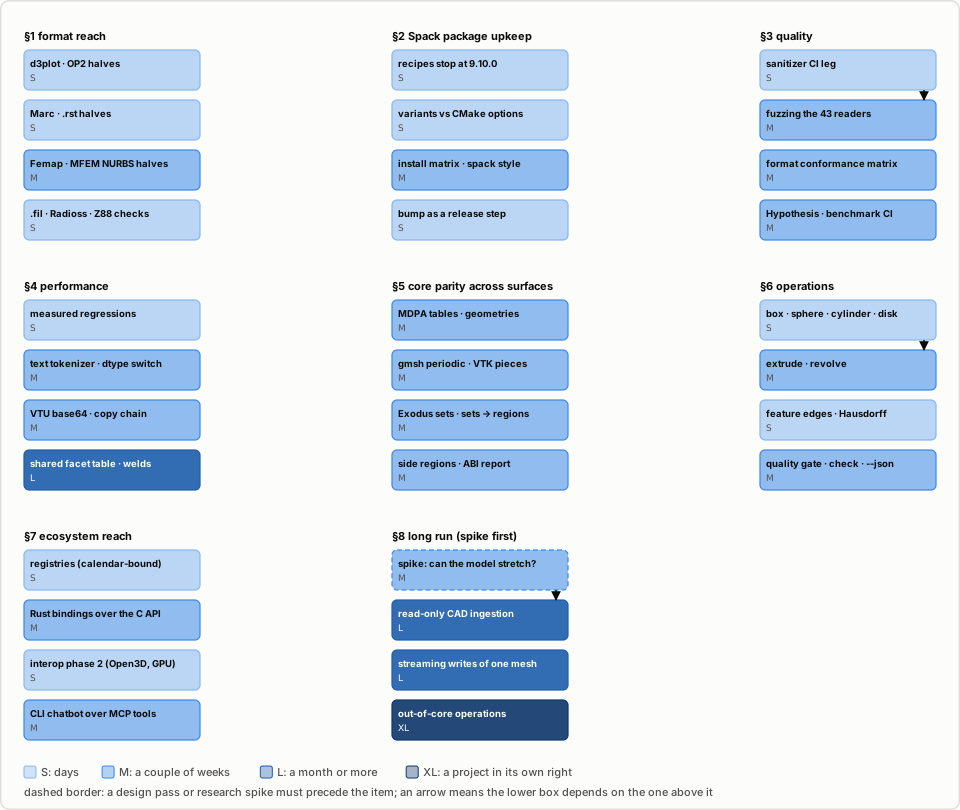
1. Format reach
Admission: a format a simulation or physics-ML workflow actually exchanges, or the missing half of a shipped one. "Exchanges" means a file that crosses a tool boundary in a real pipeline (mesher → solver, solver → post-processor, solver → training set), not a format that merely exists. Every item names the consumer on the other side of the file.
Sizes: S ≈ days, M ≈ two weeks, L ≈ a month or more, including tests, docs page and CLI wiring. Sizes assume the shared infrastructure in §1.8 exists; the first format that needs a component pays for it.
Link legend: unmarked links were opened or returned by a search while this section was written (September 2026); links marked † are quoted from memory and must be checked before relying on them. Vendor documentation portals move often — when a link is dead, search the document title.
A. FEM interchange, solver inputs and result files — native implementations
Python meshio covers none of §1.1–§1.5; these are greenfield. Cross-validation partners are named in each block.
1.1 Tecplot against preplot — S
v16.11.0 reads and writes polygonal and polyhedral zones (Tecplot) and closed Elmer's halo layer and .xplt edge variables. What is left: every .plt fixture, the polyhedral ones included, is written by TecIO rather than by Tecplot's own preplot (no licence was available). Probe: a preplot-converted FE and polyhedral file reading identically to its ASCII source.
1.2 Femap and MFEM, remaining halves — S–M
v16.11.0 writes Femap output sets, reads Femap 2401's property records, checks Patran against real P3/PATRAN and CUBIT exports, and reads MFEM meshes of any order, non-conforming meshes and parallel runs (Patran, Femap, MFEM). What was left out:
- Femap, newer element and group records. The Femap 2401 files found hold no elements, so element (404) and group (408) records from Femap 10 and from 12 on are still unverified; the 13-node pyramid (topology 19) has no documented slot layout; a written file has not been imported into Femap. Probe: a brick20 model exported by two Femap versions reading identically. S
- MFEM NURBS meshes.
MFEM NURBS meshfiles are refused: each patch would be evaluated per knot span to VTK Lagrange cells of the NURBS order, with rational basis functions and the patches' global control points. Parallel non-conforming meshes, grid functions on non-conforming meshes (their space-filling-curve numbering) and Bernstein or serendipity high-order spaces (read at the vertices) are still out. M - Patran, other exporters and the rest of the file. No ANSA or HyperMesh export has been read; loads and boundary conditions (packets 06–08, 10) and the
.nod/.els/.disresult files stay out until a consumer asks. S
1.3 Abaqus .fil, Radioss, Z88 and libMesh, remaining halves — S
v16.11.0 writes libMesh and reads its compressed files and edge and shell-face sets, reads and writes the whole Z88 deck with every element family's results and Z88Aurora's sets, and applies Radioss units, resolves its boxes, generators and surfaces and reads its animation files (Abaqus .fil, Radioss, Z88, libMesh). What was left out:
- Abaqus
.filagainst a real binary run. Eleven real ASCII files (pybaqus's tests and example) read, but no public binary.filwith a matching.datprintout exists. The original done-when, a Standard static case whoseUand von Mises fromSmatch the.dat, still needs one (ideally with shells and C3D20R). Explicit-only records, contact (15xx), modal and element-matrix records stay out until a consumer asks. S - Radioss, old decks and the rest. Decks in the 4.x fixed formats (input versions 41 and 44) from real tools have not been seen; boxes in a skew system, per-card unit systems (
/UNIT),/SURF/BOX,/PLANEand/ELLIPS, the engine deck, theT01time history and animation files of older layouts (other magic numbers) are not read. S - Z88, unrun element types. The layered shells 21 and 22 have not been run through Z88R, and a flat deck of 8-node shells (type 23) fails Z88R's own Jacobian check for reasons not found; the 16-node plate (type 19, read as corner quads) cannot be written back; surface loads (
z88i5.txt) are neither read nor written, and Z88Aurora's sets are not written. S - libMesh, refinement trees and native compression. The writer writes a refined mesh flat, as its active cells; bzip2 files and compressed output go through Python only (the native reader inflates gzip). S
1.4 Marc and Ansys .rst, remaining halves — S each
v16.8.0 reads Marc input decks and formatted post files (Marc) and completes the .rst reader with element results, reaction forces, distributed solves and the full rotor of static cyclic models (Ansys results). What was left out:
- Marc against a real run, and the rest of the deck. No Marc licence was available: the deck reader is checked on real Marc Mentat 2020 decks (DAMASK's element library, AGPL, not committed) and the post-file reader on one real
.t19. Edge and face sets (elem:facemembers),INCLUDEfiles, the Herrmann, interface, gasket and rebar element types and the 15-node pentahedron (whose element number was not confirmed) are not read; remeshing increments and post files before revision 9 are refused; the binary.t16stays on the PyPost route (§1.7). S .rstcompressed records./FCOMP,RST,1and higher are refused:detail/zlib_inflateexists, the record framing around the stream needs a sample. S- Modal cyclic expansion.
ansys_rst_cyclicexpands static analyses; a modal one needs each mode combined with its pair (or the duplicate sector) by harmonic index, as pymapdl-reader'sCyclicResultdoes. Probe: pymapdl-reader's academic rotor, whose full-rotor mode shapes meshio++ cannot produce today. S - Other element records (energies
ENG, fluxes and gradientsEFX/EGR, nonlinear dataENL, contactECT) as consumers ask.
1.5 LS-DYNA d3plot and Nastran OP2, remaining halves — S–M each
v16.9.0 reads the d3plot family and OP2 files (LS-DYNA d3plot, Nastran OP2). What was left out:
- d3plot against LS-DYNA itself. No LS-DYNA licence was available: the reader is checked on lasso-python's real test families and on families lasso-python's writer produced. No real file with element deletion events, rigid bodies, rigid roads, SPH or airbags has been read — those blocks are sized from the manual and lasso-python and skipped, not read — and it is unknown whether LS-DYNA writes the ten-node solids' extra nodes once (the 2006 manual) or twice (lasso-python). Probe: a public crash model's family that deletes elements, read against LS-PrePost. S
- d3plot, the rest. Adaptive remeshing (
NADAPT, a geometry per adaptive state; each state would carry its own mesh through the sequence engine), the 20/27-node and cubic solids, SPH and airbag particles as point clouds, rigid-body motion, and thed3part,d3thdtandbinout(LSDA) siblings; femzip needs its closed library and stays out. M - OP2, other tables. Complex (frequency response, complex modes), random and SORT2 tables; element forces
OEF, strain energiesONRGY; springs and NX's newer solid types (300–303);PARAM,POST,-2files, which are read only by extension (no header to sniff). A file with neither GEOM1 nor a sibling deck could take its points fromBGPDT/EQEXIN. S–M
B. Formats that need a vendor runtime or a heavy optional dependency
1.6 DOLFINx ADIOS2 .bp (read; optional ADIOS2 build) — M
VTXWriter output: an ADIOS2 BP4/BP5 directory with a vtk.xml schema attribute and step-wise geometry, connectivity, types, NumberOfNodes, NumberOfEntities plus field variables. ADIOS2 is a heavy dependency for one consumer, so this is an opt-in build flag, never a default. adios4dolfinx checkpoints and Fides output are different layouts — out of scope.
- Done when. A DOLFINx demo's
.bpreads as a sequence matching ParaView's VTX reader. - References. DOLFINx † · ADIOS2 documentation † · VTK ADIOS2 module (VTX schema reader) · VTX reader changes in VTK 9.4 · adios4dolfinx †
1.7 Vendor-runtime routes (exporter scripts and optional plugins, no native parser) — M in total
For these, the deliverable is a documented, tested route — a script that runs inside the vendor's own Python and writes VTKHDF/XDMF, or a plugin compiled against an SDK the user already owns. meshio++ never redistributes vendor libraries.
- Abaqus
.odb. No public specification; readable only through the ODB API on a licensed install, version-locked (abaqus upgrade -odb). Ship anabaqus pythonexporter script (instances → regions, steps/frames → sequence, field outputs by position) and document it; an optional C++ plugin against the ODB API comes only if a user asks. Where no licence is available, the.filresults file (Abaqus.fil, v16.7.0) is the fallback. — ODB2VTK (reference exporter) · abqpy † - MSC Marc
.t16. Read through PyPost (py_post), shipped with Marc/Mentat. Ship an exporter script; the formatted.t19is read natively (Marc, v16.8.0). - Femap
.modfem. COM API on Windows only. The route is "export a neutral file", which meshio++ reads (Femap). - Tecplot
.szplt. Undocumented; TecIO only. Optional link against a user-installed TecIO, or "re-save as.plt", which is read natively (Tecplot, v16.10.0). — TecIO † - ANSYS results beyond the native reader (§1.4). Document the PyDPF export route.
- Done when. Each route has a docs page, a script under
contrib/, and one manual test recorded with the vendor version used.
1.8 Shared infrastructure worth building once
- Fixed-width card tokenizer, remaining adoption.
detail/keyword_card.hpp(v15.2.0, built for LS-DYNA) splits a card into standard, long, I10 and free layouts per line, parses real fields with Fortran spellings and, since v16.3.0, parses a Fortran format line such as(3i9,6e21.13e3)into the fieldssplit_fixedcuts (the ANSYS.cdbreader's). The Nastran/OptiStruct (v16.1.0) and Patran (v16.5.0) readers use it too, and the Radioss (v16.7.0) and Marc (v16.8.0) readers its field converters (their column widths follow the deck: Radioss's input version, Marc'sEXTENDED); UNV should adopt it instead of growing its own (the.frdreader of v15.3.0 slices its own columns: the layout is fixed by the record key, not by a format line). - Node-ordering permutation registry, remaining half.
detail/node_order.hppand_node_order.py(v16.0.0, built for Code_Aster.mail) hold the MED, Code_Aster,.frd, UNV, COMSOL, Elmer, FEBio, FLUX, Patran, libMesh, Radioss and Z88 tables in both directions, with a self-test that maps a reference element through every table and checks midpoints and a positive Jacobian (node ordering). What remains: the gmsh, CGNS, GiD, Exodus and Kratos tables still live inside their readers and should move in when those formats are next touched (Marc, v16.8.0, needs no entry: every Marc element type read is in meshio++'s node order; ANSYS's degenerate shapes and Femap's 20-slot brick layout are slot maps, not permutations, and live in their readers; MFEM needs none, since its order-2 nodes are placed by the entity they sit on). - Fortran unformatted-record reader, remaining adoption.
detail/fortran_records.hpp(v16.7.0, built for Abaqus.fil) sniffs 4/8-byte markers in either byte order and splits a file into its records, anddetail/binary_stream.hppreads values in a chosen byte order (libMesh.xdr). The OP2 reader (v16.9.0) builds on it, and the Python twins share_fortran_records.py; EnSight Fortran binary should too. The ANSYS.rstreader addresses records by pointer and keeps its own view, andd3plot(v16.9.0) is word-addressed, not record-framed. - Directory-as-format support, remaining half. Reading sniffs a directory by its files since v16.2.0 (Elmer, OpenFOAM). What remains: sequence globs keep only suffixed directories (
.pmsh,.zarr), so an Elmer directory must be listed explicitly, and ADIOS2.bp(§1.6) will need its own rule. - Optional-plugin mechanism and a
contrib/script convention — §1.6, §1.7.
1.9 Suggested order
- Next FEM wave: §1.1, §1.2, §1.3, §1.4 and §1.5 as Tecplot, Femap, MFEM, Patran, Abaqus, Radioss, Z88, libMesh, Marc and Ansys users ask (the
.filcheck against a real binary Abaqus run first, and a real Marc run, as soon as one is in hand; MFEM NURBS when an isogeometric user asks). - Heavy binaries, on demand: the rest of §1.5 when a d3plot or OP2 user brings a file.
- Routes: §1.7 scripts as users ask; §1.6 when a FEniCSx user asks.
Considered, not queued
- Graphics, CAD, VFX or lab-specific rather than simulation interchange: 3MF, X3D, DXF, Alembic, OpenVDB, Silo, LAS/LAZ, E57, OBJ materials (
.mtl). - Closed FEM databases with no route worth shipping: Altair
.h3d(undisclosed format, SDK not redistributable — Altair's own advice for OpenRadioss is ANIM → VTK, see the OpenRadioss discussion); HyperMesh.hm; Abaqus.sim. - No native format to implement: deal.II (reads and writes UCD, VTK, Gmsh, Abaqus, Exodus — all reachable today); MOOSE (Exodus).
- Nastran OP4 matrices and punch
.pch: matrix and card dumps, not mesh/field exchange; pyNastran serves them. - Non-MSC Nastran HDF5 dialects: incompatible schemas; revisit with a file in hand.
- Partitioning niche: gmsh
$PartitionedEntities(Kratos partitions through MDPA). - Operators and tooling, not formats (listed only because they came up in the same review): ICP registration; mesh duals; cylindrical/spherical coordinate transforms; shell completions.
Revisit any of them when a consumer asks with a file in hand — a real deck or result file, the tool version that wrote it, and the tool that needs the converted output.
Open verification items before coding
- The Marc element number of the 15-node pentahedron, and the node counts of the Herrmann element types, against Volume B (§1.4).
- Every link marked †.
2. Spack package upkeep
Admission: a package that already exists but lives in someone else's repository and has fallen behind the release. Not a feature, and ordered straight after format reach because it is how HPC users get meshio++ at all (issue #3: "Interesting for HPC"; the maintainer's follow-up: done, but it has to be kept current with every release).
Both recipes are upstream in spack/spack-packages — meshioplusplus (a CMakePackage: C API, Fortran, installable C++ API, CLI) and py-meshioplusplus (a PythonPackage), added in PR #5624. Nothing in this repository builds or tests them, so nothing notices when they drift.
- Verify first, then bump the versions. Read on 2026-09-21, the newest tagged
version()in both recipes is 9.10.0 (plusmaster) against 15.2.0 here, and themeshioplusplusrecipe'surlstill points at thev9.10.0tarball. Probe:spack versions meshioplusplus py-meshioplusplusagainstgit tag. Add aversion(..., sha256=...)line per release worth keeping (spack checksumcomputes it);spack install py-meshioplusplus@15.2.0andmeshioplusplus@15.2.0must then concretize and build. S - Audit the recipes against six major versions of drift. Every
when="@X:"guard, thedepends_onfloors (py-scikit-build-core@0.8:,py-pybind11@2.11:,python@3.8:,cmake@3.15:) and theconflicts("%gcc@:9")must be re-checked againstpyproject.tomlandCMakeLists.txtat the new version, and the docstring's "~40 unstructured mesh formats" is now 52. The+cxx_apilibraries install aslibmeshioplusplus_core_<backend>.so.<abi>andMESHIOPLUSPLUS_ABI_VERSIONis now 15, while the C library keepsSOVERSION 0(ABI policy) — confirm the recipe finds both, and that afind_package(meshioplusplus X.Y.Z EXACT CONFIG)consumer against a Spack-installed+cxx_apistill resolves (C++ API). S - Variants that lag the CMake options. The recipes expose
hdf5,netcdf,zlib,zstd,lz4,kahip,fortran,cli,parallel,mesh_backend,cxx_apiandcxx_api_backends.CMakeLists.txtalso definesMESHIOPLUSPLUS_WITH_CGNSLIB,MESHIOPLUSPLUS_WITH_GIDPOST,MESHIOPLUSPLUS_WITH_POLYSCOPE,MESHIOPLUSPLUS_WITH_EIGENandMESHIOPLUSPLUS_WITH_JSON. Verify which of them post-date 9.10.0 and which have a Spack package to depend on (cgnsdoes); expose the ones an HPC build would choose, leave the rest at their defaults, and keep every variant named as the Conan option and vcpkg feature are (C API). S–M - Test the matrix, not one install. Build both recipes with
spack install --test=rootfor the default variants,+fortran,+cxx_api(eachcxx_api_backends),parallel=openmp|tbb|kokkosandmesh_backend=kratos, and runspack styleandspack auditbefore opening the PR. None of this is in CI here today; a smoke job that installs from aspack-packagescheckout on a schedule would catch the next drift without a person remembering to look. S–M - Make the bump a release step. Installation → Spack and the C API page both say a new release "needs no action here" because a
version(...)line is added upstream after each tag; the drift above is what that sentence produces when it is nobody's job. Add the upstream PR to the release checklist inAGENTS.md(after the tag:spack checksum, oneversion()line per recipe,spack style) and replace the sentence in both docs. Opening the PR from the release workflow needs a token on a fork and is a follow-up only if the manual step is skipped again. S - Done when. Both recipes list the current release,
spack install py-meshioplusplus@<current> +hdf5 +netcdf +zlibandspack install meshioplusplus@<current> +fortran +cxx_apisucceed on a clean Spack, the docs no longer claim the step is automatic, and issue #3 is closed. - References. Spack packaging guide † ·
spack checksum† · PR #5624, the original submission · Installation → Spack
3. Quality of implementation
Admission: work that makes every other item safer to land. None of it is a feature, so none of it competes for the same attention — it can run in parallel with everything.
- A sanitizer CI leg — ASan and UBSan over the existing
cpp-testsjob. No workflow passes-fsanitizetoday, and a fuzzer that finds a crash without one reports a symptom rather than the out-of-range read behind it. The precondition for the next item. S - Fuzzing the readers (libFuzzer, then OSS-Fuzz if the project is accepted). 43 mostly hand-rolled parsers are reachable from a C ABI, a browser, a VS Code extension and an MCP server — untrusted input reaches them by design. One fuzz target per
registry_readers()entry, seeded fromtests/python/meshes/. The highest-value non-feature item in this document. M - A format conformance matrix — one canonical mesh written to and read back from every writable format, asserting per format what survives (points, each cell type, point/cell/field data and their dtypes, each region kind) against a declared expectation.
tests/python/test_region_roundtrip.pyalready does this for regions over Gmsh/Abaqus/MED, andtests/cpp/test_sequence.cpp'sWriteSupportsTimeAgreesWithRealityis the registry-iterating shape to generalise it to. The declared expectations become a lossiness column in the format table, which today has only Read/Write/dependencies, with lossiness scattered across its notes and fifty-five per-format quirks sections. The canonical mesh should be a primitive constructor from §6. M - Property-based testing (Hypothesis) over the invariants the docs already articulate: partition-of-unity, volume conservation, conformity, byte-identical determinism, map composition. M
- A benchmark harness that covers what ships, with a CI leg. The suite exists (
benchmark/, up to ~1M synthetic tets in Python, 257k in the C++ backend benchmark, which is off by default) but no CI job runs any of it, so a performance regression is found by a user. It is also narrow:benchmark/bench.pytimes 6 format labels of the 43 the core reads, and benchmarks has no numbers for any operation or for the parallel backends —src/cpp/benchmark/bench_backends.cppcompares mesh backends only. Widenbench.pyto every registry format; add abench_ops.cpp(extract_surface,smooth,refine,merge,clean,compute_sdf,decimate,partition,reorder) over a size sweep and SEQ/OpenMP/TBB/Kokkos; add a 10M+ cell tier; run it on a schedule that records rather than gates. Every §4 item is gated on this showing its before/after, and it decides whether the scale items in §8 matter at all. S–M - Test and install the ParaView plugin.
tools/paraview-meshioplusplus-plugin.pyships as a reader and writer, but nothing tests it, and thedata_filesentry that would install it is commented out inpyproject.toml, so its page describes a plugin path nothing writes. Apvpythonsmoke step plus the install fix. S - Finish the fallback narrowing. The per-format shims route every decline through
core_declined(_fallback.py), but two halves of the same defect remain. First, 44 broadexcept Exceptionhandlers in 36 package-root operation files (_clean.py,_data_average.py,_curvature.py, …) still wrap the C++ core and, unlike a format fallback, silently substitute a different algorithm; each operation needs its own ruling on which exceptions mean "unsupported" and which mean "bad input", with_error.py's(ValueError, TypeError)re-raise as the model. Second, the C++ core has oneReadErrorfor both "malformed file" and "construct I deliberately decline", and about a hundredstd::stoi/stoll/.at()call sites in the format readers leakValueError/IndexErrorinstead (tests/python/meshes/tecplot/quad_zone_space.tecmakes the C++ Tecplot reader throwstd::stoull, and now logs a warning before the Python twin reads it); aReadErrorsubclass, or a per-entry-point wrapper in_core.cpp(not the global translator, which would remap the operations'std::invalid_argument), makes the "recognised decline" contract total. Running the suite once underMESHIOPLUSPLUS_STRICT_CORE=1sizes both. M
4. Performance
Admission: a measured or code-verified slowdown in a path a user hits, with the shape of the fix named. Nothing here is scheduled before the §3 harness can show its before/after.
Two findings frame the section. First, the serial phases below are deliberate: each is documented in the code as a determinism pin, not an oversight — output is byte-identical across parallel backends and thread counts, and the reference-file tests enforce it — so every fix must keep that guarantee and prove it with a SEQ-versus-OpenMP diff, not assert it. Second, every parallel item is conditional on the backend: a SEQ build (and the stl fallback without TBB) runs parallel_for sequentially, so each change must also show that SEQ does not get slower — a parallel sort is O(n log n) where the hash map it replaces is O(n).
Measured regressions (verify first: benchmark/results.csv is one run on one machine). Gmsh binary write at 0.68× legacy meshio and MED read at 0.81–0.93×, both reported as parity or better in benchmarks until this change; XDMF (HDF5) write at 0.92–0.97×; XDMF read at 1.0× on a single-block mesh against 10× on mixed topology, which suggests the post-read conversions — xdmf.cpp has no parallel_for at all. Re-measure on the widened harness, then profile. S each to size
Text I/O.
- A shared tokenizer and number path. 29 readers split each line with
std::istringstreamand>>into astd::vector<std::string>— one stream and N heap allocations per line (su2.cpp,vtk_read.cpp,mdpa.cpp,avsucd.cpp,tecplot.cpp,unv.cpp,flac3d.cppand 22 more) — whilegmsh.cpp'sGmshCursor, astring_viewcursor callingstrtodstraight on the buffer, is the in-repo model to copy. Built on the shippeddetail/fast_number.hpp(locale-independentparse_double/snprintf_c) and migrated reader by reader against the reference files; every one of those streams is already pinned to the classic locale bydetail/classic_stream.hpp, so what remains here is performance only. The worst cases: XDMF ASCIIDataItems (astd::stringand a dtype switch per scalar), VTU ASCII arrays (push_backwith noreserve, then a second pass with a dtype switch per element) andmdpa.cpp, which materializes onestd::stringper line of the whole file before parsing. M - Hoist the per-element dtype switch.
detail::dispatch_dtype(detail/value_io.hpp) exists to move aDTypeswitch out of a hot loop, and is used in 14 source files against nearly 500 per-elementread_double/read_int/read_pointcall sites. In I/O the hot ones are the VTU ASCII writer andvtu_to_int64(detail/vtk_xml.cpp) and the Exodus reader's index shift, coordinate transpose andcolumn_stack(exodus.cpp), which are also fully serial — the exact treatment MED already had, which took it from 0.2–0.6× to parity. S each - Parallel row formatting in ASCII writers.
abaqus.cppandansysinp.cppformat rows in parallel into one string per row and stream them in order, with byte-identical output;vtu,vtp,vtk,meditandtecplotstill format serially with a locale-awareostream << intper index, and the OpenFOAM writer formats every coordinate throughostream << std::setprecision(16), the slowest formatting route in the standard library. The reference files are the gate, not the claim —setprecision(16)'s exact output has to be reproduced. S per writer
Binary I/O (VTU).
b64decodeis serial and pushes one byte at a time (detail/vtu_binary.cpp), whileb64encodebeside it is parallel; decode is the VTU read hot path. Its inverse table is guarded by a hand-rolledstatic bool init, which is a data race as soon as decoding is parallel or the GIL is released — replace it with a magic static in the same change. A branchless resize-then-index loop first, then parallel chunks after a whitespace pre-scan (chunks are not independent without one). S- The VTU binary read copies each payload five or six times:
vtu_stripcopies the base64 text and thensubstrs it,vtu_parse_binarydecodes into astd::vectorandmemcpys that into the array,vtu_decode_uncompressedbuilds another vector to strip the header, and the codec returns onestd::vectorper 32 KiB block which is then copied again (on write, the blocks are concatenated with noreserve). Decode straight into the destination array; independent<DataArray>s can then decode in parallel. It roughly halves peak memory too. M - Raw
<AppendedData>is not written. Both engines read it in.vtusince v16.6.0 (with base64 appended data and BigEndian files); no writer emits it. It is the VTU encoding with no base64 at all, so files meshio++ writes could skip both items above; a format-reach item as much as a performance one. M
Memory and allocation.
- Small, mechanical: five readers slurp the file by hand instead of going through
detail/file_source.hpp(ply,medit,ansys,wkt,stl), and several accumulate withoutreservealthough the count is in the header (gid_read.cpp,openfoam.cpp,ansysinp.cpp,unv.cpp). S - Per-cell heap allocations in every polyhedral reader.
AddPolygonBlock/AddPolyhedronBlocktake nestedstd::vectors, so the CGNS, EnSight, MED, OpenFOAM, UNV, FLAC3D and VTU readers allocate one vector per cell and one per face; the VTU path additionally sorts each cell's nodes and buckets cells through astd::map. A CSR ingestion overload — flat node ids plus face and cell offsets, the shape the WASM binding already crosses with — removes all of it at once. It changes the installed API, so it pairs with an ABI bump. M–L
Serial phases inside parallel operations.
- One shared, deterministic facet and edge table. Seven places fill facet or edge keys in parallel and then deduplicate them through a single-threaded
unordered_map(surface.cpp,smooth.cpp,partition.cpp,convert_cells.cpp,refine.cpp,detail/marching.cpp,detail/surface_distance.cpp) — on a 10M-tet mesh, ~40M hash operations on one core while the rest idle; it is the dominant phase ofextract_surface,extract_skin,smooth,partition,refineandelevate. Nine independent key and hash types exist for it, anddetail/face_mesh.hpphas only four consumers.refine.cppalready states the property a parallel version needs — numbering is a pure function of (block, cell, slot) — so a parallel sort of (key, slot) followed by a segmented first-occurrence scan reproduces it exactly there; the other six sites need that argument made before the claim.parallel.hpphas onlyparallel_for, so the first step is aparallel_sort/parallel_reduceprimitive; the second is caching the table so an N-step pipeline stops rebuilding it N times. L optimize_volumerebuilds everything on every sweep — a freshMeshwith new point and connectivity arrays,smooth's node adjacency and boundary hash, and three single-threadedunordered_maps for the 2-3 and 3-2 flips — with oneparallel_forin the whole file. Hoist the adjacency out of the sweep and maintain the face and edge maps across flips. S–M- Welding is single-threaded.
cleankeeps its own point grid rather thandetail::SpatialGrid(its header says so), reads each coordinate through the dtype switch, and deduplicates cells with astd::stringbuilt per cell as the hash key, alongside three per-cell vectors;mergescans 27 buckets per point on one core. Move toSpatialGrid, fixed-size keys and a chunked scan merged keep-first. M - Distance-kernel construction is serial — the triangle soup, edge table, pseudonormals and grid insertion (
detail/surface_distance.cpp) — while its queries are parallel;compute_sdf,shrinkwrap,voxelize,compute_curvatureandrepairall pay it. A BVH is deliberately not the fix:detail/surface_distance.hpprejects one because its visit order would make the equidistant-triangle tiebreak observable. M reordersorts an index vector through an indirect comparator after a serial bounding-box scan, andpartition's space-filling-curve path does the same; a radix sort on the 64-bit curve key replaces both. S- Hoist the dtype switch in operations, as in I/O:
refine(29 call sites),interpolate(21),convert_cells(13),repairanddiff(7 each),partition(6). S each - Operations with no parallel phase at all:
remesh(serial clustering),remesh_volume(serial cut),agglomerate(astd::setand anunordered_mapallocated per seed),split,undo_green, andhessian(twogradientpasses plus deep copies).compute_quality(chunked partials merged in chunk order) andsobolev_deform(a gather-form sparse product) are the in-repo models. L in total - Radius and k-nearest search in the core.
proximity_graphis numpy-only — its own docstring measures 200k points at 6.4 s for a radius graph and 23 s for k=16 on one core — whiledetail::SpatialGridalready has the needed primitives. Expose the neighbour search as a core operation the Python layer calls, keeping graph assembly in Python per Non-goals. M
Boundaries and startup.
- The Python bindings never release the GIL. Nothing in
bindings/pythonusesgil_scoped_releaseor acall_guard, so a multi-gigabyte read or a 10M-cell operation blocks every other Python thread, and no caller can convert files in a thread pool. Release after the numpy→Meshconversion and re-acquire before theMesh→numpy one, once theb64decodetable race above is fixed, auditing that no released region touches a Python object. S–M import meshioplusplustakes ~180–210 ms, ~160–190 ms of it the CLI. The package__init__imports_cli, which imports every verb module, and_common.pyimportsrichfor library use; every MCP process and CLI call pays it. Load_clilazily through a module__getattr__and moverichinto the CLI. The heavy optional dependencies (h5py,netCDF4,torch,pxr,vtk) are already imported inside functions. S- A declined C++ read costs a full parse before the Python one starts.
vtu_read.cppbuilds the whole XML DOM, base64 bodies included, before rejecting lzma;gmsh.cpprejects$Periodiconly after$Nodesand$Elementsare parsed; with an ambiguous extension one.mshcan be parsed up to six times. A cheap pre-flight — attribute and section-header scans — before the expensive parse, with only early rejections falling back. Every decline is now logged at DEBUG (and raises underMESHIOPLUSPLUS_STRICT_CORE=1), which is what shows how often it happens; the durable fix is §5's core parity. S–M - The MCP server re-reads the input file on every tool call — 65 call sites in
mcp/_tools.pygo through an uncached_load(), so an agent's info → clean → decimate → convert parses one file four times. A bounded cache keyed on (path,mtime_ns, size); anything weaker manufactures a stale-read bug. S - pybind11 per-call overheads, together: the
Mesh→numpy conversion re-imports theMeshclass on every call, the contiguity check does a Python attribute lookup per array, operations clone connectivity they never change (transform), and polygon/polyhedron blocks cross the boundary one node id and one face at a time where the WASM binding already uses a CSR triple. S–M - Flat-binding accessor copies, together: R copies the points twice and shifts connectivity to 1-based with a scalar loop, and Julia's safe accessors
copythe borrowed view; both are documented, and both are fixable behind the same accessor names. S - The browser viewer round-trips every operation result through a VTP file — written into MEMFS, copied out with
.slice(), then parsed again by vtk.js on the main thread. A typed-array mesh channel between worker and renderer removes three full passes. L
Deliberately not, and recorded so it is not re-proposed:
- Explicit SIMD intrinsics or
-marchflags — portability across wheels, WASM and the release binaries is worth more than the scalar kernels cost; revisit only if the harness shows a kernel dominating. - Kokkos device execution — every
parallel_forbody captures host pointers (parallel.hpp); the GPU route is the DLPack/CuPy handoff (GPU handoff). - A BVH in place of the uniform grid — the tiebreak argument above.
- Tuning the pure-Python fallback readers — the fix is making the C++ path accept the file (§5), not a faster fallback;
_decimate.py's heap-based twin is deleted oncedecimateaccepts its inputs, not optimised.
Recommended posture: the harness and the measured regressions first; then the small isolated wins — b64decode, the lazy CLI import, optimize_volume — then the shared facet table, the largest total win; the boundary items as their consumers ask.
5. Core parity across surfaces
Admission: something the Python layer can do that the C++ core cannot, or that the core can do and a binding cannot reach. A construct that forces the Python fallback is not "slower from C" — it is unreadable from C, Fortran, Julia, R, WASM and the native CLI, none of which has a fallback. Ordered by this project's own consumers, Kratos first.
- MDPA beyond mesh-level blocks. The C++ core reads and writes
Nodes/Elements/Conditions/SubModelParts, butBegin Table,Begin Geometries,Begin Mesh <id>,Begin Constraintsand non-numericModelPartDatathrow — or, under a lenient read, are skipped and listed inMdpaInfo, which no flat binding exposes (MDPA). M - Gmsh
$Periodicand format 4.0 in the C++ core.$Periodic, both directions: a periodic 4.1 file is unreadable from every flat binding today (Gmsh). The C++ reader also accepts only versions 2.2 and 4.1 (gmsh.cpp), so a 4.0 file, which the Python reader reads, is unreadable from them too. Pairs with periodic node matching in §6. S–M - VTK-family constructs the C++ readers refuse:
<AppendedData>and multiple<Piece>s in.vtp,.vts,.vtrand.vti(the.vtureader handles both since v16.6.0; its appended-data decoder invtu_read.cppis the one to share), and legacy.vtkstructured points, structured grid and rectilinear grid (VTU, VTK). S–M - XDMF 2 and XPath references — the C++ core implements XDMF 3 only, and
Reference="XML"DataItems not at all (XDMF). M - MED multi-mesh files and profiles, which are Python-only and not reachable even under a lenient C++ read (MED). M
- Netgen extras — periodic
identifications,materials/bcnames/cd2names/cd3names,edgesegmentsgi2and the.vol.gzcontainer (Netgen). S–M - An Exodus writer that carries sets and steps. It writes element blocks but no node sets or side sets, so only element-block regions round-trip, and it writes one step per file; a multi-step writer is a stateful object of the
XdmfTimeSeriesWritershape (Exodus). M - Sets → regions, phase 2. XDMF
Setsare not mapped (UNV groups became regions in v15.6.0 and Ansys components in v16.3.0), and VTU/VTP need a documented region convention (Named regions). M - Named Side regions surviving operations.
subdivide,agglomerate,undo_greenandconvert_cells(simplexify)drop them through their parent-cell remap, and the cutters (slice,isosurface,extract_surface,extract_skin) drop them outright (Named regions); for a Kratos model, Side regions are where the boundary conditions live. M - A structured pipeline report on the flat ABI. C, Fortran, Julia and R receive status plus
mio_last_error()only; a caller-buffer JSON accessor is recorded as a follow-up, as are the v2 multi-mesh steps (Inputs:forMerge/Interpolate/UndoGreen, anOutput.PatternforSplit/partition) (pipelines). S–M - PCD
binary_compressedon the flat ABI. The C++ API and Python write it (write_pcd(..., PcdData::BinaryCompressed),data="binary_compressed"), butWriteOptions/mio_write_optsonly carry the VTK block codecs, so C, Fortran, Julia, R and WASM can read it and cannot write it; the fix is an appendedMIO_CODEC_LZFenumerator routed towrite_pcd(PCD). S - glTF write options on the flat ABI.
mio_write("x.glb")andwriteMeshwrite the defaults; the colour field, colormap and range, split angle, up axis and unit scale are reachable from Python, C++, both CLIs and MCP only, so C, Fortran, Julia, R and WASM cannot colour a.glbor change its axis (glTF). The fix is amio_gltf_optsstruct with a reserved tail, following themio_curvature_optsshape. S - Point/cell sets beyond regions in the core, so the
convert -s/-dsets↔data conversions work in the native CLI and flat bindings (Julia). S–M
6. Operations
Admission: a new operation, or a public face for machinery that already exists privately inside one.
Generation. Almost every operation transforms a mesh you already have. The exceptions all start from something else — grid from a lattice (detail/grid_lattice.hpp), voxelize/compute_sdf from a surface's bounding box, remesh_volume from a closed surface — and nothing builds a shape from parameters, sweeps one, or triangulates a domain.
- Primitive constructors —
box,sphere,cylinder,disk, in their ownoperations/primitives.hppbesidegrid. Dependency-free, and it removes the fixture-file dependency from tests, docs, notebooks, the browser demo and the MCP server; it is also the canonical mesh the §3 conformance matrix needs. Highest leverage per line of code in this document. S extrude— 2-D → 3-D sweep (triangle → wedge, quad → hexahedron) withnlayersand per-layer offsets, carrying regions to side and cap regions. The most-requested generation primitive. Mrevolve—extrude's rotational sibling around an axis, sharing its layer machinery; degenerate cells on the axis are the only new work. M- Delaunay / constrained 2-D meshing — genuinely useful, but robust geometric predicates are where dependency-free stops paying. Better as an optional Triangle or Gmsh backend, off by default, following the KaHIP pattern. L
Analysis and editing.
- Feature edges as a line mesh. The feature-angle crease test exists three times (
decimate,smooth,remesheach carrymFeatureAngleDeg) and only ever pins nodes; one public op emittinglinecells serves inspection, boundary-condition picking and those three in one place. S - Hausdorff distance between two meshes — a symmetric max-reduction over the shipped
distance_to_surface, returning the scalar the remesh/decimate tests and the conformance matrix want to assert on. S - Periodic node-pair matching — given two boundary regions and a transform, return the matched node pairs.
$Periodicalready round-trips as metadata andproximity_graphalready does minimum-image search; Kratos periodic conditions are the consumer. S–M - A quality gate — pass/fail thresholds over the metrics and histograms
compute_qualityalready produces, acheckCLI verb that exits non-zero, and uniform--jsonoutput (today only a handful of verbs take it — notinfo,quality,difforconvert). What a CI pipeline over meshes actually scripts. S–M - Region set algebra — union, intersection, difference, rename and retag of named regions. Regions are a first-class layer with add/replace/enumerate only; every consumer that builds boundary conditions from them hand-rolls this. S
- Time-axis resampling of sequences. The sequence engine reads time values and drives N→N, fan-in and fan-out, but never resamples; aligning two solvers' timelines (or a solver and a surrogate's) is the missing step before a pairwise
diffor a training pair. S–M agglomeratefollow-ups — coplanar boundary-face merging (fusing adjacent group faces on one plane into a single polygon) and a shape-quality absorption gate, both deferred when it shipped (agglomerate). S–M
7. Ecosystem reach
Admission: getting what exists to the people who would use it.
- Registration and distribution. All pure logistics and all blocking real adoption; the effort is small per target but the calendar time is set by each registry's review, so start early. S each, calendar-bound
| Target | Status today |
|---|---|
| conda-forge | Not started. |
| CRAN | R CMD check --as-cran already runs in CI, so the gate exists; only submission remains (R). |
| Julia General | Not registered, so Pkg.add("MeshioPlusPlus") does not work yet (Julia). |
| Blender Extensions Platform | Extension zips are built and attached to every release; only the listing remains (Blender). |
| ConanCenter and the vcpkg registry | Recipes are self-hosted and CI-validated under packages/; neither is submitted (C API). |
| ParaView | The plugin exists; installing it with the wheel is the §3 item. |
- Rust bindings over the C API — the next language by scientific adoption after Julia and R, and the ABI/
SOVERSIONwork makes it cheap. M - Interop phase 2 — the Open3D and DOLFINx bridges exist as named stubs that raise
NotImplementedError(interop); the pinned-memory staging for CuPy is wired in C++ (v8.5.0) but not from Python (GPU handoff). S–M each - A CLI chatbot —
meshioplusplus chat, a natural-language entry point from the terminal. The MCP server already exposes the whole Python surface to an agent, but only to a host that speaks MCP (Claude Desktop, an IDE); a user with an LLM API key cannot ask the CLI "why does this file fail to convert" or "clean this mesh and tell me what changed". A thin client over existing work, not new mesh functionality. S–M- Reuse, not reimplementation. The tool-calling loop drives
mcp/_tools.py'sTOOL_REGISTRYin-process — never a second copy of its dispatch, path sandbox or result sanitizing — so every tool added there reaches the chatbot for free, under the parity guaranteetest_every_operation_has_a_toolalready gives MCP. The pattern is proven, not hypothetical:mcp/_http.pyalready dispatches the dashboard's/api/tools/<name>through the same registry. - v1 scope. A stateless-per-turn loop (history + tool schemas out, tool calls executed, results fed back until a plain-text reply) over files under the CWD or
--root, reusing the MCP sandbox; context lives only in the terminal session — no persistence, no server. - Packaging. A
chatextra carrying the model provider's SDK, kept out of[all]and imported only by the new_cli/_chat.py, so_tools.py, the default CI matrix and every other surface are untouched; without the extra or an API key the verb fails by name, following themeshioplusplus-mcpentry-point precedent. Provider-agnostic wiring and persisted history are follow-ups, not v1. - Docs. A
doc/chat.mdpage modelled on MCP, plus the README and tool-table updates theAGENTS.mdchecklist requires.
- Reuse, not reimplementation. The tool-calling loop drives
8. Long run (spike first)
Admission: work whose shape is unknown until an investigation writes it down. Findings before code.
Scale. Memory-mapped reads (mmap, via ReadOptions and the C ABI but not Python's read()) roughly halve the peak footprint of a large read, and the XDMF series appender and Python's chunked write_dataset write a series or a dataset without holding it — but nothing writes one mesh larger than memory, and no operation streams. Run the §3 benchmark tier first; it decides whether either item below matters.
- Streaming / chunked writes of one mesh, the counterpart to selective and memory-mapped reads. L
- Out-of-core operations for the ops that are already block-local. XL
NURBS and higher-order geometry. The data model is strictly linear/Lagrange polytopes: a CellBlock is a cell-type string plus a node-index array. NURBS is a genuinely different object — control points, weights, knot vectors, and a parametric mapping — and CAD/IGA formats (STEP, IGES, Rhino 3dm, .iga) express geometry that no current cell type can hold. This is the most architecturally invasive item on the list and should be approached as a research spike, not a feature.
- Spike: how far can the current model stretch? Higher-order Lagrange cells already exist (
hexahedron27, VTK-Lagrange types); a rational Bézier/NURBS patch needs weights and a knot vector, which have nowhere to live. Determine whether a side-channel struct (theMedInfo/GmshInfoprecedent) suffices, or whether theMeshneeds a genuine second entity kind. Write the finding up before committing. M - Read-only CAD ingestion first: a NURBS surface tessellated to a triangle mesh at a requested tolerance, with the parametric data carried out-of-band. This delivers most of the practical value (getting CAD into the mesh world) without touching the data model, and is the natural first release. L
- A real IGA data model — patches, control nets, weights, knots, trimming curves — plus formats and evaluation. This is XL, likely a separate library or a major version, and should only be attempted if the spike shows real demand.
- Dependency reality: robust STEP/IGES parsing effectively means OpenCASCADE, which is a heavyweight LGPL dependency. If ingestion goes ahead, it must follow the KaHIP/Polyscope pattern — strictly optional, off by default, never in the core, licence implications documented. Findings before code.
- No C++ tessellator exists yet —
tessellateis Python-only — so read-only CAD ingestion reaching every surface also carries that port.
Recommended posture: spike and document; do not schedule implementation until the spike says what shape it takes.
Non-goals and decisions taken
Recorded so they are not re-proposed as gaps.
- MPI in the library — none planned (C++ API);
partition's ghost layers produce the halo an MPI assembly in the owning application needs. - Solver-coupled physics-ML — assembled solver residuals, adjoints and Sobolev training, co-simulation, active-learning labeling, adaptive remeshing driven by a surrogate, and MPI model-part gathering. Every one needs a live solver (an assembly routine, its tangent, its communicator) and meshio++ has no notion of a discrete system; they belong in the application that owns the solver, the division Symbolic and physics describes.
- The Python-only layers stay Python —
pmsh,zarr,caeandusd, and the physics-ML surface (tessellate, grids, point budgets, proximity graphs, datasets, training) are export targets and tooling for a training pipeline, registered in Python rather than the shared C++ registry. A core kernel they call (the neighbour search in §4) does not change that. - Polyscope in the release CLI binaries — excluded deliberately, so
view/screenshotthere report the build flag rather than opening a window (viewer). - General meshing algorithms as operations — hex and hex-dominant meshing, boolean/CSG, boundary-layer inflation, quadrangulation and geodesic distance are each a library in their own right; the answer is an optional backend (the KaHIP pattern), not a native implementation.
- KaHIP in the WASM build — no Emscripten port, and a graph partitioner would bloat every consumer's bundle;
"auto"resolving to the SFC method is the answer, and"kahip"throwing by name is the contract. - zstd/lz4 codecs, memory mapping and the Kokkos backend under Emscripten — the codecs have no Emscripten port and are compiled out, CMake refuses the Kokkos backend under Emscripten, and there is nothing to map inside MEMFS.
- Single-file output for DOLFIN, TetGen and EnSight from WASM, or lifting DOLFIN's simplicial restriction — both are facts of the formats;
writeMesh's written-paths return value (v11.2.0) is the fix for the bookkeeping they cause. - Polyhedron blocks as a WASM gap —
vtu,ensight,cgns,medandopenfoamall write them from WASM; a consumer that cannot is constrained by its own data model.
Suggested sequencing
Open work only; what shipped is in CHANGELOG.md.
- Format reach (§1) — the remaining halves as users ask.
- Spack package upkeep (§2) — a small, mechanical catch-up (recipes, variants, one release-checklist line) that unblocks HPC users on the current release; then a checklist step, so it stays current.
- Sanitizer leg, then fuzzing (§3) — a parallel track from day one; it does not compete for the same attention as features.
- Performance (§4) — the harness and the measured regressions first, then the isolated wins (
b64decode, the lazy CLI import,optimize_volume), then the shared facet table. - Primitive constructors (§6) — a few days, and a prerequisite of the conformance matrix, every demo surface and
extrude/revolve. - Core parity (§5) — MDPA first, then Side-region survival and sets → regions, then the rest by consumer demand.
- Registration (§7) — calendar-bound, so start the submissions early and let them run alongside everything else.
- Long-run spikes (§8) — the benchmark tier decides the scale items; the NURBS spike is scheduled independently of the rest.