
Select
select(mesh, name, kind) writes one named region: the points, cells or cell sides that pass a box, a half-space, a ball, a data or quality threshold, a connected component, or a smooth patch grown from a seed point. It turns a boundary-condition patch, a contact surface or a material zone into a line of a script, reproducible on the next remesh, rather than a pick in a GUI; the region is what a solver deck names and what find_interface selects by.
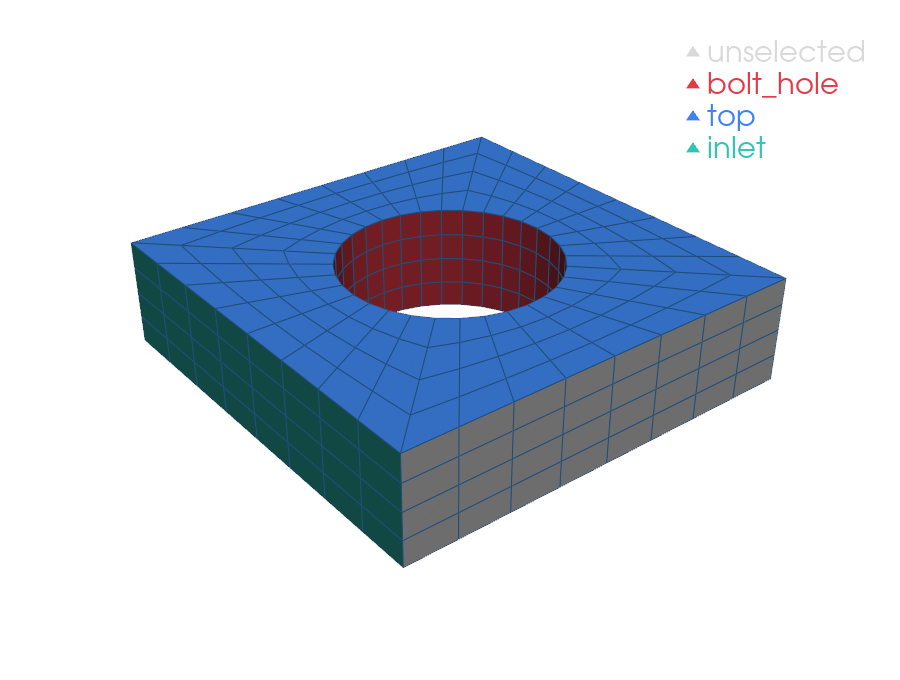
import meshioplusplus as mp

m = mp.read("bracket.vtu")

m = mp.select(m, "inlet", "side", box=(-1, -1, -1, 0.0, 1, 1))          # boundary faces in a box
m = mp.select(m, "top", "side", seed=(0.5, 0.5, 2.0))                   # the smooth face nearest a point
m = mp.select(m, "rim", "point", sphere=((0, 0, 0), 0.1))               # points in a ball
m = mp.select(m, "upper", plane=((0, 0, 1), (0, 0, 1)), mode="centroid")  # cells above z = 1
m = mp.select(m, "steel", where=("material", "==", 2))                  # cells by cell_data
m = mp.select(m, "slivers", quality=("min_dihedral", "<", 10))          # cells by quality
m = mp.select(m, "part1", component=1)                                  # the second loose part
m, report = mp.select(m, "wall", "side", seed=(0, 0, 0), feature_angle=20, return_report=True)
report["num_selected"], report["num_candidates"], report["num_grown"]
The result is the input, unchanged — points, connectivity, block order, data and every other region are bit-identical — plus the region. A region of the same name and kind is replaced, whatever its dimension or tag, so rerunning a script leaves one region; tag= sets its integer tag (a gmsh physical tag, an Exodus side-set id).
What can be selected
kind | Candidates | Entries |
|---|---|---|
"cell" (default) | every cell | global, block-major cell indices |
"point" | every point | point indices |
"side" | the facets of the cells of the mesh's highest dimension: faces of the 3-D cells, or edges of the 2-D cells when there are none; with boundary_only=True (the default) only facets owned by one such cell | (cell, local facet) pairs in the numbering regions gives |
A side region's dimension is its facets' (2 for faces, 1 for edges); a point or cell region's is -1. Polygons name their edges and polyhedra their faces in storage order; cells whose type has no facet table (the VTK Lagrange types) contribute no sides.
Criteria
Every criterion given must pass, and at least one is required. Each is evaluated over all candidates on its own and the results are intersected — a patch grows over the whole surface even when a box also restricts the selection.
| Criterion | Argument | A candidate passes when |
|---|---|---|
| Box, half-space, ball | box=(lo3, hi3) or six numbers, plane=(point3, normal3), sphere=(center3, radius) | it is inside all the shapes given: lo <= p <= hi, (p - point) . normal >= 0, |p - center| <= radius. A point tests itself; a cell or side reduces its nodes by mode: all inside ("all", default), any inside ("any"), or its centroid, the mean of its distinct nodes ("centroid") |
| Data | where=(array, op, value) | the comparison holds on a scalar point_data array (points) or cell_data array (cells; a side takes its owner cell's value). op is one of <, <=, >, >=, ==, !=, the vocabulary crop and refine share; a NaN never matches |
| Quality | quality=(metric, op, value) | the comparison holds on a compute_quality metric (scaled_jacobian, min_dihedral, aspect_ratio, ...), computed on the fly. Cells and sides only; a metric that does not apply to a cell type is NaN there, so the cell never matches |
| Component | component=k | the cell is in the k-th node-connected component, numbered as split with by="component" numbers its pieces (each component's lowest cell, ascending). A point passes when a cell of the component uses it, a side when its owner is in it |
| Grow | seed=(x, y, z) | the facet is in the patch grown from the facet nearest the seed (by centroid; ties to the lowest index) |
The point data and cell data are not converted into each other: a where on a point region refuses a cell_data name, and on a cell region a point_data name, saying which conversion (data to-cell or data to-point, see data averaging) to run.
Growing a patch
The patch grows breadth first from the seed facet across every edge that exactly two facets use and whose dihedral angle is at most feature_angle (default 30 degrees) — the edges feature_edges would not draw, by the same crease test. With normal_tolerance > 0 a facet also joins only when its normal lies within that many degrees of the seed's, which splits a smooth closed surface (a sphere, a cylinder) into a cap.
The facets grown over depend on the kind:
"cell": the 2-D cells of the mesh. A volume mesh has none; select its sides instead."side": the candidate faces (the boundary faces, or every face withboundary_only=False). A mesh whose highest dimension is 2 has edges for sides, which have no normal; select its cells instead."point": the 2-D cells, or the boundary faces of the 3-D cells when there are none; the patch's nodes are selected.
Unlike segment, which partitions the whole surface into patches, select grows one patch from a point you name — the one a boundary condition goes on.
Feeding the interface operations
Cell regions are what find_interface, region_adjacency and contact_pairs select by, and side regions what split_interface takes:
m = mp.select(m, "left", plane=((1, 0, 0), (-1, 0, 0)), mode="centroid")
m = mp.select(m, "right", plane=((1, 0, 0), (1, 0, 0)), mode="centroid")
faces, report = mp.find_interface(m, "left", "right", return_report=True)
Determinism and engines
Per-candidate tests run in parallel into disjoint slots; the growth is a serial breadth-first walk with neighbours in ascending order, and the component labels are split's own. The region is the same on every mesh backend and thread count.
select is C++-core only: the growth walks the core's crease test and the quality criterion its metrics, and a numpy twin of either would be a second implementation to keep byte-identical (the remesh_volume precedent). Without the compiled core the Python function raises NotImplementedError.
CLI
meshioplusplus select IN OUT --name NAME [--kind cell|point|side] [--tag N] \
    [--box XMIN,YMIN,ZMIN,XMAX,YMAX,ZMAX] [--plane PX,PY,PZ,NX,NY,NZ] [--sphere CX,CY,CZ,R] \
    [--where 'ARRAY OP VALUE'] [--quality 'METRIC OP VALUE'] [--component K] \
    [--seed X,Y,Z] [--feature-angle DEG] [--normal-tolerance DEG] \
    [--mode all|any|centroid] [--all-facets] [--json] [--quiet]
Both CLIs take the same flags; --where and --quality parse NAME OP VALUE as crop --where does.
Other languages
mio_select_opts opts;
mio_select_opts_init(&opts);           /* an all-zero struct is NOT the default */
opts.name = "top";
opts.kind = MIO_REGION_SIDE;
opts.use_seed = 1;
opts.seed[0] = 0.5; opts.seed[1] = 0.5; opts.seed[2] = 2.0;
opts.quality_metric = "scaled_jacobian";
opts.quality_compare = MIO_REFINE_GT;
opts.quality_value = 0.2;
mio_select_report report;
mio_mesh* out = mio_select(mesh, &opts, &report);out = m%select_region('top', kind='side', seed=[0.5_real64, 0.5_real64, 2.0_real64], &
num_selected=n)
out = m%select_region('slivers', quality_metric='min_dihedral', quality_op='<', &
quality_value=10.0_real64)r = select_region(mesh, "top"; kind="side", seed=(0.5, 0.5, 2.0))
r = select_region(mesh, "steel"; where_array="material", where_op="==", where_value=2)
r.mesh, r.num_selectedr <- mio_select(mesh, "top", kind = "side", seed = c(0.5, 0.5, 2))
r <- mio_select(mesh, "part", component = 2)const r = m.selectRegion(mesh, 'top', { kind: 'side', seed: [0.5, 0.5, 2] });
const s = m.selectRegion(mesh, 'slivers', { quality: ['min_dihedral', '<', 10] });Fortran's method is select_region, because Fortran reads select as the start of a construct, and Julia's is too, so it does not clash with DataFrames.select. In Fortran, Julia and R component is 1-based, like every other index there; in C, Python, WebAssembly, the CLIs and the pipeline it is 0-based.
It is also a settings-pipeline step, {"Op": "Select", "Name": "top", "Kind": "side", "Seed": [0.5, 0.5, 2.0]}, with the keys Name, Kind, Tag, Mode, BoundaryOnly, Bbox, Point + Normal, Center + Radius, Where + Compare + Value, Quality + QualityCompare + QualityValue, Component, Seed, FeatureAngle and NormalTolerance — see pipelines — and the MCP tool select.