
Volume retetrahedralization (isosurface stuffing)
meshioplusplus.remesh_volume(mesh, cell_size=..., ...) retetrahedralizes a volume mesh (or a closed surface) at a caller-chosen resolution by isosurface stuffing, discarding the input's own tetrahedra entirely and generating a fresh mesh from a body-centered cubic (BCC) lattice. It is the volumetric sibling of remesh — the same relationship decimate_volume has to decimate. Nothing else in this repo can raise the quality of a tetrahedral mesh at a chosen target resolution: refine subdivides the input's own (possibly bad) cells, decimate_volume can only remove elements, smooth (see "ODT smoothing" below) only moves points. remesh_volume instead generates a fresh lattice-based mesh, so output element quality is a property of the lattice construction, not of the input.
import meshioplusplus

mesh = meshioplusplus.read("part.vtu")  # a volume mesh, or a closed surface

out = meshioplusplus.remesh_volume(mesh, cell_size=0.5)
out = meshioplusplus.remesh_volume(mesh, resolution=(64, 64, 64))

out, report = meshioplusplus.remesh_volume(mesh, cell_size=0.5, return_report=True)
print(report["num_tets"], report["num_vertices_warped"], report["num_non_manifold_edges"])
Both CLIs expose it as a verb:
meshioplusplus remesh-volume part.vtu out.vtu --cell-size 0.5
meshioplusplus remesh-volume part.vtu out.vtu --resolution 64,64,64 --warp-fraction 0.2
Why a lattice, not Delaunay / CVD / ODT remeshing
doc/roadmap.md's "Volumetric CVD/ODT" bullet names the literal 3D counterpart of remesh's own surface clustering — optimal Delaunay triangulation / centroidal Voronoi tessellation in 3D. That method needs robust orientation and in-sphere predicates, exactly where this project's dependency-free, MIT posture stops paying: the permissive predicate library (Geogram, BSD-3) is a large new dependency, and the smaller, purpose-built alternatives are copyleft (TetGen is AGPL-3.0, CGAL's Mesh_3 is GPL) — a poor fit even as an optional dependency for an MIT project.
Isosurface stuffing needs no predicate at all — only a signed-distance field, which this repo already has (sample_distance) — and every uncut lattice tetrahedron has a dihedral angle from a small, mesh-size-independent fixed set, rather than an unbounded one. It closes the bullet's capability (retetrahedralize at a chosen resolution with bounded element quality), though it is honestly not the named method. SmoothMethod::Odt (below) closes the "ODT" half of the bullet's name separately and honestly: ODT smoothing on an existing tet mesh's fixed connectivity, not ODT remeshing.
Attribution and licence
Implemented from the published description only of Labelle & Shewchuk, "Isosurface Stuffing: Fast Tetrahedral Meshes with Good Dihedral Angles" (SIGGRAPH 2007). Neither the paper's own reference implementation (Stellar, non-commercial licence) nor TetGen (AGPL-3.0, also by Shewchuk) is read or vendored here — the same clean-room posture doc/remesh.md documents for its ACVD attribution, applied to a second reference. See CITATION.cff.
The algorithm
Lattice. A body-centered cubic lattice — two interleaved simple cubic lattices, the second offset by half a cell on every axis — is generated over the (padded) bounding box, sized with the exact same vocabulary
compute_sdf/VoxelOptionsuse (resolution/cell_size/bounds/padding/padding_relative), reused verbatim rather than reinvented. A per-axisresolutionthat would resolve to non-cubic cells is refused by name.Its natural tetrahedralization — 12 congruent tets per cell, each cell's body-center connected across one fixed diagonal of each of the cell's 6 faces — gives every uncut tet a dihedral angle from the fixed set {45°, 60°, 90°, 120°}, independent of cell size (every cell is a translate of the same unit construction). This is this project's own derivation, not a transcription of Labelle & Shewchuk's own tetrahedralization (never read): the paper reports a tighter {60°, 90°, 120°} set for its own construction; this one is a deliberately simpler, independently-derived and numerically-verified alternative — the 12-tet table tiles the unit cell with no gap or overlap, every tet is positively oriented, and the tets' volumes sum to the cell's own — that still delivers a small, mesh-size-independent bound, reported honestly as what it is rather than as a reproduction of the paper's exact angles.
Classify. Every lattice vertex gets a signed distance to the surface and an inside/outside label from that sign, fixed for the rest of the algorithm.
Warp. A lattice vertex within
warp_fraction * hof the surface (hthe lattice's own cell size) is moved — its label unchanged — onto the nearest point on the surface. This is what removes the arbitrarily thin slivers a naive cut would otherwise leave near the boundary; warping is load-bearing, not an optimization (see "The warp/quality tradeoff, measured" below).Cut. A tet whose four vertices share one label is kept whole or discarded. A straddling tet is cut by a small sign-mask case table — the same idea marching tetrahedra uses for a level surface (
detail/marching.hpp), here applied to fill the interior volume instead. Each crossing edge gets one cut point, reusing an incident vertex's warped position when one of the edge's two endpoints was warped, falling back to linear interpolation otherwise.
Determinism follows the repo's standard phase split: signed distances and warps are computed in parallel into disjoint per-vertex slots; since v16.19.0 the cut, weld and compaction passes run in parallel too, deduplicating cut points over the shared sort-based facet table by ascending edge key (the refine.cpp/surface.cpp idiom) instead of a serial pass, so two lattice tets sharing a face still agree bit-for-bit on that face's cut points.
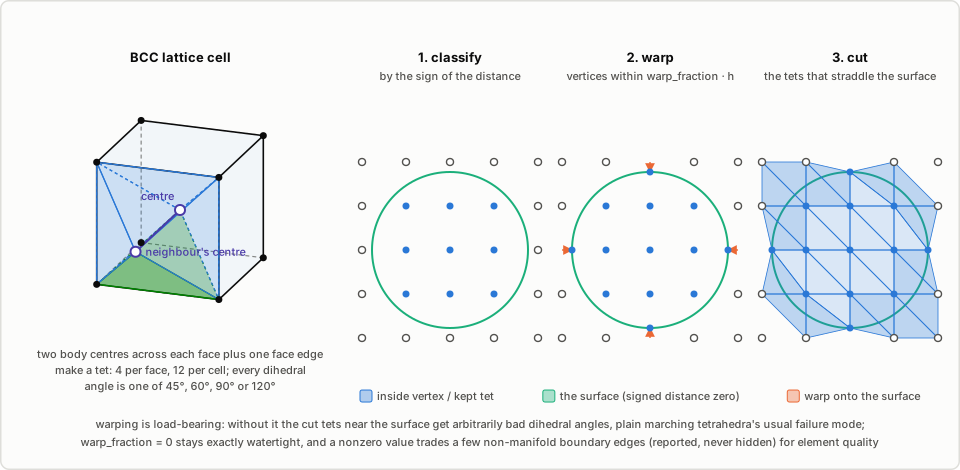
The warp/quality tradeoff, measured
Every claim below is a measurement on this repo's own test fixtures (a 12×24 or 16×32 UV sphere), not an assertion carried over from the paper — the RemeshOptions::max_anisotropy precedent from the surface remesh operation, applied here.
Warping genuinely improves boundary-tet quality, even at a small fraction — on a 16×32 sphere at cell_size=0.3, the worst (minimum) dihedral angle in the mesh rises from about 0.1° unwarped to several degrees at even a small warp_fraction, and keeps improving as the fraction grows toward its default:
warp_fraction | vertices warped | worst min dihedral |
|---|---|---|
| 0.00 (off) | 0 | ~0.1° |
| 0.01 | 14 | ~0.9° |
| 0.05 | 47 | ~4.6° |
| 0.10 | 48 | ~10.0° |
Reusing a warped vertex's position for every cut edge it touches — the mechanism that carries this quality benefit into the cut region — can also leave a small number of the output's own boundary edges non-manifold, on some inputs, at warp_fraction > 0 only. This is reported honestly as RemeshVolumeResult.num_non_manifold_edges rather than hidden. On a 12×24 sphere at cell_size=0.25 (the fixture tests/cpp/test_remesh_volume.cpp uses):
warp_fraction | vertices warped | non-manifold edges | boundary triangles | fraction |
|---|---|---|---|---|
| 0.00 (off) | 0 | 0 (exact) | 1360 | 0.0% |
| 0.01 | 2 | 0 | — | — |
| 0.05 | 39 | 5 | — | — |
| 0.15 | 103 | 17 | — | — |
| 0.25 | 199 | 64 | — | — |
| 0.35 (default) | 273 | 78 | 1360 | 3.8% |
In every measured case, orientation stays exact (num_inverted == 0) and the boundary stays hole-free (boundary_edges == 0, inconsistent_pairs == 0) — the defect is confined to a small fraction of edges being shared by more than two boundary triangles, never a hole or a winding disagreement. A caller needing an exactly watertight boundary should either set warp_fraction=0 (mathematically exact, at the cost of the quality improvement above) or post-process the result with clean(weld=True).
What does NOT survive
Identical to remesh: the output has entirely new points and new connectivity, so there is no point or cell map, and point_data/cell_data/regions are dropped (a warning is logged, never silent); field_data carries through. Compose with interpolate/conservative_interpolate to transfer a field onto the result.
Scope
Accepts a volume mesh (its boundary is extracted internally via extract_surface, which is closed by construction) or a closed surface directly (triangle, quad, rectangular polygon) — unlike plain remesh, which only ever works on a surface and throws on a volume input. The boundary of the result is only ever as good as the lattice resolution and the warp step can make it: sharp input edges and corners round off (output boundary vertices are warped lattice vertices), and features thinner than a cell merge or vanish. A caller wanting a genuinely high-quality boundary composes with extract_surface + remesh on the result rather than expecting this operation to build one in — this is a deliberate composition, not a built-in.
C++-core only, with no numpy fallback at all — the subdivide/agglomerate/decimate_volume/remesh precedent: warp and cut are discrete branches on a sign near a threshold, so a second, independently-written implementation could land on the other side of a near-tie and diverge into a different mesh, not a last-ulp difference. meshioplusplus.remesh_volume raises NotImplementedError naming the reason when _core is unavailable, for any input.