
Models
physicsnemo.models holds 25 architecture families. You do not need to know them all; you need to know which shape of data you have, because that is what picks the family.
Pick by data shape
| Your data is | Use | What meshio++ gives you |
|---|---|---|
| A regular grid, same resolution in and out | FNO, AFNO, UNet | the grid data path and the fno/afno families in TrainSpec (2-D through Grid.Squeeze); grid, voxelize and write_vti produce the lattice |
| A coarse grid in, a fine grid out | SRResNet (srrn) | the grid data path, a paired Target in the manifest, and the srresnet family in TrainSpec |
| An unstructured mesh with connectivity | MeshGraphNet family | graph_sample — nodes, edges, features, targets |
| An unordered point cloud | Transolver, FIGConvNet, FLARE | feature_matrix gives the node table, select_points the token budget |
| A CAD surface plus a volume (external aero) | DoMINO | extract_surface plus compute_sdf as a nodal field |
| A time series of states | RNN, mesh_reduced | TimeSeries and the target_offset pairing |
| Particles with trajectories | MeshGraphNet, VFGN | mesh edges only; proximity graphs are a gap |
| A distribution, not a single answer | diffusion U-Nets, DiT | nothing yet |
| The globe | GraphCast, Pangu, FengWu, DLWP | nothing; no mesh counterpart at all |
The same choice as a chart — start from the shape of one sample and follow the arrows:
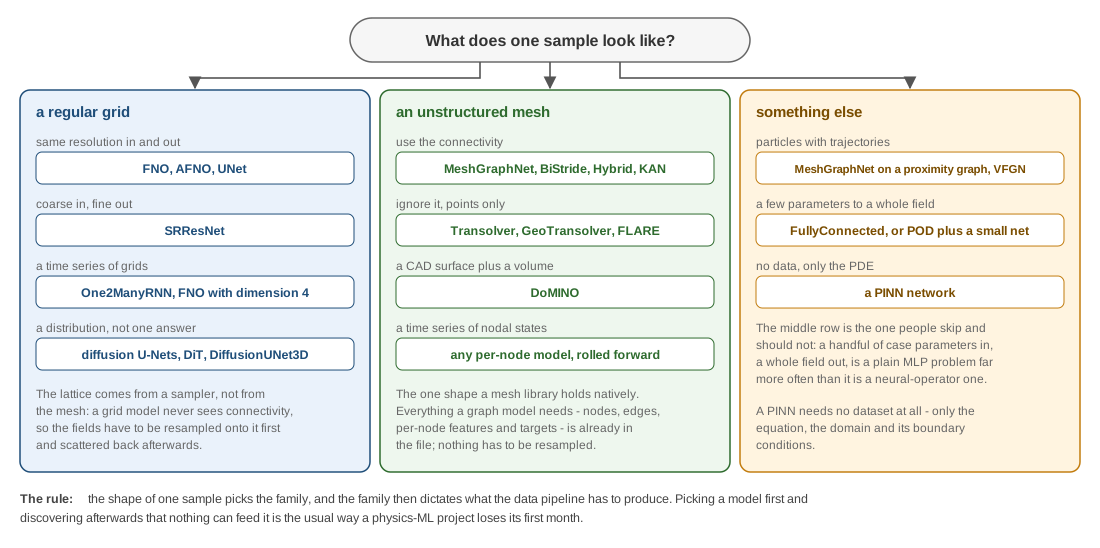
Figure 1: What one sample looks like decides the family. Everything else is detail.
The families
Neural operators on grids
| Family | Classes | Notes |
|---|---|---|
fno | FNO | The reference neural operator. dimension=1..4; the 4-D case is a spatio-temporal block operator |
afno | AFNO, ModAFNO | Fourier operator with an adaptive token mixer. ModAFNO takes a timestep input, so simulated time conditions it |
dpot | DPOTNet | Denoising pre-trained operator transformer, 2-D and 3-D |
unet | UNet | A plain 3-D convolutional U-Net |
pix2pix | Pix2Pix | Image-to-image translation |
srrn | SRResNet | Super-resolution residual network — coarse in, fine out |
Graphs and meshes
| Family | Classes | Notes |
|---|---|---|
meshgraphnet | MeshGraphNet, BiStrideMeshGraphNet, HybridMeshGraphNet, MeshGraphKAN | Encode–process–decode on an edge graph. The variants add a multiscale hierarchy, proximity "world" edges, and KAN layers |
mesh_reduced | Mesh_Reduced, Sequence_Model | Reduce a mesh, then learn the dynamics in the reduced space with temporal attention |
graphcast | GraphCastNet | The weather architecture, on an icosahedral grid |
vfgn | VFGNLearnedSimulator and its encode/process/decode parts | Virtual Foundry GraphNet, for sintering and additive manufacturing |
Point clouds and transformers
| Family | Classes | Notes |
|---|---|---|
transolver | Transolver | Attention over learned "physics slices" of a point cloud |
geotransolver | GeoTransolver | Geometry-aware successor |
figconvnet | FIGConvUNet | Factorized implicit grids; per-point fields plus a scalar (drag-style) head |
flare | FLARE | Experimental attention successor (also under experimental.models) |
domino | DoMINO | External aerodynamics: CAD surface plus volume, with pretrained checkpoints |
Generative
| Family | Classes | Notes |
|---|---|---|
diffusion_unets | SongUNet, SongUNetPosEmbd, DhariwalUNet, CorrDiffRegressionUNet, UNet, StormCastUNet | The denoiser backbones. 2-D image oriented |
dit | DiT | Diffusion transformer — the denoiser to reach for on non-image data |
topodiff | TopoDiff | Diffusion for topology optimization |
A volumetric 3-D denoiser exists too, under physicsnemo.experimental.models.diffusion_unets.DiffusionUNet3D — see Companion packages.
Sequences and weather
rnn (One2ManyRNN, Seq2SeqRNN), dlwp (DLWP), dlwp_healpix (HEALPixUNet, HEALPixRecUNet), pangu (Pangu), fengwu (Fengwu), swinvrnn (SwinRNN).
The plain one
mlp (FullyConnected) — a multilayer perceptron. It is the right first model far more often than it looks: if your input is a handful of case parameters and your output is a field, you want this, not a neural operator.
Worth knowing about, on nobody's critical path
| Family | Class | What it would bring |
|---|---|---|
dpot | DPOTNet | a PDE foundation model (AFNO mixing, pretrained across equation families) to fine-tune on your own grids |
topodiff | TopoDiff | generative topology optimization with constraint channels, on compliance data |
pix2pix | Pix2Pix, Pix2PixUnet | a plain convolutional image-to-image translator; fits any grid pipeline mechanically |
experimental.xdeeponet | DeepONet | branch (parameters) plus trunk (coordinates) operator learning — parameters in, field at the mesh nodes out, without a POD basis; the deeponet family in TrainSpec, over each entry's Metadata |
experimental.globe | GLOBE | boundary-driven elliptic problems, from named boundary meshes |
experimental.aerojepa | AeroJEPA | self-supervised pretraining on geometry alone, before any labels exist |
experimental.strata, experimental.healda | Strata, VideoHealDA | weather emulation on the sphere and HEALPix data assimilation; the assimilation idea matters for digital twins, the API is calendar-shaped |
pangu, fengwu, swinvrnn, dlwp_healpix | as named | global weather architectures with no mesh counterpart |
Building blocks
physicsnemo.nn holds the layers the models are made of — around 150 of them. Two are worth knowing by name:
ConcreteDropout— dropout with a learned rate, which makes MC-dropout uncertainty estimates meaningfully calibrated instead of arbitrary;physicsnemo.nn.functional.derivatives— differential operators used by the physics-informed path.
In meshio++
Five families are wired end to end, one per data shape in the chart: MeshGraphNet, through TrainSpec's Model.Name: "meshgraphnet", graph_sample for the tensors and predict for the write-back; SRResNet, through Model.Name: "srresnet" over the grid data path's coarse/fine pairs; FNO and AFNO, through "fno"/"afno" over the same grid path with the coarse grid paired with itself, 2-D through the thin-axis squeeze (AFNO is 2-D only and patches a fixed image, so the squeeze is required and the sample shape must divide the patch); and the experimental DeepONet, through "deeponet", whose branch reads each entry's Metadata parameters and whose trunk is the mesh's own points — parameters in, field out, on a fixed geometry. See the neural-operator families and parameters in, field out. The graph family came first for a reason — a mesh with connectivity is the shape meshio++ natively holds, and PyG batches ragged graphs of different sizes natively, which is what makes a dataset of differently-sized meshes trainable with no padding convention of its own.
Everything else on the chart above is reachable by hand: feature_matrix gives you the node table any point-cloud model wants, select_points reduces it to a token budget, to_torch/to_dlpack move it to the device without a file round trip, and the model is then ordinary PyTorch. The rest of the dataset half has since shipped too — proximity_graph (v10.31.0) builds the radius/kNN graphs a particle method needs, and make_window/iter_windows/rollout (v10.33.0) give a sequence model its history and its autoregressive evaluation loop.
Next: Data and datapipes — feeding them.