
Value conditioning (clamp / normalize / standardize)
data_condition conditions the values of data arrays without changing the geometry. It is a data operation, not a file format.
| Mode | Transform |
|---|---|
"clamp" | x → min(max(x, lo), hi) |
"normalize" | affine map from the array's own [min, max] onto [lo, hi] (default [0, 1]) |
"standardize" | (x − mean) / stddev — zero mean, unit standard deviation |
import meshioplusplus as mp

mesh = mp.read("part.vtu")

mesh = mp.data_condition(mesh, "point", ["T"], mode="clamp", lo=0.0, hi=100.0)
mesh = mp.data_condition(mesh, "cell", ["damage"], mode="normalize")
mesh = mp.data_condition(mesh, "point", ["T"], mode="standardize")

# Keep the original and write the result under a new name.
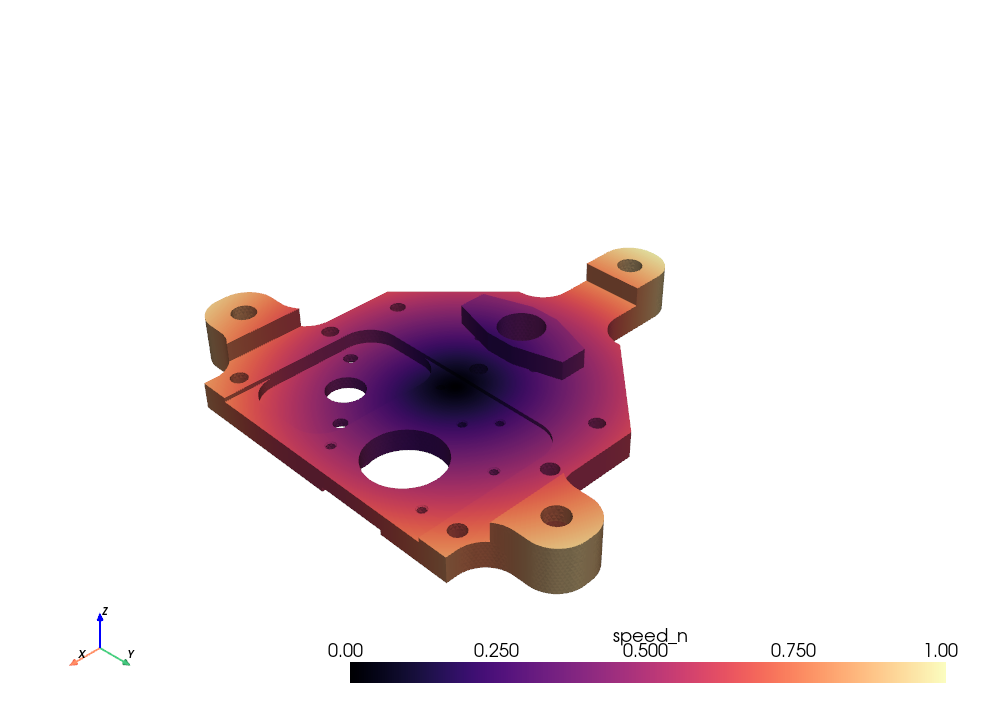
mesh = mp.data_condition(mesh, "point", ["T"], mode="normalize", suffix="_n")
Omit the name list to condition every array at that location.
Scope: components vs magnitude
scope="component" (the default) treats each trailing component independently, so each column of a vector array is conditioned on its own statistics.
scope="magnitude" computes the statistics over each row's Euclidean magnitude and rescales whole rows, preserving direction — the natural choice for a velocity or displacement field.
mp.data_condition(mesh, "point", ["velocity"], mode="normalize",
                  scope="magnitude")
Statistics
Statistics come from the finite values only — see the NaN policy. For a cell_data array they are computed jointly across all cell blocks before a single transform is applied to each: normalizing one block against its own extremes would make the pieces mutually incomparable.
Degenerate reductions are handled rather than producing NaN:
normalizeon a constant array (or one with no finite values) fills the target lower bound and warns.standardizewith zero standard deviation fills0and warns.
Data types
clamp preserves the input dtype, so clamping an int32 array leaves it int32 (pass preserve_dtype=False to force float64). normalize and standardize always produce float64 — a rescaled integer field is not an integer field.
CLI
meshioplusplus data clamp     in.vtu out.vtu --point T --min 0 --max 100
meshioplusplus data normalize in.vtu out.vtu --cell damage --to 0,1
meshioplusplus data normalize in.vtu out.vtu --point T --zero-mean
--magnitude selects the magnitude scope, --suffix writes to a new name instead of in place, and --nan ignore|replace|fail (with --nan-value) selects the non-finite policy. See the CLI reference.
Other languages
- C API —
mio_data_condition(mesh, location, names, count, mode, lo, hi, scope, nan_policy, nan_replacement, suffix)with theMIO_COND_*,MIO_SCOPE_*andMIO_NAN_*enumerations. See the C API reference. - Fortran —
m%data_condition(MIO_DATA_POINT, ["T"], mode=MIO_COND_NORMALIZE). See the Fortran reference. - WebAssembly / JavaScript —
dataCondition(mesh, "point", ["T"], "normalize", 0, 1, "component", "ignore", 0, ""). See the WebAssembly reference.