
Cell conversion (linearize / simplexify / elevate)
meshioplusplus.convert_cells(mesh, mode=...) converts a mesh's element representation — which cell types it is built from — while leaving the object it describes intact. It is a mesh operation (like crop and split), not a file format, and uses only standard C++/numpy, so it runs under every mesh backend.
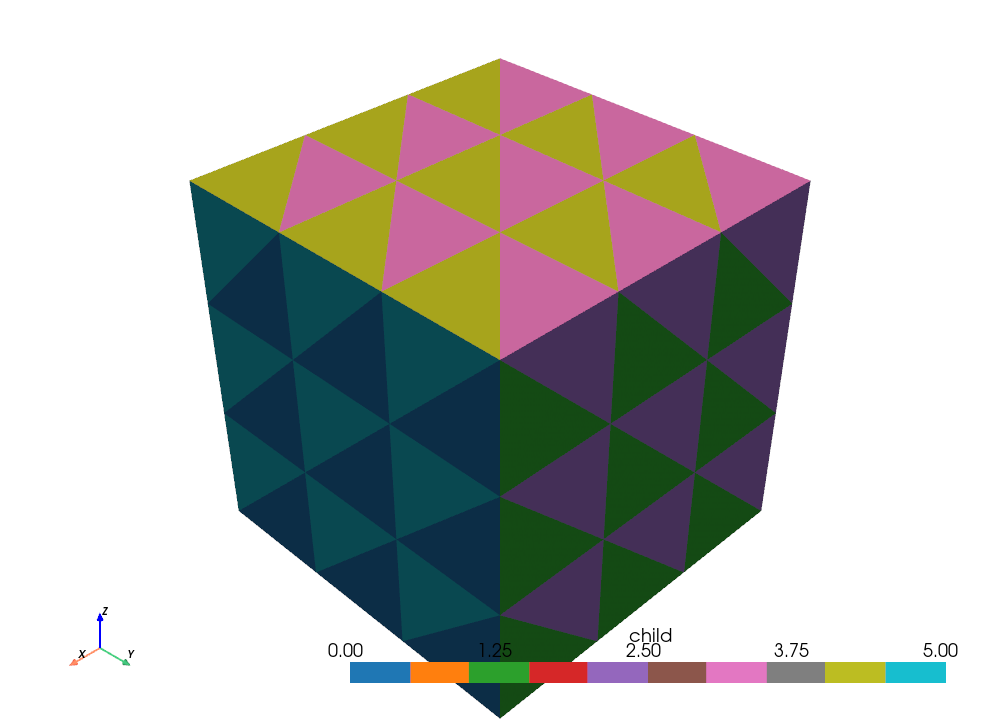
import meshioplusplus

mesh = meshioplusplus.read("domain.msh")

# drop the higher-order nodes: tetra10 -> tetra, hexahedron27 -> hexahedron, ...
linear = meshioplusplus.convert_cells(mesh, mode="linearize")

# decompose into simplices: hexahedron -> 6 tetra, quad -> 2 triangles, ...
tets = meshioplusplus.convert_cells(mesh, mode="simplexify")

# promote to serendipity quadratic: triangle -> triangle6, tetra -> tetra10, ...
quadratic = meshioplusplus.convert_cells(mesh, mode="elevate")

meshioplusplus.write("tets.vtu", tets)
Modes
| mode | does | cells | points |
|---|---|---|---|
"linearize" | every higher-order cell becomes its linear base, keeping the corner connectivity verbatim | unchanged | orphaned mid nodes pruned |
"simplexify" | every cell is decomposed into simplices of the same topological dimension | grows | unchanged (children reuse the parent's corner nodes) |
"elevate" | every linear cell is promoted to its serendipity (edge-only) quadratic counterpart | unchanged | grows (one new node per unique edge) |
Type mappings:
| linear | quadratic (elevate ⇄ linearize) | simplex decomposition (simplexify) |
|---|---|---|
line | line3 | — (already a simplex) |
triangle | triangle6 | — (already a simplex) |
quad | quad8 | 2 × triangle |
tetra | tetra10 | — (already a simplex) |
pyramid | pyramid13 | 2 × tetra |
wedge | wedge15 | 3 × tetra |
hexahedron | hexahedron20 | 6 × tetra |
polygon(n) | — | (n − 2) × triangle (fan around node 0) |
linearize additionally accepts the full-Lagrange types (quad9, triangle7, hexahedron27, wedge18, pyramid14, and the higher *20/*64 families), mapping each to its linear base.
All three modes are idempotent on cells they do not apply to — a linear block passes through linearize unchanged, an already-simplex block through simplexify, an already-quadratic block through elevate — so they are safe on a mixed-order mesh. Under simplexify, higher-order input is linearized first.
Two constructs raise rather than guess:
- a polyhedron block under
simplexify(a 2-level ragged block has no simplex template); - the full-Lagrange targets
quad9/hexahedron27underelevate— they need face- and body-centre nodes, which this version deliberately does not produce.
What changes
- Block structure is preserved 1:1 in every mode: the output has exactly as many cell blocks as the input, in the same order. That is what keeps the
cell_datacorrespondence (one array per block) correct under every backend. linearize: corner connectivity verbatim; unreferenced points pruned and connectivity/point_dataremapped. Cell count unchanged, socell_dataandfield_datapass through.simplexify: points untouched; each parent'scell_datarow is replicated to its children;point_data/field_datapass through.elevate: new nodes are appended after the originals, with coordinates at the edge midpoint andpoint_dataset to the mean of the edge's endpoints. Cell count unchanged, socell_data/field_datapass through.- Named regions (and so
point_sets/cell_sets) are remapped. Undersimplexifya cell region entry expands to the parent's children, and a side region's facet to the child facets lying within it; underlinearize/elevatea facet keeps its number (since v16.27.0). record_parent_ids=Trueattaches an Int64convert:parent_cellcell_dataarray recording, per output cell, the index of the input cell it came from within its own block.
Output is deterministic: the decomposition templates are fixed, and the elevate mid-edge numbering is assigned by a serial pass over a parallel-filled buffer, never a concurrent hash insert. Results are byte-identical across the MESHIO/NATIVE/KRATOS backends and any thread count.
Every emitted simplex is positively oriented for a well-oriented input, and the decomposition conserves volume — the hexahedron template is a canonical Freudenthal fan around the main diagonal 0–6. (It is conforming across a shared face only when neighbouring hexahedra agree on that diagonal, which is why the diagonal is fixed rather than chosen per cell.)
The numpy fallback handles rectangular cell blocks; ragged/polyhedron blocks are handled by the C++ core only.
simplexify and elevate linearize/decompose a curved cell's geometry — they keep only the corner nodes, and neither carries any provenance back from a synthetic simplex to the higher-order cell it came from. tessellate is the curvature-aware alternative for the five higher-order types it covers (triangle6/quad8/quad9/tetra10/hexahedron27): it subdivides onto a refinement lattice using each cell's own isoparametric shape functions (so a curved boundary tessellates onto the curve rather than being chopped straight), interpolates fields on the way in, and records a full point/cell provenance map that Tessellation.gather/.scatter/.aggregate use to move data back onto the original cell — the missing half of convert_cells(simplexify)'s own conformity guarantee.
CLI
meshioplusplus convert-cells in.msh out.vtu --mode linearize
meshioplusplus convert-cells in.msh out.vtu --mode simplexify
meshioplusplus convert-cells in.msh out.vtu --mode elevate
meshioplusplus convert-cells in.msh out.vtu --mode simplexify --record-parent-ids
Note this is distinct from the format-conversion convert verb. See the CLI reference.
Other languages
- C API —
mio_convert_cells(mesh, mode, record_parent_ids)returns an opaquemio_convert_cells_result(_meshborrow,_take_mesh, zero-copy_point_map/_cell_map,_free). See the C API reference. - Fortran —
mesh%convert_cells(mode, record_parent_ids=..., point_map=...). See the Fortran reference. - WebAssembly / JavaScript —
convertCells(mesh, mode, recordParentIds, returnMaps), returning the bare mesh or{mesh, pointMap, cellMaps}whenreturnMapsis set. See the WebAssembly reference.