
Smoothing (Laplacian / Taubin / ODT)
meshioplusplus.smooth(mesh, method="taubin", iterations=10) improves element shape by relaxing each free node toward the centroid of its edge neighbours (method="odt" instead moves each free interior tet vertex toward the volume-weighted average of its incident tets' circumcenters — see ODT smoothing below). It is a mesh operation (like refine and clean), not a file format, and uses only standard C++/numpy, so it runs under every mesh backend.
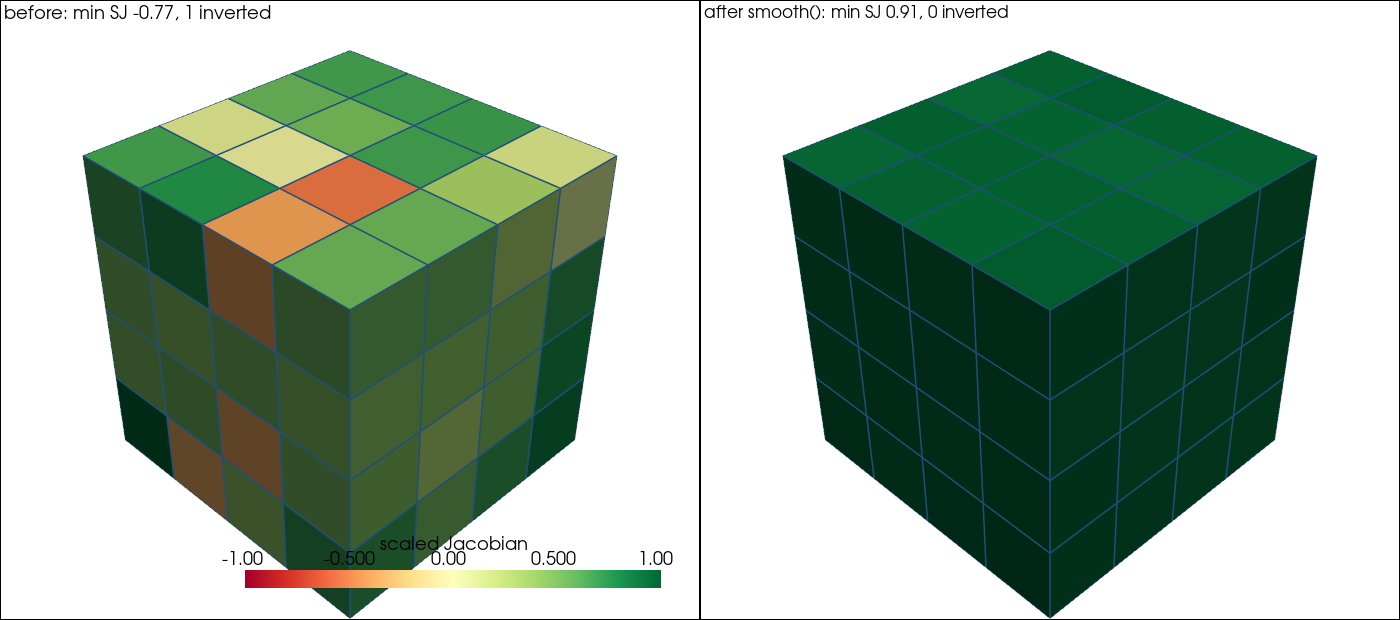
It is a pure coordinate move. Connectivity, cell counts, cell_data, field_data and point_data values all come through unchanged; only the point coordinates differ, and the points array keeps its input dtype. That makes smooth the geometric counterpart to mesh quality, which only measures the thing this operation fixes.
import meshioplusplus

mesh = meshioplusplus.read("rough.msh")

# the default: Taubin, 10 iterations, boundary and features pinned
better = meshioplusplus.smooth(mesh)

# Laplacian is stronger per pass but shrinks the mesh
strong = meshioplusplus.smooth(mesh, method="laplacian", iterations=5)

# ask what actually happened
out, report = meshioplusplus.smooth(mesh, iterations=20, return_report=True)
print(report)   # {'num_nodes_moved': 27, 'max_displacement': 1.012, ...}

meshioplusplus.write("better.vtu", better)
Two methods
Both are driven by the same edge-neighbour centroid displacement L(i) = mean(x[j] for j adjacent to i) - x[i].
| method | per iteration | shrinks? |
|---|---|---|
laplacian | one x <- x + lambda*L(x) pass (lambda defaults to 0.5) | yes, unavoidably |
taubin | a +lambda pass (0.33) then a -mu pass (−0.34) | no |
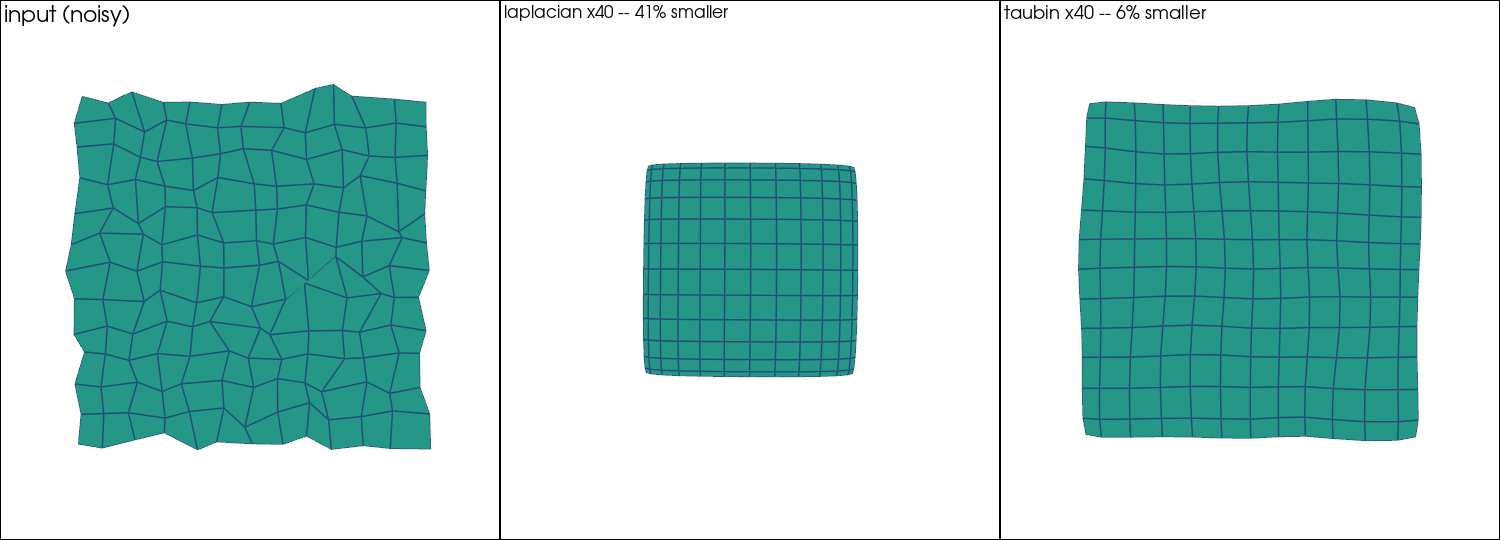
Laplacian is a low-pass filter with no pass band: every spatial frequency is attenuated, including the zeroth. Run to convergence, a closed surface collapses toward a point. It is the right choice when a handful of passes is enough and volume loss does not matter.
Taubin follows each smoothing pass with a deliberate un-smoothing pass whose larger magnitude overshoots, so the pair has a pass band below k = 1/lambda + 1/mu where features are preserved, and a stop band above it where noise is attenuated. With the defaults that cutoff is ≈ 0.089, and hundreds of iterations leave the enclosed volume essentially unchanged. This is why it is the default.
The difference is not subtle — the same noisy grid, 40 iterations of each, with the boundary deliberately left free:
lambda must lie in (0, 1), and Taubin additionally requires mu < -lambda < 0 — otherwise the pass pair amplifies instead of filtering, and smooth raises rather than diverging quietly. Passing a negative lambda selects that method's own default (0.5 or 0.33); this is why the parameter's default is -1.0 rather than a number.
Python naming
The Python parameter is lambda_, with a trailing underscore, because lambda is a Python keyword. Every other surface spells it lambda.
ODT smoothing
method="odt" is optimal-Delaunay-triangulation smoothing: rather than the edge-neighbour centroid laplacian/taubin use, each free interior tet vertex moves toward the volume-weighted average of its incident tets' circumcenters. It is closed-form, not iterative-within-a-pass — one pass computes the target directly from the current mesh, the same Jacobi update laplacian/taubin already use.
Tet-only. smooth otherwise works on any mesh; method="odt" raises by name on any non-tetra block, rather than silently pinning or ignoring it. This is what closes the "ODT" half of doc/roadmap.md's "Volumetric CVD/ODT" bullet — honestly, as ODT smoothing on an existing tet mesh's fixed connectivity, not ODT remeshing (which would need to change the connectivity itself; see remesh_volume for the operation that actually generates a fresh tet mesh).
mesh = meshioplusplus.read("tangled.vtu")  # a tetra mesh

better, report = meshioplusplus.smooth(mesh, method="odt", iterations=10, return_report=True)lambda's negative-sentinel-means-"this method's own default" convention (above) extends to ODT: its default is 0.9, a near-full step toward the circumcenter average, damped rather than exactly 1.0 for the same reason the other two methods are not exactly 1.0. mu is silently ignored by ODT, matching laplacian's own silent ignoring of it — deliberately not a named-error option the way RemeshOptions.max_anisotropy is under the wrong metric, since making only the newest method strict while its sibling stays lenient would be a worse inconsistency than either rule applied uniformly.
Boundary pinning still applies: with fix_boundary=True (the default), a tet mesh's boundary vertices are pinned exactly as under laplacian/taubin, so ODT only ever relaxes the interior. The inversion guard (below) applies unchanged too — an unguarded ODT step can invert a tet near a concave boundary, which is why the numpy fallback (below) refuses method="odt" unconditionally rather than only under guard_inversion=True.
This is C++-core only, with no numpy fallback at all — unlike laplacian/taubin, whose continuous part the fallback does implement (just not the inversion guard). ODT's target is a genuinely different closed-form computation (a circumcenter, not a centroid), and pairing it with the same "raise unless the guard is off" fallback posture would still leave an unguarded ODT step meaningless on a concave mesh; meshioplusplus.smooth(mesh, method="odt") raises NotImplementedError naming the reason when _core is unavailable, for any input.
The neighbour graph is edges, not cliques
Two nodes are neighbours iff they share a cell edge — the same cell_refine_edges table refine uses, so the two cannot drift. Ragged polygon rows and polyhedron faces contribute their ring edges.
This matters. Reordering builds the clique graph (every pair of nodes sharing a cell) because that is the sparsity pattern of the FEM matrix whose bandwidth it exists to reduce. Smoothing on that graph would pull each hexahedron corner toward its three face diagonals and its body diagonal as hard as toward its three real edge neighbours, bevelling cubes toward spheres. On the edge graph, a structured hexahedron block is a fixed point.
What is pinned
A node never moves if it is:
- on the boundary, when
fix_boundary=True(the default). Boundary is the once-used-facet test: a face used by exactly one 3D cell, or — in a pure surface mesh — an edge used by exactly one 2D cell. Without this the domain's own shape changes: a closed surface contracts and an open domain's walls creep inward. - a feature node, when
preserve_features=True(the default, withfix_boundary): an endpoint of a feature edge — an edge whose two faces' normals differ by more thanfeature_angledegrees (default 30; 0° is coplanar, 90° is the edge of a box — thevtkFeatureEdgesconvention), or one used by three or more faces. On a volume mesh the faces are the boundary facets; on a surface mesh they are the surface's own cells, so the creases of a bent sheet hold (since v16.23.0 — before, a surface mesh's features were looked for only at the corners of its boundary polyline, and only in the XY plane). A surface mesh also pins the corners of its boundary polyline, where consecutive boundary edges turn by more than the angle, measured in 3-D. Without it, unfeatured boundary smoothing rounds every geometric corner off. - named in
frozen— an index array, or the name of amesh.point_setsentry. Unioned with the other pins, never subtracted from them. - referenced only by blocks whose edge topology is unknown — the higher-order family (
tetra10,quad8, …), the VTK-Lagrange types,custom,vertex. Atetra10's mid-edge nodes have no meaningful centroid: moving them would silently flatten a deliberately curved mesh, and moving only the corners would strand the mid-nodes off their edges. An unknown neighbourhood gives no defined target, so the node holds still — and says so once, via a warning.
The inversion guard
Smoothing can in principle push a node through a neighbouring face. With guard_inversion=True (the default), a node's candidate position is committed only if no incident cell's signed measure would change from valid to inverted; otherwise the node holds still for that pass and the event is counted in num_skipped_inversion.
The rule is "do no harm", not "preserve the sign":
- a currently-valid cell may not be made invalid — the guard's whole purpose;
- a cell that arrives already inverted imposes no constraint at all. Blocking its sign change would mean the guard prevents smoothing from repairing a tangle, which is one of the main reasons to reach for this operation. (An early version did exactly that: 5 inverted cells in, 4 still inverted out with the guard on, versus 0 with it off.)
- an exactly degenerate cell likewise imposes nothing, so a sliver's nodes are not pinned forever.
Three measures are used, by cell family:
| cells | measure |
|---|---|
tetra, hexahedron, wedge, pyramid | signed volume by the outward face fan |
2D cells in a 2D mesh (PointDim == 2) | signed shoelace area |
| 2D cells in a 3D mesh | normal flip: dot(n_before, n_after) <= 0 |
The third has no counterpart in compute_quality, which correctly declines to call a triangle floating in 3D "inverted" — a facet in space has no intrinsic orientation. Smoothing needs only the weaker, purely relative question did this facet just fold back over itself?, so it asks that one, and a triangle surface mesh is guarded rather than left free to fold.
Polyhedron cells do have a signed measure since v9.16.0 (the corner-average fan over the cell's own faces), so the guard covers them — and their boundary is detected too, so fix_boundary pins their outer nodes. Cells with no signed measure at all (line, custom) are skipped, not pinned: a missing safety check is not a missing target, and pinning there would freeze an entire beam-element curve for no geometric reason.
The guard costs a second CSR (node → incident cell) plus a corner table, both built only when it is enabled.
What changes
- Points move. Nothing else does. Point and cell counts, block structure, connectivity,
cell_data,field_dataandpoint_datavalues are all carried through unchanged, and the points array keeps its dtype (iteration runs indoubleregardless, with a single cast on write-back, so a Float32 mesh does not accumulate one rounding per pass). point_sets/cell_setspass through untouched — unlike refine/crop/split, whose shims must remap them, this operation never adds, removes or renumbers a node or a cell.mesh.infoandgmsh_periodicare not carried through (as for every other operation).- The report carries
num_nodes_moved(nodes whose net displacement exceeded a scale-relative tolerance),max_displacement(measured against the input, not the previous pass) andnum_skipped_inversion(a count of(node, pass)rejection events, so one node rejected in five passes counts five).
Determinism
Every pass is Jacobi: all new positions are computed from the previous pass's positions and committed together, so no node ever observes a half-updated neighbour and the result cannot depend on traversal order. The update loop contains no hashing, no sorting and no floating-point reduction; neighbour sums run in ascending node id, the boundary set comes from a serial dedup pass over a parallel-filled buffer (the same phase split extract_surface uses), and the summary counters are folded serially out of per-node slots.
Output is byte-identical across the MESHIO/NATIVE/KRATOS backends and across thread counts — verified on a 52k-node mesh.
The numpy fallback reproduces the continuous part of the algorithm to within round-off, but does not implement the inversion guard: that is a discrete branch on the sign of a cell measure, and near a degenerate cell two implementations could legitimately land on opposite sides and then diverge macroscopically. Rather than ship a second, subtly different guard, the fallback raises if one is requested — pass guard_inversion=False to use it.
CLI
meshioplusplus smooth rough.msh better.vtu
meshioplusplus smooth rough.msh better.vtu --method laplacian --iterations 5
meshioplusplus smooth rough.msh better.vtu --feature-angle 45 --no-guard-inversion
meshioplusplus smooth rough.msh better.vtu --lambda 0.4 --mu=-0.45
meshioplusplus smooth tangled.vtu better.vtu --method odt --iterations 10
Negative values need the --mu=-0.45 form, as for transform and crop. See the CLI reference.
Other languages
- C API —
mio_smooth(mesh, method, iterations, lambda, mu, fix_boundary, preserve_features, feature_angle, guard_inversion, &nodes_moved, &max_displacement, &skipped_inversion)returns a plainmio_mesh*; the three counter out-params are individually optional.methodis passed straight through, so"odt"needs no C API surface of its own beyond the string.frozenis reached throughmio_smooth_opts/mio_smooth_ex(themio_refine_opts/_expattern):opts.frozen/opts.num_frozenname 0-based point ids to pin outright, range-checked (an out-of-range id fails the call by name);mio_smoothitself is exactlymio_smooth_exwithfrozenunset. See the C API reference. - Fortran —
mesh%smooth(method, iterations [, lambda, mu, fix_boundary, preserve_features, feature_angle, guard_inversion, nodes_moved, max_displacement, skipped_inversion, frozen]);frozenis a 1-basedinteger(int64)array, shifted to 0-based across the ABI. See the Fortran reference. - Julia —
smooth(mesh; method="taubin", iterations=10, ..., frozen=nothing);frozenis 1-based. See the Julia reference. - R —
mio_smooth(mesh, method="taubin", iterations=10L, ..., frozen=NULL);frozenis 1-based. See the R reference. - WebAssembly / JavaScript —
smooth(mesh, method, iterations, lambda, mu, fixBoundary, preserveFeatures, featureAngle, guardInversion, frozen), returning{mesh, numNodesMoved, maxDisplacement, numSkippedInversion}.frozenis an optional array of 0-based point ids to pin outright, unioned with any boundary/feature pins; an out-of-range id throws naming it. See the WebAssembly reference.