
Diffusion and deployment
physicsnemo.diffusion
A diffusion model does not predict an answer; it samples from a distribution of plausible answers. That is the point: run it several times and the spread between the samples is a calibrated statement about what the data does not determine.
The subpackage splits the problem into three replaceable parts, and knowing the split is most of what you need:
| Part | Answers | In physicsnemo |
|---|---|---|
| Denoiser | What network removes the noise? | any model implementing diffusion.base.DiffusionModel — the U-Nets, or DiT |
| Preconditioner | How is noise scaled and the network conditioned on the noise level? | EDMPrecond, VEPrecond, VPPrecond, iDDPMPrecond, EDMPrecondSuperResolution |
| Sampler | How do we walk from noise to a sample? | deterministic_sampler, stochastic_sampler, EDMStochasticHeunSolver, EulerSolver, HeunSolver |
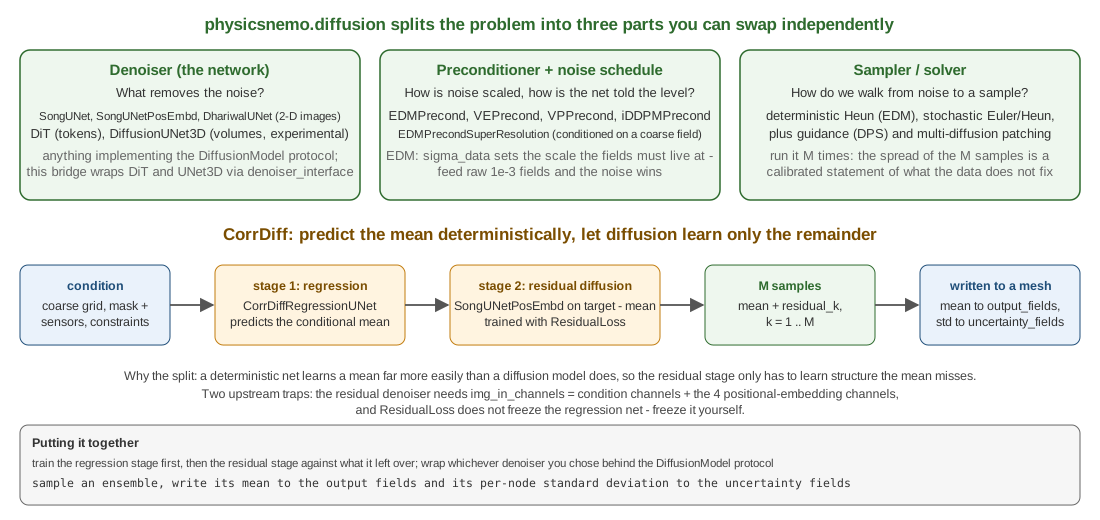
Figure 1: The three replaceable parts, and CorrDiff's regression-plus-residual split.
Also: diffusion.guidance (diffusion posterior sampling — DataConsistencyDPSGuidance steers samples toward masked observations, ModelConsistencyDPSGuidance toward a differentiable forward model, both at sampling time and without retraining), diffusion.noise_schedulers (EDM, VE, VP, iDDPM, one module per class since 2.2), diffusion.multi_diffusion (patch-based tiling of a 2-D domain larger than the training resolution), and diffusion.metrics with the EDM losses.
Two APIs coexist in 2.2. The protocol API — DiffusionModel, Predictor and Denoiser protocols, EDMNoiseScheduler, EDMPreconditioner, MSEDSMLoss, samplers.sample(denoiser, latents, scheduler, solver=) — is what guidance and multi-diffusion are written against. The legacy modules (samplers.legacy_deterministic_sampler, metrics.legacy_losses, preconditioners.legacy) each warn that they will be deprecated in a future release. New work should target the protocol API.
CorrDiff is the two-stage recipe that matters for physics: a regression model predicts the conditional mean, then a residual diffusion model learns what the regression could not. Predicting the mean with a deterministic model is much easier than making diffusion learn it, and the split shows.
physicsnemo.metrics
metrics.general—crpsandkcrps(proper scoring rules for ensembles),calibration,ensemble_metrics,entropy,histogram,mse,relative_error,power_spectrum,wasserstein,reduction.metrics.cae— CFD-flavoured integrals and quantities.
CRPS is the one to know: it scores a whole ensemble against a single observation, rewarding both accuracy and honest spread. An over-confident ensemble scores badly even when its mean is right.
physicsnemo.optim
CombinedOptimizer (different optimizers on different parameter groups) and Muon. Torch's own optimizers work fine; reach for these only when you need them.
physicsnemo.deploy.onnx
export_to_onnx_stream and run_onnx_inference. ONNX is the portable artifact: a .onnx file plus ONNX Runtime needs neither physicsnemo nor torch to run, which is what makes it the right thing to hand to a production host.
Two caveats, both of which report success while being wrong. Not every operator exports — the FFTs inside FNO-style models are not supported by the CPU ONNX Runtime, while MLP and convolutional models export and run everywhere. And ONNX Runtime silently falls back to CPU when a CUDA build is missing or a device index does not exist, and silently drops the index when it does ("cuda:1" running on device 0). Both need an explicit check rather than trust.
In meshio++
Nothing here is wired into meshio++, and only one piece of it is a gap worth naming.
metrics.general.power_spectrum is the honest measure of whether a super-resolved or generated field has the right small-scale content, as opposed to a plausible-looking one with the high wavenumbers smoothed out — pointwise error does not see the difference. meshio++'s power_spectrum (v10.27.0) computes exactly this on any lattice with nothing but an FFT, azimuthally averaged and Parseval-exact — the natural companion to the grid data path, and the number the srresnet superresolution family's own spectrum_rel_l2 training rows are reported against.
For the rest, the boundary is clean: an ensemble's mean and per-point standard deviation are just two more point_data arrays, so anything meshio++ can write can carry them. Write the mean into the field's own name and the spread into a <field>_std sibling, and every viewer, every format and every downstream operation treats them as ordinary data — which is the whole reason to keep uncertainty in the mesh rather than in a framework-specific container.
Next: Uncertainty and guardrails.