
Sizes from an error estimate — error_size
error_size turns a per-cell error indicator into a per-point size field. estimate_error measures where a field is badly resolved and writes error:zz, one value per cell; mesh_cad_surface's background reads a size per point. error_size joins the two, so an adaptation loop re-meshes from the CAD model instead of moving points off it.
import meshioplusplus as mp

model = mp.read("part.cad.json")
mesh = mp.mesh_cad_surface(model, 0.2)
mesh.point_data["f"] = solve(mesh)  # a field on the mesh
mesh = mp.estimate_error(mesh, "f")  # cell_data error:zz
sized, report = mp.error_size(mesh, target_error=1e-3, min_size=0.01, return_report=True)
adapted = mp.mesh_cad_surface(model, 0.2, background=sized)  # reads point_data "size"
How a size is chosen
The procedure is the adaptive one of Zienkiewicz and Zhu (1987). With N cells evaluated and a target global error eta, the error each cell may carry when the error is spread evenly is e = eta / sqrt(N). A cell of size h_K (its diameter, the largest distance between two of its nodes) whose indicator is eta_K asks for h_K (e / eta_K)^(1/p), where p is the rate at which the indicator falls with h: the element order for the recovered-gradient error, 1 for linear elements. A cell whose indicator is zero asks for no change of its own and is bounded by max_size alone.
The size is clamped to [min_size, max_size] (0 is no bound) and written per point as the least of its cells' sizes: the finer request wins, as every size source of mesh_cad_surface refines. A point with no evaluated cell (a cell whose indicator or size is not finite is skipped) reads NaN, which background treats as no size there.
Geometry, connectivity, regions, property sets and every existing array pass through; only the size array is added. The result is byte-identical across mesh backends and thread counts.
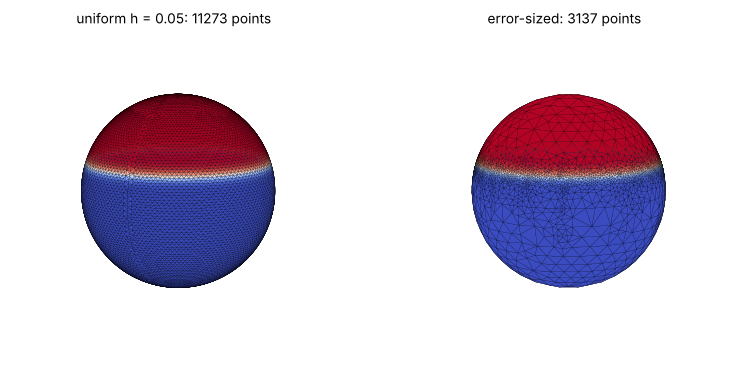
On the unit sphere with a tanh layer across it (notebook 42), the indicator of the layer's field on a mesh at h = 0.1, asked for 1.5 times that mesh's global error, re-meshes the sphere with 3,137 points at an L2 interpolation error of 1.54e-2, where a uniform mesh at h = 0.05 needs 11,273 points for 1.59e-2.
Options and report
| option | meaning |
|---|---|
error_array | the one-component cell_data indicator (error:zz) |
target_error | the target global error eta, in the indicator's norm (required, positive) |
order | the rate p (1) |
min_size, max_size | the bounds on the size written (0: none) |
output | the point_data array written (size, what background reads by default) |
overwrite | allow replacing an existing array of that name |
The report has num_cells (evaluated), num_skipped (cells whose indicator or size is not finite), num_clamped (cell sizes the bounds clamped), min_size and max_size (over the points written). A missing indicator, one that is point_data or has more than one component, a target error or order that is not finite and positive, a negative bound, min_size > max_size or an output-name collision is refused by name.
Bindings
| surface | entry |
|---|---|
| Python | meshioplusplus.error_size(mesh, error_array="error:zz", *, target_error, order=1.0, min_size=0.0, max_size=0.0, output="size", overwrite=False, return_report=False); a numpy twin answers when the core is absent |
| C++ | error_size(const Mesh&, const ErrorSizeOptions&) → ErrorSizeResult (operations/error_size.hpp) |
| C | mio_error_size(mesh, &opts, &report) with mio_error_size_opts (80 bytes, through mio_error_size_opts_init) and mio_error_size_report (64 bytes) |
| Fortran | m%error_size(target_error, [error_array, order, min_size, max_size, output, overwrite, …]) |
| Julia | error_size(mesh; target_error, error_array, order, min_size, max_size, output, overwrite) |
| R | mio_error_size(mesh, target_error, error_array, order, min_size, max_size, output, overwrite) |
| WASM | errorSize(mesh, {targetError, errorArray, order, minSize, maxSize, output, overwrite}) |
| CLI | data error-size INFILE OUTFILE --target-error E [--array NAME] [--order P] [--min-size H] [--max-size H] [--output NAME] [--overwrite] [--json], both CLIs |
| MCP | error_size(input_path, output_path, target_error, ...) |
| Pipeline | ErrorSize after an EstimateError step, with TargetError, Array, Order, MinSize, MaxSize, Output |
References
- O. C. Zienkiewicz and J. Z. Zhu, "A simple error estimator and adaptive procedure for practical engineering analysis", International Journal for Numerical Methods in Engineering 24 (1987).