
Layers and functionals
physicsnemo.models is built from physicsnemo.nn. You rarely need the layers to use an architecture, but you need them for three things: building a small custom model that still travels in a .mdlus, calling a GPU-optimized operation on mesh data without any model at all, and understanding what a flag such as use_te or mc_dropout actually switches on.
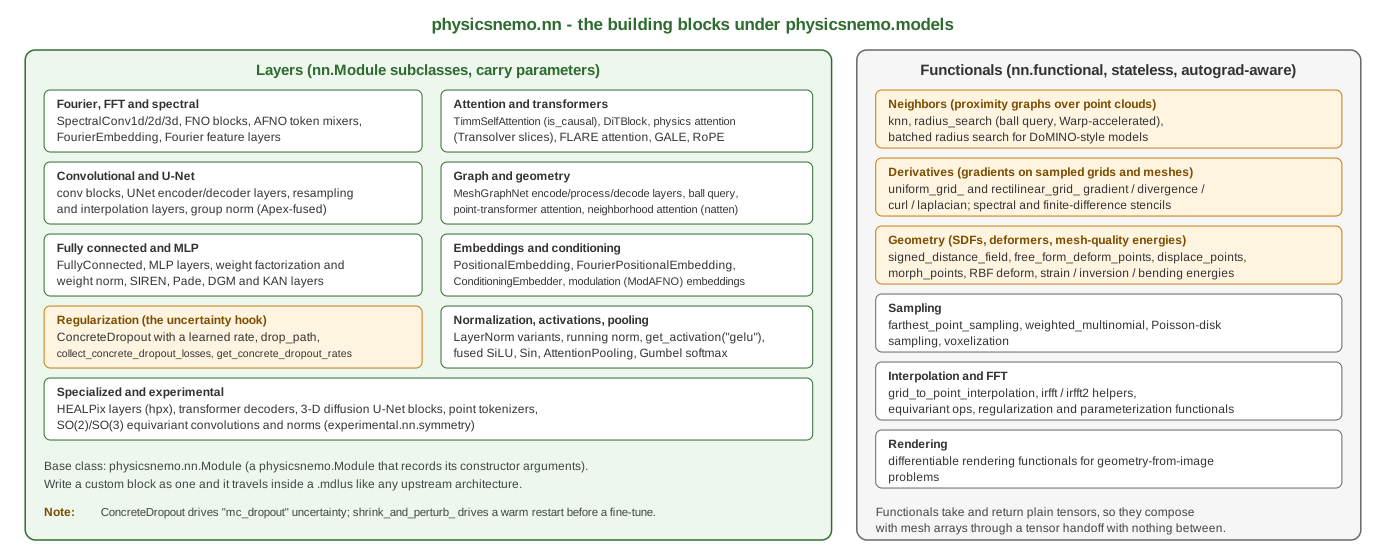
Figure 1: The layer and functional families. Highlighted boxes are the ones a mesh pipeline reaches for directly.
Two kinds of building block
Layers are torch.nn.Module subclasses that carry parameters. Their base class, physicsnemo.nn.Module, is the same physicsnemo.Module the architectures use (see Core and checkpoints): it records its constructor arguments, so a custom block written as one reconstructs itself from a checkpoint like any upstream model.
Functionals (physicsnemo.nn.functional) are stateless operations on plain tensors, autograd-aware, with Warp or CUDA kernels behind the expensive ones. They take and return tensors, so they compose with mesh arrays through to_torch or to_dlpack with nothing in between.
The layer families
Upstream's API index groups them the same way; the names below are the ones you will meet in the model source or in a configuration.
| Family | Representative classes | Where you meet it |
|---|---|---|
| Fourier, FFT and spectral | SpectralConv1d/2d/3d, the FNO and AFNO blocks, FourierEmbedding, Fourier feature layers | every neural operator on a grid; FNO(dimension=..)'s spectral modes are these layers' modes |
| Attention and transformers | TimmSelfAttention (is_causal since 2.2), DiTBlock, the physics attention of Transolver (learned "slices"), FLARE attention, GALE, RoPE embeddings | Transolver, GeoTransolver, FLARE, DiT; the use_te flag swaps in TransformerEngine kernels (fp8) |
| Convolutional and U-Net | convolution blocks, U-Net encoder/decoder layers, resampling and interpolation layers, Apex-fused group norm | UNet, SRResNet, the diffusion U-Nets |
| Graph and geometry | the MeshGraphNet encoder/processor/decoder layers, ball query, point-transformer attention (2.2), neighborhood attention (natten) | MeshGraphNet and its variants, FIGConvUNet, DoMINO's local stencils |
| Fully connected and MLP | FullyConnected, MLP layers, weight factorization and weight normalization, SIREN, Pade, DGM and KAN layers | physicsnemo.models.mlp.FullyConnected, MeshGraphKAN, PINN networks |
| Embeddings and conditioning | PositionalEmbedding, FourierPositionalEmbedding (2.2), ConditioningEmbedder, the modulation embeddings of ModAFNO | diffusion conditioning, time conditioning of ModAFNO |
| Regularization | ConcreteDropout, drop_path, collect_concrete_dropout_losses, get_concrete_dropout_rates | calibrated MC-dropout uncertainty |
| Normalization, activations, pooling | LayerNorm variants, running norm, get_activation("gelu"), fused SiLU, Sin (2.2), AttentionPooling, Gumbel softmax | everywhere; AttentionPooling is how a per-point backbone feeds a scalar GP head |
| Specialized and experimental | HEALPix layers, transformer decoders, 3-D diffusion U-Net blocks, point tokenizers, SO(2)/SO(3) equivariant convolutions and norms (experimental.nn.symmetry) | weather models, DiffusionUNet3D, GeoTransolver's tokenizer |
Around 150 layer classes in total. The practical rule: if you want a small custom model, compose FullyConnected or a couple of SpectralConv blocks as a physicsnemo.nn.Module subclass, save it as a .mdlus, and it loads anywhere the upstream models do.
The functional families
| Family | Functions | Notes |
|---|---|---|
| Neighbors | knn, radius_search (ball query), batched radius search | Warp-accelerated; upstream measured its ball query at up to 1384x faster and 249x less peak memory than a naive torch implementation |
| Derivatives | uniform_grid_gradient/divergence/curl/laplacian, the rectilinear_grid_ family (2.2), spectral and finite-difference stencils | gradients take a bare scalar field and prepend a derivative axis; divergence and curl take a channels-first vector with channels equal to the spatial rank; the stencils are periodic unless you trim |
| Geometry | signed_distance_field (returns (sdf, hit_points, hit_faces) since 2.2), free_form_deform_points, displace_points, morph_points, radial_basis_function_deform_points, the strain / measure / inversion / bending / volume energies | the Warp backend computes in float32 and is auto-selected whenever CUDA exists |
| Sampling | farthest_point_sampling (2.2), weighted_multinomial, Poisson-disk sampling, voxelization | subsampling point clouds to a token budget |
| Interpolation and FFT | grid_to_point_interpolation, irfft/irfft2 helpers, equivariant ops, regularization and parameterization functionals (shrink_and_perturb_ lives one level up in physicsnemo.nn) | |
| Rendering | differentiable rendering functionals | geometry-from-image problems |
Two traps worth knowing
The derivative functionals have an inconsistent layout convention between gradients and vector operators — a gradient prepends its derivative axis, a divergence expects channels first — so anything calling both has to normalize between them rather than assume one rule.
Several functionals auto-select Warp on a CUDA machine and compute in float32. That is fine for training and wrong by ten orders of magnitude when you are checking a float64 field against an analytic derivative, so pin the torch backend for float64 input.
In meshio++
Several of these functionals have a meshio++ counterpart that needs no GPU, no torch and no framework at all, computed in the C++ core over the mesh you already have:
| PhysicsNeMo functional | meshio++ |
|---|---|
| grid derivatives | gradient — Green-Gauss or least squares, on any cell type, plus hessian |
signed_distance_field | compute_sdf, sample_distance — with the angle-weighted pseudonormal sign rule |
| voxelization | voxelize, grid — a real hexahedron mesh every writer already understands |
grid_to_point_interpolation | interpolate, and conservative_interpolate when the total has to be preserved |
They are not interchangeable: the meshio++ versions run on the host over an unstructured mesh and are exact for a linear field; the physicsnemo ones run on the device over a dense lattice and are differentiable. Use the framework's when the value has to carry a gradient back to the model, and meshio++'s for everything else — including preparing the features the model is trained on, which is the common case.
The sampling functionals have a host-side counterpart: select_points is exact farthest-point sampling (plus a lattice-then-farthest "grid" method that scales to millions of points, and a random baseline), returning indices in selection order so one budget serves every smaller one by slicing — the same job as farthest_point_sampling, on numpy, before anything reaches a device. The neighbour functionals have a host-side counterpart too, since v10.31.0: edge_index still builds a graph from mesh edges or the cell dual, but proximity_graph builds one from geometry alone — exact radius or k-nearest-neighbour searches over a vectorized bucket grid, with an optional periodic minimum-image mode — for a particle state that has positions and no connectivity.
Next: Data and datapipes.