
The settings pipeline
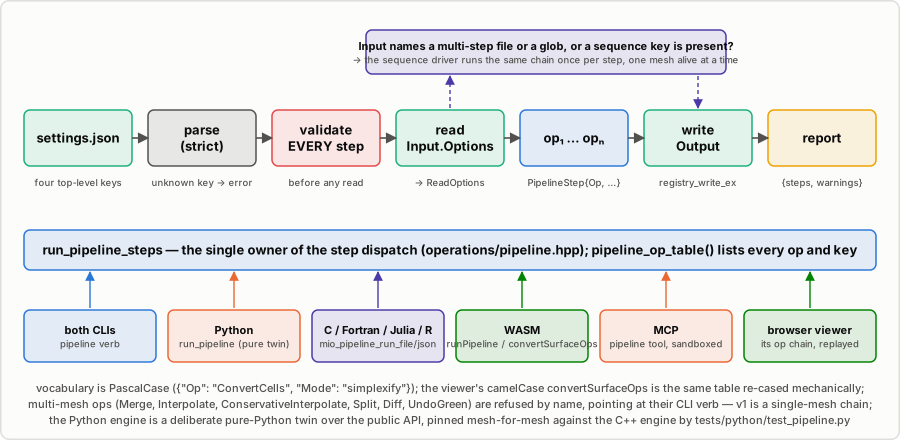
Since v9.11.0 meshio++ can run a whole chain of operations declaratively: one settings.json document describes read → operations → write, and every surface executes it — both CLIs (the pipeline verb), Python (meshioplusplus.run_pipeline), C (mio_pipeline_run_file/_json), Fortran, Julia, R, WASM (runPipeline) and the MCP server (the pipeline tool).
meshioplusplus pipeline settings.json            # either CLI
meshioplusplus pipeline settings.json --input other.msh --output out.vtu
meshioplusplus pipeline settings.json --json # machine-readable report{
"Version": 1,
"Input": { "Path": "bracket.msh", "Format": "gmsh" },
"Operations": [
{ "Op": "Transform", "RotateAxis": [0, 0, 1], "RotateDegrees": 45 },
{ "Op": "Gradient", "Array": "temperature", "Operator": "gradient" },
{ "Op": "ConvertCells", "Mode": "simplexify" },
{ "Op": "Refine", "Array": "temperature:gradient", "Compare": ">",
"Value": 0.5, "Closure": "redgreen" },
{ "Op": "Clean" },
{ "Op": "Quality" }
],
"Output": { "Path": "out.vtu", "Encoding": "binary", "Codec": "zlib" }
}
The rules
- Vocabulary is PascalCase for op names and parameter keys (
"Op": "ConvertCells","RemoveOrphans": true). Enum values keep the exact lowercase spellings the rest of meshio++ uses ("simplexify","redgreen","cell","rcm"). Refine's comparison key isCompare, neverOp—Opis the step discriminant. - Parsing is strict. An unknown op, an unknown key on a step, an unknown top-level key, or a mis-typed value is an error naming the offender — never silently ignored (the same rule
registry_write_exapplies toOutputoptions a format cannot honour). - Version 1 runs over one mesh at a time. Multi-input/output operations are rejected, and
Partitionattaches labels. Version 2 adds file-backed inputs and terminal spatial fan-out without changing v1 semantics.Diff,ShrinkwrapandConservativeInterpolateremain CLI/API-only multi-mesh operations. - Steps are validated before the input is read — a typo in step 7 never costs reading a 10 GB mesh first.
- The CAD model travels with the mesh as far as the steps that use it (v17.17.0, roadmap 6.1.1). A CAD read (CAD JSON, STEP, IGES) returns a B-rep beside its sampled mesh, and an MFEM NURBS read a NURBS model; the model steps
MeshCadSurface,IgaSampleandIgaRefineact on it, andFitCadhands on the solid it fits.ProjectToCadkeeps it too, since it puts the mesh back on the model. Every other step drops it, since nothing else keeps a model in step with the mesh it changes, so a model step after one fails naming the step that dropped it (step 2 'Smooth' changed the mesh, which drops the model); a model step on an Input that carries none fails naming its format. Output writes the mesh, never the model. A step applied on its own (apply_pipeline_step,run_pipeline_steps, a sequence, the WASM viewer'sconvertSurfaceOps) has no Input read behind it, so the model steps fail there by name. - The run returns a report:
{"steps": [{"op", ...counters}], "warnings": [...]}with PascalCase counter keys (PointsWelded,SectionFaces,NumSkipped, ...).
Top-level schema
| Key | Required | Meaning |
|---|---|---|
Version | no (default 1) | schema version; 1 or 2 |
Input | yes | {Path, Format?, Options?} — Format defaults from the extension, with the sniff_format read fallback |
Operations | no (default []) | the step array; empty = a plain convert |
Output | yes | {Path, Format?, Encoding?, Codec?, FloatFormat?} |
Input.Options narrows the read (see selective reads): PointsOnly (bool), DataArrays (string array; absent = all, [] = none), TimeStep (int), Lenient (bool), Mmap ("auto" | "on" | "off").
Output maps onto registry_write_ex: Encoding ("ascii" | "binary" | "raw_appended"; raw_appended is VTU only, see VTU), Codec ("none" | "zlib" | "lz4" | "zstd", VTU/VTP block codecs), and FloatFormat (a printf-style float format for ASCII writers that take one). An option the output format cannot honour is an error.
Operations
Op | Parameters (defaults) | Notes / counters |
|---|---|---|
Quality | — | attaches quality:* cell data |
Clean | Weld (false), Atol (1e-8), RemoveOrphans (true), DropDegenerate (true), DropDuplicateCells (true) | counters PointsWelded, PointsRemovedOrphan, CellsDroppedDegenerate, CellsDroppedDuplicate |
Smooth | Method ("taubin"), Iterations (10), Lambda (method default), Mu (−0.34), FixBoundary (true), PreserveFeatures (true), FeatureAngle (30), GuardInversion (true) | counters NumNodesMoved, MaxDisplacement, NumSkippedInversion |
Refine | Levels (1), Cells, Region, Array + Compare ("<") + Value (0), Closure ("redgreen"), RecordLevels (false), RecordHierarchy (false) | at most one selector; Compare, not Op; RecordHierarchy attaches refine:cell_id/refine:parent_id and forces refine:entity |
Decimate | Ratio | TargetFaces | MaxError | MaxDeviation (none, and no MaxFaces → Ratio 0.5), Coverage (0.999), MaxFaces (none), Placement ("optimal"), PreserveBoundary (true), PreserveFeatures (true), FeatureAngle (30) | counters FacesRemoved, CollapsesRejected; with MaxDeviation or MaxFaces also Deviation, DeviationMet, Rounds (deviation-bounded) |
Adapt | Hsiz | Size | Metric (none: MMG sizes from the mesh), Hmin, Hmax, Hausd, Hgrad, Hgradreq (MMG's defaults), AngleDetection (45), Optim, NoInsert, NoSwap, NoMove, NoSurf, Nreg, Opnbdy (false), Frozen (a point region), Required (region names) | MMG remeshing (a build with MESHIOPLUSPLUS_WITH_MMG); counters NumPointsIn, NumPointsOut, NumElementsIn, NumElementsOut, LowFailure, QualityMin, QualityMean; MMG's warnings join the run's |
DiscretizeLevelset | LevelSet (a point_data name, required), Isovalue (0), RemoveSmallComponents (off), Materials (a flat [Ref, Split, RefInside, RefOutside, ...] list), and Adapt's MMG parameters | MMG embeds the isovalue conformally: medit:ref, the cell regions inside/outside and the side region interface; Adapt's counters |
MeshDomain | Hsiz | Size, Holes (a flat [x0, y0, x1, y1, ...] list), and Adapt's MMG parameters | MMG's MMG2D_mmg2dmesh triangulates the planar domain the line cells bound, one cell region subdomain:<k> per enclosed region; Adapt's counters plus NumSubdomains and NumHoles |
Move | Displacement (a point_data vector, required), Moving (region names, required), Lagrangian (1), and Adapt's MMG parameters | MMG's Lagrangian mode (an MMG built with ELAS) moves the Moving regions' boundary facets by the displacement and remeshes; Adapt's counters |
DecimateVolume | Ratio | TargetCells | MaxError (none → Ratio 0.5), Placement ("optimal"), PreserveBoundary (false, unlike Decimate), PreserveFeatures (true), FeatureAngle (30) | counters TetsRemoved, CollapsesRejected |
Partition | Nparts (2), Method ("auto"), Imbalance (0.03), Mode ("eco"), Seed (0), WeightsKey | attaches partition:part; counter Nparts |
Slice (alias Section) | Point, Normal (required), RecordParentIds (false), Chain (false), MinLength (0) | counter SectionFaces; warns when the plane misses; Chain walks a surface's section into polylines (chained sections) |
FitCurves | Tolerance (0), SnapAngle (0), Normal, MinArcPoints (4), MinArcSweep (5) | lines, arcs and circles from a chained section, written as sketch:piece and the sketch:* field data (fit curves); counters NumLines, NumArcs, NumCircles, MaxResidual |
Silhouette | Normal (0, 0, 1), Clearance (0), RoundAngle (180), ArcSegments (64), Extrude (false), Region (""), MergeTolerance (1e-9) | the outline of a part along Normal, holes included, as a chained line mesh (or, with Extrude, the prism over it) (silhouette); counters NumLoops, NumHoles, Area, Perimeter |
Measure | Spec (a JSON file's path, or the JSON text), Require (false) | elements, dimensions and GD&T tolerances (measure); the mesh gains its element table; with Require, a failing check stops the pipeline; counters NumElements, NumDimensions, NumTolerances, NumFail |
AlignDatums | Primary, Secondary, Origin ("") | the 3-2-1 datum alignment of a measured mesh (measure) |
RemoveIslands | Connectivity ("edge"), MinDiagonal (0.01), MinArea (0), MinCells (0), Relative (true), DryRun (false) | drops the small connected components (remove islands); counters NumComponents, NumRemoved, NumCellsRemoved |
FlipNormals | Region ("") | reverses the winding of every cell or a region's (flip normals); counter NumFlipped |
Clip | Origin, Normal (required), Keep ("below"), Cap (true) | cuts a surface by a plane, keeps a side and caps it (clip); counters NumSplit, NumCapTriangles, NumLoops |
ProfileSolid | Features (text, required), Step (""), Scan (""), Provider (""), Deflection (0) | the current mesh, a fit_curves sketch, built into a solid through a CAD provider (profile solids); counters Volume, NumFaces, Valid |
FaceSupport | Scan (a path, required), Tolerance (0), MeasuredShare (0.9), InferredShare (0.1), HoleData ("repair:hole") | the scan's support of each face of the current fit_cad solid (closing the CAD loop); counters NumMeasured, NumPartial, NumInferred, ShareWithin |
FitCadIterate | Step (""), PartClass ("any"), TargetWithin (0), TargetExplained (0), SegmentTolerance (0), FitTolerance (0), MaxRounds (4), WorstFaces (3), RefineFactor (0.25), Backend ("auto") | the current mesh (a closed scan) to its best solid (closing the CAD loop); counters NumRounds, BestRound, TargetMet, ShareWithin |
ConstrainPrimitives | FaceTolerance (0), AngleTolerance (-1), DistanceTolerance (-1), MinFraction (-1), Force, Forbid ("A:B:REL" texts, comma-separated) | fitted primitives related under control (constraining primitives); counters NumConstrained, NumGroups, NumRelations, NumUnmet |
OffsetSurface, Thicken, Hollow | Distance, Thickness or Wall (required), Side ("inward", Thicken), SmoothIterations (0) | offsets a surface, thickens it into a closed shell or hollows a closed one (offset); counters MaxMove, NumFolded, NumRimQuads |
Sections | Offsets (required), Direction ([0, 0, 1]), MinLength (0), RecordParentIds (false) | replaces the surface with its chained line sections at the planes n . x = offsets[k], merged with section:offset; counter SectionCells |
Gradient | Array (required), Operator ("gradient"), Method ("green-gauss"), Location ("cell"), Output, Component | counters NumSkipped, NumFallback; warns on skipped cells |
Normals | PointNormals (true), CellNormals (false), Weight ("angle" | "area"), SplitAngle (absent → one smooth normal per point; a number of degrees in [0, 180] splits vertices at creases), RecordParentIds (false), Region | attaches normals; counters NumIsolated, NumUndefined, NumDegenerate, NumSplitPoints, NumAddedPoints; warns when the input winds inconsistently and no split was asked for; see normals |
FeatureEdges | FeatureAngle (30), Feature, Boundary, NonManifold, Inconsistent (all true), Region | replaces the mesh by its feature edges, line cells with feature:kind/feature:angle; counters NumFeature, NumBoundary, NumNonManifold, NumInconsistent; see feature edges |
OptimizeVolume | MaxIterations (10), Relocate (true), Flip (true), PreserveBoundary (true), MinImprovement (1e-6), Objective (worst; energy is the ODT energy), MaxRingSize (7) | ODT remeshing of a tetrahedral mesh (see optimize_volume); reports the flip counts, NumEdgeRemovals, NumMultiFaceRemovals, NumWorstSmoothed, NumVerticesMoved, NumTets, MinQualityBefore/After and MinDihedralBefore/After |
Select | Name (required), Kind (cell), Tag (-1), Mode (all), BoundaryOnly (true), Bbox, Point + Normal, Center + Radius, Where + Compare (<) + Value, Quality + QualityCompare (<) + QualityValue, Component (-1: off), Seed, FeatureAngle (30), NormalTolerance (0) | a data step: writes one named point, cell or side region (see select); reports NumCandidates, NumSelected, NumGrown and NumComponents |
Segment | FeatureAngle (30), NormalTolerance (0), CurvatureTolerance (0), MinPatchCells (1), Region, Prefix (patch), Method (angle; primitive ends a patch where its primitive does), Tolerance (1e-3 of the diagonal, primitive only) | a data step: adds segment:patch, segment:adjacency and one cell region per patch (segment); reports NumPatches, NumMerged, NumFeatureEdges, NumBoundaryEdges |
FitPrimitives | PatchData (segment:patch), Tolerance (1e-3), Relative (true), MinInlierFraction (0.9), Types (all), MaxIterations (50), Region (""), Seeds (none: a flat list of x, y, z triples), FeatureAngle (30), RimAngle (15), OutputRegion (fit:feature), UsedPoints (auto), Criterion (least_squares; minimum_zone, min_circumscribed, max_inscribed) | a data step: adds fit:* cell data and fit:patch_* field data, and with Seeds the cell region OutputRegion (fit primitives); reports NumPatches, NumPlane … NumTorus, NumUnfitted, NumFeatureCells |
FitCad | Path (none), Tolerance (0: automatic), ExactEdges (true), Types (all; [] facets everything), MeshDeflection (0: automatic), MaxDemotionRounds (8), Freeform (true), FreeformDegree (3), FreeformMaxControl (64), FreeformSplit (true), Fillets (true), Threads (true), MergeFaces (true), Backend (auto, occt or native) | the fitted skin becomes a CAD solid through the optional OpenCASCADE backend, or the kernel-free native backend without it (fit CAD), written as STEP to Path when given; the mesh continues as the solid re-meshed with fit_cad:* cell data (native: the skin itself); reports Native (1 when the native backend built it), Valid, VolumeRatio, MaxDeviation, NumFaces, NumBspline, NumSplitPatches, NumFillet, NumHelical, NumVariableFillet, NumBlend, NumRoundedThread, NumVertexBlend, NumChamfer, NumConicBlend, NumTaperedThread, NumVariablePitchThread, NumFacetedFaces, NumDemoted. Backend: "occt" raises naming -DMESHIOPLUSPLUS_WITH_OCCT=ON in a build without it. RefineSegmentation (false; v17.11.0) first refines the patches as the RefinePatches step does, with MaxRefineIterations (10), RefineEpsilon (1e-3), NormalWeight (1), AllowMerge (true), AllowSplit (true), RansacSeed (an integer in [0, 2^53]; default 0x6d657368696f2b2b), RefineTolerance (1e-3) and RelativeTolerance (true); only then does the report add Refined (1), NumRefineSplits, NumRefineMerges, ExplainedAreaFraction and RefinementKept (1 when the solid was built from the refined patches), so a report without it is unchanged. FreeformGeneral (false) tries a patch the plane and cylinder freeform fit leaves unexplained as a general B-spline face, with FreeformTolerance (0: a quarter of the tolerance), FreeformSmoothing (1e-12), MaxFreeformPoles (40), MaxFreeformIterations (30) and MaxFreeformSplits (2), and adds NumFreeformGeneral, NumFreeformRefinements and AvgFreeformPoles; OpenCASCADE only, SewTolerance (0: the tolerance) sets the sewing tolerance, ExtendSurfaces (false; adds NumExtendedEdges) extends freeform surfaces past their patches, SnapJunctions (false; adds NumSnappedJunctions) places the corners where analytic faces meet by least squares, and FaceDeviation (false; adds HausdorffMax and HausdorffRms) measures each face against the skin as fit_cad:face_hausdorff / fit_cad:face_rms field data. Every run reports Closed (1 when every shell is closed) after NumDemoted. FreeformMode (legacy, so a report without it is unchanged; adaptive, network, auto; v17.12.0) picks the freeform mode, with FreeformParameterization (auto), ExtraordinaryVertex (g1x), LocalRefine (knots), FreeformG1ToleranceDeg (1), FreeformMaxControlPoints (400), LayoutTargetPatchSize (0.1), LayoutMaxValenceDeviation (2), ResegmentRounds (2), LayoutSnapToFeatures (true), ValidateBySurfaceSampling (true) and ConstrainPrimitives (false, the constrained primitives); only outside legacy does the report add BrepChecked, FacetAreaFraction, NumFreeformAdaptive, NumNetworkPatches, NumNetworkEdges, NumExtraordinaryVertices, NumResegmented, NumEscalations and MaxG1AngleDeg, only with ConstrainPrimitives NumConstrainedPrimitives and NumConstraintGroups, and the mesh continues with the fit_cad:face_table field data |
RefinePatches | Tolerance (1e-3), Relative (true: a fraction of the diagonal), NormalWeight (1), Epsilon (1e-3), FeatureAngle (30), MaxIterations (10), MinPatchCells (3), RansacSeed (an integer in [0, 2^53], the most a JSON number holds exactly; default 0x6d657368696f2b2b), Types (all), AllowSplit (true), AllowMerge (true), Prefix (patch) | a data step (v17.11.0): refines the segment:patch labels of a prior Segment step by variational shape approximation (refine_patches) — boundaries move, freeform patches are split by seeded RANSAC and neighbours one primitive explains merged — and rewrites segment:patch, segment:adjacency, the patch regions and the fit:* data, adding refine:* field data; points and connectivity are untouched. Raises without segment:patch. Reports NumPatches, NumIterations, NumSplits, NumMerges, NumPrimitive, NumFreeform, ExplainedAreaFraction, HausdorffMax and Stop, why it stopped as a number (report counters are numbers): 0 unchanged, 1 small_gain, 2 iteration_cap, 3 energy_rose |
EditRegions | Edit (union | intersection | difference | rename | retag | delete), Inputs (region names), Output, Kind (pins the inputs' kind), Dim, Tag, KeepInputs (true) | one region edit, points/cells/data untouched — a list of edits is a list of steps; counter NumRegions; see editing regions |
RegionAdjacency | Regions (optional ordered list of Cell-region names) | replaces the mesh with conforming shared facets; when fewer than two Cell regions exist, multiple cell blocks are treated as groups; counters NumFacets and Measure; see region adjacency |
FindInterface | RegionA, RegionB (Cell-region names); Mode ("conforming" or "proximity"), Master ("a" or "b"), GapTolerance (0), AngleTolerance (30), OverlapTolerance (0) | replaces the mesh with matched master facets; counters NumPairs, Area, MaxGap, UnmatchedA, UnmatchedB; this pipeline form selects both parts from the current mesh |
SplitInterface | Region (Side-region name), AddCohesive (false) | duplicates node fans along the Side region and optionally inserts cohesive cells; counters NumDuplicatedPoints, NumCohesiveCells; see interfaces and contact |
QualityGate | Require (threshold texts, e.g. ["scaled_jacobian >= 0.2"]), MaxInverted (0), MaxDegenerate (0; negative disables either) | a gate, not a transform: the mesh passes through untouched and a failed check stops the pipeline with the summary as its error; counters NumChecks, NumFailed; see quality gate |
CheckConformity | Tolerance (1e-9, a fraction of the facets' bounding-box diagonal), Require (true), AttachFlags (false) | a gate by default: a mesh that is not conforming (a hanging node, T-junction, partly overlapping or unwelded facet pair) stops the pipeline, naming the counts; with Require false it only reports, and AttachFlags writes conformity:hanging onto the mesh that flows on; counters NumHangingNodes, NumTJunctions, NumPartialOverlaps, NumUnweldedFacets; see conformity |
CheckTetrahedra | ZeroVolumeFactor (1e-6, a fraction of the longest edge cubed), Require (true) | a gate by default: a mesh with an inverted or degenerate tetrahedron or an overlapping pair stops the pipeline, naming the counts; with Require false it only reports; the mesh flows on unchanged; counters NumTetrahedra, NumInverted, NumDegenerate, NumOverlaps; see tetrahedron check |
FindIntersections | Other ("": a mesh file to test against), Region, RegionOther (""), Require (true), AttachFlags (false) | a gate by default: a surface that intersects itself (or meets Other) stops the pipeline, naming the pair count; with Require false it only reports, and AttachFlags writes intersections:count onto the mesh that flows on; counters NumPairs, NumTrianglePairs, NumCoplanar; see intersections |
Thickness | Other (""), Direction ("auto"), MaxDistance (0), Min (0), Region, RegionOther (""), Require (true), Method ("ray", "sphere" or "cone"), ConeAngle (15), ConeRays (16), TwoSided (false), MaxNormalDeviation (90) | thickness:distance and thickness:hit_cell flow on; with Min, a facet below it stops the pipeline unless Require is false; counters NumHit, NumMissed, NumBelow, Min, Max, Mean, P2, P95; see thickness |
Deviation | Reference (required unless Element names an element of the mesh's own table), Patch (-1: the surface), Element ("": an element of the Reference's, or the mesh's, element table), Tolerance (0), MinShare (0), Require (true), Bins (20), MaxNormalAngle (90), ReferenceRegion (""), Register (false) | deviation:distance flows on; with Tolerance and MinShare, a share within tolerance below MinShare stops the pipeline unless Require is false; Register lays the scan onto the reference first and the registered scan flows on; reports NumMeasured, Min, Max, Mean, Rms, Sigma, ShareWithin, and with Register RegistrationRms (deviation) |
DeviationRegions | Tolerance (required), Field ("deviation:distance"), Prefix ("deviation:"), MinArea (0) | one named cell region per region beyond tolerance and deviation:region; reports NumExcess, NumMissing, NumDropped (deviation) |
Exaggerate | Field ("deviation:distance"), Scale (10), Clamp (0), SmoothFraction (0.01) | points moved along their normals by the scaled deviation; reports NumMoved, Clamp (deviation) |
Colorize | Field (required), Cmap ("viridis"), VMin, VMax (0, 0: automatic), Symmetric (false), Steps (0), NanColor ("#808080"), Component (-1) | UInt8 red, green and blue data on the field's location; reports VMin, VMax (colorize) |
Snapshot | Path (required: .png, .txt, .ansi, .html or .cast), Width (320), Height (240), Supersample (1), Cols (100), Rows (40), Encoding ("halfblock" | "quadrant" | "sextant" | "braille" | "ascii"), ColorDepth ("truecolor" | "256" | "16" | "mono"), PngCompress (0), the camera View, Azimuth, Elevation, Roll, Perspective, Fov, Zoom, Shading, Edges, FeatureAngle, the colours Background and FillColor (#rrggbb[aa] or none), colouring by ColorBy, Component, Cmap, VMin, VMax, Colorbar, Axes, ScaleBar, and the field options Reduce, Expr, ClipLow, ClipHigh, Symmetric, Scale, ScaleThreshold, Categorical, ColorRegions, CategoryEdges, Isolines, IsoLevels, Vectors, VectorCount, Warp, WarpScale, WarpOutline, Diagnostic, QualityMetric, and the cut-away Cutaway (a flat list of numbers, six per plane, at most two: a point, then the normal of the side kept) with CutawayTint, and the streamlines Streamlines (a vector point array), StreamSeeds (40), StreamLength (0.5) and StreamColor, and the theme Theme ("none" | "synthwave"), GridFloor, Bloom, Fringe and Scanlines | a side output, not a transform: the mesh passes through untouched and the software rasterizer writes the frame as it stands at this point, so a Smooth or Decimate can be shown before and after in a report; counters Width, Height. The parameters are the options of snapshot, with the same names in PascalCase |
GeodesicDistance | Sources (point ids), SourceRegion, TimeFactor (1), Tolerance (1e-10), MaxIterations (0: automatic) | attaches geodesic:distance point data (geodesic distance); counters NumSources, NumUnreached, MaxDistance, Converged |
Parameterize | Padding (0.02), MaxDepth (8), MaxStretch (2) | a UV atlas: uv point data, the surface split at its seams (parameterize); counters NumCharts, NumFlipped, Stretch, PackingEfficiency |
LaplacianEigenmodes | NumModes (10), Tolerance (1e-8), MaxIterations (0: 300) | attaches laplacian:modes point data and laplacian:eigenvalues field data (eigenmodes); counters Iterations, MaxResidual, Converged |
Morph | Array (required: the displacement point data), FixBoundary (true), ConstrainedArray (""), Stiffening (1), Steps (1), AllowInverted (false), Tolerance (1e-10), MaxIterations (0) | moves the constrained points by Array and the rest by its harmonic extension (morphing); counters NumConstrained, NumInverted, MaxDisplacement, Converged |
Untangle | FixBoundary (true), Rings (2), Smooth (false), MaxSweeps (100) | moves nodes until no tetrahedron or hexahedron corner is inverted (untangling); counters NumInvertedBefore, NumInvertedAfter, MinQualityAfter, Sweeps |
PrepareMetric | Arrays (required: the metric fields), Output ("metric"), TargetVertices (0: skip), Norm (2; 0: infinity), Hmin, Hmax (0: open), Gradation (0: skip), MaxSweeps (100) | intersects, normalises, clamps and grades metric fields into point data Output (metric toolbox); counters ComplexityBefore, ComplexityAfter, NumGraded |
ConvertCoordinates | System ("cylindrical" or "spherical"), Axis ([0, 0, 1]), Origin ([0, 0, 0]), Reference ([1, 0, 0]), Arrays (vector/tensor names), Inverse (false), RecordCoordinates (true) | records coords:<system> point data and rewrites the named arrays in local components (coordinates); counters NumArrays, NumSingular |
ConvexHull | Dimension (0: 2 for flat points, else 3; or 2, 3) | replaces the mesh with the convex hull of its points: a triangle surface or a line loop of the extreme points with hull:point_id (hull); counters Dimension, NumVertices, NumFacets, Area, Volume |
ReconstructSurface | Normals ("normals"), K (8), CellSize (0), Resolution (0), MaxDistance (0), EstimateNormals (true), NormalsK (16), MaxCells (20000000) | replaces the mesh with a triangle surface through its points, the zero level set of the signed distance to their tangent planes (surface reconstruction); counters NumSamples, Spacing, CellSize, MaxDistance, NumLatticePoints, NumUndefined, NumTriangles, NumComponents, EstimatedNormals |
EstimateNormals | K (16), Orientation ("consistent", "viewpoint" or "none"), Viewpoint ([0, 0, 0]), RecordVariation (false) | attaches normals point data from local plane fits (point-cloud normals); counters NumDegenerate, NumComponents |
RegisterRigid | Target (required: the mesh file to register onto), Method ("point_to_point" or "point_to_plane"), MaxIterations (50), Tolerance (1e-10), MaxDistance (0: keep all pairs), Initial ("identity" or "auto"), SymmetricCheck (false), SourceRegion (""), TargetRegion (""), AdaptiveTrim (0), RotateData (false) | moves the mesh onto Target by iterative closest points (rigid registration); counters NumRejected, InitialRms, Rms, Iterations, Converged |
RegisterLandmarks | SourcePoints, TargetPoints (required: as many x, y, z triples, three or more), Weights, RotateData (false) | moves the mesh by the rigid motion laying the picked points onto their targets (landmarks); counter Rms |
AutoAlign | AngleTolerance (10), Subdivisions (3), Region (""), RotateData (false) | poses the mesh on its largest flat face, or a cylinder on its axis, lowest point at z = 0 (auto-align); counters Share, AxisMode (1 for the axis pose) |
Delaunay2D | — | replaces the cells with the Delaunay triangulation of the points' x, y (every point kept) (hull); counters NumTriangles, NumDuplicates |
EstimateError | Array (required), Method ("zz"), Marking ("none" | "absolute" | "fraction" | "dorfler"), MarkingValue (0), Output, Marked | attaches error:zz (and error:marked when Marking isn't "none"); counters GlobalError, NumSkipped, NumMarked; warns on skipped cells |
ErrorSize | TargetError (required, positive), Array ("error:zz"), Order (1), MinSize (0: no bound), MaxSize (0: no bound), Output ("size") | a data step (roadmap 6.10.2): the per-cell indicator an EstimateError step attached becomes a per-point size array by the Zienkiewicz-Zhu adaptive procedure (error estimation), what a later mesh_cad_surface's background reads; geometry untouched, an existing Output replaced. Counters NumCells, NumSkipped, NumClamped, MinSize, MaxSize; warns on skipped cells |
Isosurface | Array (required), Isovalue (0) or Isovalues, Component, RecordParentIds (false) | counter ContourCells; warns when empty |
Transform | exactly one of Translate[3], Scale (number or [3]), RotateAxis[3]+RotateDegrees, Matrix[16] (row-major), ScaleUnits (a factor, e.g. 0.001 for mm→m); plus RotateData (false) | |
ConvertCells | Mode ("linearize" | "simplexify" | "elevate"), RecordParentIds (false) | |
Subdivide | RecordParentIds (false) | one polyhedral child per 3D cell face, connected to a new interior point; no per-type template table |
Tessellate | Levels (2), Curved (true), Fields (true), RecordStencil (false) | isoparametric subdivision of the curved cell types (triangle6, quad8, quad9, tetra10, hexahedron27) onto a reference lattice into triangle/tetra cells, every other cell passing through, with the tessellate:* provenance arrays (curved tessellation); counters NumCurvedSourceCells, NumPassThroughSourceCells, NumPoints, NumCells, NumFacetsWithBadCount (zero for a conforming tessellation) |
Agglomerate | TargetGroupSize (8), MergeCoplanarFaces (false), CoplanarAngle (1), MinSphericity (0) | greedy seed-and-grow over the shared-face dual, merging face-adjacent cells into one polyhedron per group; the many-to-one counterpart to Subdivide; counters NumFacesMerged, NumRejected; see agglomerate |
TetToPoly | FeatureAngle (1), PointDataToCellData (false), RecordVertexIds (false) | the median dual of a tetrahedral mesh, one polyhedron per vertex (see tetrahedral ⇄ polyhedral); reports NumNewPoints, NumBoundaryFaces and NumSplitVertices |
PolyToTet | RecordParentIds (false) | simplexify, keeping a polyhedron that already is a tetrahedron as one tetra; reports NumExactTets and NumFannedCells |
Crop | one of Bbox[6] ([xmin,ymin,zmin,xmax,ymax,zmax]), Point[3]+Normal[3], or Where (a scalar cell_data name) + Compare ("<") + Value (0); Mode ("all" | "any", not with Where), RecordIds (false) | counter CellsKept |
ExtractSurface | RecordParentIds (false) | |
ExtractSkin | Linearize (false) | |
Reorder | Method ("rcm" | "morton" | "hilbert") | |
DataDrop | Point/Cell/Field (string arrays), IgnoreMissing (false) | |
DataKeep | Point/Cell/Field — only locations mentioned are touched; [] drops all there | |
DataRename | Point/Cell/Field, entries "OLD:NEW" (split on the last colon — names carry colons: gmsh:physical) | |
SetsToData | Location (cell; point or cell), optional Name, Join (-), Order (all distinct set names once; omitted/empty uses mesh set order) | Scalar Int64 labels; later overlaps win, uncovered rows are -1; removes converted regions |
DataToSets | Location (cell; point or cell), required Key | Scalar integer field → region-backed sets; removes source field |
DataCalc | Expr ("NAME = EXPRESSION", split on the first =), Location ("point"), Overwrite (false) | |
DataCondition | Mode ("clamp" | "normalize" | "standardize"), Location ("point"), Names, Scope ("component" | "magnitude"), Lo (0), Hi (1), NanPolicy ("ignore"), NanReplacement (0), Suffix | |
TensorInvariants | Location ("point"), Names (every 6- or 9-component array by default), Outputs ("mises,principal,hydrostatic,deviatoric" by default), Prefix, Suffix, Overwrite (true) | |
ToCell / ToPoint | Names; ToPoint also Weight ("uniform" | "measure") | |
MeshCadSurface | TargetSize (required), MaxChordalDeviation (0), MinPointsPerEdge (0), Tolerance (0: automatic), RecordFaceIds (true), Edges (true), MatchUnreferencedTrims (true), Strict (false), MaxPoints (50000000), MinAngle (0), SmoothIterations (0), SmoothMethod ("laplacian" | "odt"), Order (1), CurvatureDeviation (0), CellsAcrossGaps (0), Grading (0: 1.5), PoleRings (0), FaceSizes and EdgeSizes (flat [index, size, …] lists, 0-based), Background (a mesh path) and BackgroundArray ("size"), Metric ("mean" | "varying"), VirtualEdges (false), ReparamConditionNumber (0), ModelTolerances (true since v19.0.0), VirtualFaces (true since v19.0.0), LopCorners (false), MetricBackground (a mesh path), MetricArray and MetricError (0), Untangle (false), Quads (none, dominant or all), QuadPairs (matching or greedy) | a model step: meshes the B-rep the Input read carries (mesh generation), the options of mesh_cad_surface in PascalCase; the mesh becomes the surface mesh. Counters NumPoints, NumTriangles, NumFaces, NumFailed, NumOpenEdges, NumNonManifoldEdges, NumRefinementPoints, NumCurvedStraightened, MinAngleDeg, MaxAngleDeg, NumReparametrised, NumMergedFaces, NumLoppedCorners, NumUntangled, NumQuads; the operation's warnings join the run's, prefixed MeshCadSurface: |
IgaSample | Subdivisions (0: automatic), TrimSamples (16), Trim (true), Edges (true) | a model step: samples the B-rep or NURBS model into Lagrange cells (isogeometric layer); counters NumPatches, NumPoints, NumCells |
IgaRefine | Subdivisions (1), Elevate (0) — each a number or one to three integers, the missing directions at the default — SampleSubdivisions (0), TrimSamples (16), Trim (true), Edges (true) | a model step: refines the model exactly and samples it again; the refined model is the one later steps see, so IgaRefine then MeshCadSurface meshes the refined B-rep. Counters as IgaSample |
ProjectToCad | Model (a CAD JSON, STEP or IGES path; without it, the B-rep the Input read carries while no step has dropped it), FaceArray ("cad:face"), EdgeArray ("cad:edge"), MaxDistance (0: no limit), TrimSamples (16) | moves the mesh's points back onto the model by their cells' cad:face and cad:edge (project to CAD); the model stays with the run after it. Counters NumProjected, NumOnEdges, NumOnCurves, NumOutsideTrim, MaxMove |
BoundaryLayer | FirstHeight (required), NumLayers (3), Growth (1.2), Reverse (false), CollisionFraction (0.45), SmoothIterations (5), MaxShrink (6), Collapse ("points" | "layers"), NormalSmoothIterations (0), FrontCheck (true) | grows prismatic layers from the triangle and quad surface (boundary layers); the mesh becomes the layers, wall and cap. Counters NumCells, NumShrunk, NumCollapsed, NumFewerLayers, NumFrontCrossings, MinScaledJacobian |
Extrude | Direction ([0, 0, 1], the whole displacement), NumLayers (1), Ratio (1), Offsets (none), RecordLayers (false), MaxCells (20000000) | sweeps the surface into a volume (or a curve into a surface); counters NumCells, NumFlipped, MinScaledJacobian; see sweeps |
Revolve | Axis ([0, 1, 0]), AxisPoint ([0, 0, 0]), Angle (360, degrees), NumLayers (16), Tolerance (1e-9), RecordLayers (false), MaxCells (20000000) | sweeps it around an axis; counters NumCells, NumOnAxis, MinScaledJacobian; see sweeps |
Mirror | Point ([0, 0, 0]), Normal ([1, 0, 0]), Plane ("": or "auto", the mesh's own symmetry plane), KeepOriginal (false), Weld (true), Tolerance (1e-9), ReflectData (false) | reflects across the plane with every cell right side out; counters NumFlippedCells, NumPointsOnPlane, NumDroppedCells, and with "Plane": "auto" SymmetryShare; see mirror |
Tetrahedralize | Backend ("auto" | "netgen" | "octree", or a mesher's name such as "tetgen" or "gmsh"), MaxSize (0: none), MaxVolume (0: none), Grading (0.3), OptimizeSteps (3), MaxCells (50000000), FaceArray ("cad:face") | fills the closed triangle surface with tetrahedra, its triangles kept through Netgen or its boundary fitted through the native octree backend (tetrahedralize); the mesh becomes the tetrahedra and the surface. Counters NumTetrahedra, NumPoints, NumNewPoints, NumRegions, NumBoundaryTriangles, BoundaryPreserved (1 or 0), HausdorffToSurface, MinDihedralDeg, MaxDihedralDeg, Volume; the operation's warnings join the run's, prefixed Tetrahedralize:. Backend "auto" takes Netgen when the build has it (-DMESHIOPLUSPLUS_WITH_NETGEN=ON) and "octree" otherwise; "netgen" without it fails naming the flag |
RemeshQuads | TargetFaces (0: half the triangles), Backend ("auto" or a quad remesher's name, "quadriflow" | "instant_meshes"), Sharp (false), Boundary (true), Adaptive (false), Dominant (false), Seed (0), MaxCells (50000000) | remeshes the triangle surface into field-aligned quads through an installed QuadriFlow or Instant Meshes, run as a separate process (remesh_quads); the mesh becomes the quads. Counters NumQuads, NumTriangles, NumPoints, MinScaledJacobian, MeanScaledJacobian, HausdorffToSurface; the operation's warnings join the run's, prefixed RemeshQuads:. No remesher installed fails naming the programs |
CutLevelSet | LevelSets (point_data names), Planes (six numbers per plane: origin, then normal), Selection ("": <first> < 0), IncludeUncut (true), Backend ("auto" | "lut" | "quadrays"), Degree (2), Triangulate (false), RecordParentIds (true) | the part the level sets select, through CutCells (level-set cutting); counters NumCells, NumCutCells, NumUncutCells, NumPieces, Dimension, Measure; without CutCells the step fails naming MESHIOPLUSPLUS_WITH_CUTCELLS |
Sequences (transient / multi-file runs)
Since v9.12.0 the same document can describe a whole transient run: a glob/list input, the chain applied per step, and a fan-out or fan-in output. Eight additional keys, all optional:
| Key | Where | Meaning |
|---|---|---|
Mode | top level | "sequence" / "fan-in" / "fan-out"; asserts the inferred shape rather than selecting it, and errors naming both on a mismatch |
Parallel | top level | run the steps in a thread pool (Python driver only; an error for a fan-in, and the C++ engine warns and runs serially) |
Workers | top level | worker count for Parallel; 0 means one per core |
Pattern | Input | a glob (* and ? only); mutually exclusive with Path/Paths |
Paths | Input | an explicit, ordered list; not re-sorted |
Times | Input | explicit per-step times; the count must match |
TimeFrom | Input | "auto" (the documented precedence) / "file" / "filename" / "index" |
Resample | top level | resample onto new times: Times (an array or {Start, Stop, Step}) or TimesFrom (another sequence's glob), Method ("linear" | "nearest" | "previous"), Extrapolate ("error" | "clamp"), BlendPoints (false); at most two source meshes live — see Resampling onto new times |
Output.Path may carry {step} or {index} to write one file per step.
{
  "Version": 1,
  "Input": { "Pattern": "raw/out_*.vtu" },
  "Operations": [{ "Op": "Quality" }, { "Op": "Clean" }],
  "Output": { "Path": "post/out_{step}.vtu" }
}
Two rules worth stating explicitly:
- A document using none of these keys behaves exactly as before — the C++ engine literally delegates to the single-file
run_pipeline, and Python'srun_pipelinenever enters the sequence code path. - Conversely, the typed single-file parser (
parse_pipeline_json) rejects a sequence key by name rather than ignoring it. Ignoring one would run a transient document as its first step, which is exactly the silent truncation this feature exists to prevent. The CLI verb, Python'srun_pipelineand the MCP tool all route a sequence document to the right engine automatically, so nobody has to know which kind of document they hold.
See sequences for the ordering rule, the time-value precedence, the mode-inference table and the streaming guarantee.
Where the engine lives
The engine is operations/pipeline.{hpp,cpp} in the C++ core, split in two layers:
- The typed layer (
PipelineStep,apply_pipeline_step,run_pipeline_steps,run_pipeline) always compiles and is the single owner of the step dispatch — the browser viewer'sconvertSurfaceOpspipeline goes through the same code, so the viewer's op chips and a settings.json cannot drift apart (the viewer's op specs are the same words in camelCase; the two casings differ by exactly the first character). - The JSON front-end (
parse_pipeline_*,run_pipeline_json/_file) parses the document with nlohmann/json v3.12.0, vendored as a git submodule atsrc/cpp/third_party/jsonexactly like Eigen. When the submodule is absent or-DMESHIOPLUSPLUS_WITH_JSON=OFF, the entry points still exist and throw naming the flag (pipeline_has_json()/mio_pipeline_has_json()/_core.__has_json__report which build you have). Wheels, the release CLI binaries and the from-source builds all carry it; the conan/vcpkg packages currently do not (the submodule is not in a source export — the Eigen rule), so there the C ABI entry points fail by name.
Python's run_pipeline is deliberately a pure-Python twin dispatching over the public Python API rather than the C++ engine: it inherits every operation's C++/numpy parity contract and the per-format Python fallbacks (a gmsh $Periodic input still runs), and it works on an sdist install with no submodule. _core.run_pipeline_file/_core.run_pipeline_json expose the C++ engine too, and tests/python/test_pipeline.py pins the two engines' outputs — and the transcribed op/key table (_core.pipeline_op_table()) — against each other.
Per-surface entry points
| Surface | Call |
|---|---|
| both CLIs | pipeline SETTINGS.json [--input P] [--output P] [--json] [--quiet] |
| Python | run_pipeline(settings, input_path=None, output_path=None) — settings = dict | JSON text | path |
| Python, in memory | apply_operations(mesh, operations, *, version=1) → (mesh, report) — below |
| C | mio_pipeline_run_file(path), mio_pipeline_run_json(text), mio_pipeline_has_json() |
| Fortran | mio_pipeline_run_file(path [, stat, errmsg]), mio_pipeline_run_json(...), mio_pipeline_has_json() |
| Julia | run_pipeline_file(path), run_pipeline_json(text), pipeline_has_json() |
| R | mio_pipeline_run_file(path), mio_pipeline_run_json(text), mio_pipeline_has_json() |
| WASM | runPipeline(settings) — object | JSON text | MEMFS .json path (no nlohmann in the wasm build; JSON.parse does the text forms) |
| MCP | tool pipeline(settings_path, input_path?, output_path?) — the sandbox covers the paths inside the document too |
In memory: apply_operations
apply_operations(mesh, operations) applies the steps to a mesh already in memory and returns (mesh, report), the report shaped as run_pipeline's: the same vocabulary, the same strict validation of every step before any runs, the same counters and warnings, without the Input read and the Output write. It gives a notebook, the Blender add-on or a ParaView filter the whole pipeline without a file.
import meshioplusplus as mp

mesh = mp.read("part.vtu")
out, report = mp.apply_operations(mesh, [
    {"Op": "Refine"},
    {"Op": "Smooth", "Iterations": 5},
    {"Op": "Quality"},
])
report["steps"][0]          # {"op": "Refine", ...counters}

mesh, _ = mp.apply_operations(None, [{"Op": "Generate", "Shape": "box", "Dims": [4, 4, 4]}])
operations is a list of step objects, the JSON text of one, or a whole settings document, whose Operations (and Version) are used and whose Input and Output are ignored; version selects the schema otherwise. The input mesh is never modified, and None is accepted when the first step is Generate. Python's run_pipeline and apply_operations share one step loop, so a chain gives the same mesh and report through either.
Three things need the file run and raise naming run_pipeline: Split and a Partition with RecordIds or GhostLayers, which write one file per piece. A model step (MeshCadSurface, IgaSample, IgaRefine) meshes the CAD model the mesh carries in mesh.info — the brep a CAD JSON, STEP or IGES read or fit_cad leaves, or an MFEM read's nurbs patches — and raises naming mesh.info when there is none; as in a file run, a step that changes the mesh drops the model. Version 2's Merge, Interpolate and UndoGreen still read their Inputs paths. apply_operations is Python-only, and the MCP server lists it among the in-memory APIs it does not wrap: its pipeline tool is the file form.
Structured reports on the flat ABI
The existing status-only entry points remain unchanged. C adds mio_pipeline_run_file_report / mio_pipeline_run_json_report (and mio_sequence_pipeline_run_*_report for sequence documents), returning an owned mio_pipeline_report* or NULL on failure with mio_last_error(). Query mio_pipeline_report_json(report, NULL, 0) for the byte length excluding NUL, allocate that length plus one, then call it again to copy JSON; free the handle with mio_pipeline_report_free. Accessors never rerun the pipeline, including a size query or truncated copy. JSON-enabled builds serialize the same {"steps": [{"op": "Clean", ...PascalCase counters}], "warnings": [...]} shape as Python/WASM, with non-finite counters as null. JSON-disabled builds fail by name, not missing symbol.
Fortran adds call mio_pipeline_run_file_report(path, report, stat, errmsg) / mio_pipeline_run_json_report(text, report, ...), with an allocatable JSON string, and the analogous sequence subroutines. Julia adds run_pipeline_file_report(path) / run_pipeline_json_report(text) and run_sequence_file_report / run_sequence_json_report, returning JSON strings. R adds mio_pipeline_run_file_report(path) / mio_pipeline_run_json_report(text) and analogous mio_sequence_pipeline_run_*_report, returning JSON character scalars (parse with jsonlite::fromJSON if desired). These wrappers copy the report and release its native owner automatically, without requiring a JSON parser dependency in the binding package.
Version 2 spatial multi-mesh steps
Set "Version": 2 to extend the v1 vocabulary. Per-step Inputs is a non-empty array of file paths; paths are resolved relative to the process working directory, like Input.Path. Each auxiliary file is read with inferred/sniffed format and default reader options. For transient auxiliary files, this selects the default first step; select a frame beforehand if another is needed. Downstream ordinary steps operate on the one mesh returned by a multi-input step.
| Step | Role of current mesh / Inputs | Additional parameters |
|---|---|---|
Merge | current mesh first, followed by all Inputs in declared order | Weld (false), Atol (1e-8), SourceTag (true), DataPolicy ("intersection" or "fill"), DropDuplicateCells (false); counter NumInputs includes the current mesh |
Interpolate | current mesh is target; exactly one Inputs source | Method ("nearest"), Arrays (all source point data), Extrapolate (false), DefaultValue (0), OnConflict ("error") |
UndoGreen | current mesh is fine; exactly one Inputs coarse mesh | counters NumGroupsUndone, NumCellsRemoved |
terminal Split | splits the current mesh; no extra inputs | By ("type", "component", "region"/"tag", "regions"), Tag; requires Output.Pattern with {key} |
terminal Partition with a pattern | decomposes the current mesh into pieces | v1 partition parameters plus RecordIds (false), GhostLayers (0); requires {part} |
Split and partition-to-pieces must be the last step: no implicit downstream branch processing. Without a pattern, v2 Partition still attaches labels as in v1; RecordIds/GhostLayers are valid only for fan-out. Output.Pattern and Output.Path are mutually exclusive. Patterns replace all occurrences of {key} for Split or {part} for Partition (zero-based part ids); unknown/mixed tokens are errors. Split keys retain ASCII letters, digits, ., _ and -; every other UTF-8 byte becomes _, and empty/./.. keys become _. Before writing any piece, both engines reject canonical-path collisions between outputs or with any input, including collisions caused by sanitization or existing symlinks. Existing non-input destinations are overwritten; writes are not an all-or-nothing filesystem transaction. Zero pieces write no files and report NumPieces: 0.
{
  "Version": 2,
  "Input": {"Path": "left.vtu"},
  "Operations": [
    {"Op": "Merge", "Inputs": ["right.vtu"], "Weld": true},
    {"Op": "Partition", "Nparts": 2, "Method": "sfc", "RecordIds": true}
  ],
  "Output": {"Pattern": "part_{part}.vtu", "Codec": "none"}
}
Python, native C++, both CLIs, C/Fortran/Julia/R status/report entry points and WASM runPipeline accept the same document. Native typed callers use Pipeline.mVersion = 2 and place the pattern in PipelineOutput.mPath; installed layouts are unchanged. pipeline_v2_op_table() / _core.pipeline_v2_op_table() expose the extended vocabulary; the existing per-mesh apply_pipeline_step and pipeline_op_table remain v1. MCP checks all auxiliary inputs and each expanded output against its configured sandbox, including output symlinks.
Spatial Version 2 is deliberately separate from transient sequence documents (Mode, Input.Paths/Pattern, {step} outputs, resampling): combining that vocabulary is rejected, never an implicit cross-product of branches. A multi-step Input.Path materializes one state, by default the first; use Input.Options.TimeStep to select another, including -1 for the last. Use a v1 sequence pipeline and standalone v2 pipelines for the spatial stages.
- conan/vcpkg packages shipping the parser via a registry
nlohmann_json/3.12.0dependency instead of the submodule.
Generate
{ "Version": 1, "Operations": [ { "Op": "Generate", "Shape": "box", "Dims": [8, 8, 8], "CellType": "tetra", "Order": 2 } ], "Output": { "Path": "block.vtu" } }Builds a mesh from parameters (doc/primitives.md) and replaces the incoming geometry; it never reads the incoming mesh. When Generate is the first step of a single-mesh document, Input may be omitted. A document with any other first step still requires Input, and sequence documents (Mode, Input.Pattern, Input.Paths) always do.
Shape is one of rectangle, box, disk, uv_sphere, icosa_sphere, cylinder, reference_triangle, ngon, annulus, lshape, plate_with_hole, honeycomb, reference_cells, line, circle, helix, sphere_points, box_points, tetra_sphere, octa_sphere, cube_sphere, geo_sphere, torus, moebius, tube, cone, capsule, box_surface, platonic, ball, spherical_shell, pipe, fichera or solid_torus. The other parameters are the shape's arguments in PascalCase, with the defaults of the Python function: Dims (rectangle, box, honeycomb), Size (two values for rectangle and reference_triangle, three for box, a number for lshape and plate_with_hole), Origin, Center, Radius, Height, N (disk, reference_triangle, lshape), Nu, Nv (uv_sphere), Subdivisions (icosa_sphere), Nxy, Nz (cylinder), Sides, Rings (ngon), InnerRadius, OuterRadius, Ntheta, Nr, Angle (annulus), Nt, Nr (plate_with_hole), Edge (honeycomb), Start, End (line), Pitch, Turns (helix), Seed (box_points), MajorRadius, MinorRadius (torus, solid_torus), Width, NumTwists (moebius), Ncap (capsule), Ratio (spherical_shell, pipe), Name (platonic), CellType, Split, Order (up to 10), Complete (full-Lagrange order 2), MaxCells, and Types, Pairs (reference_cells). The step reports NumPoints and NumCells.
Voxelize
{ "Op": "Voxelize", "Resolution": [64, 64, 64], "Fill": "surface" }Keys: Resolution (two entries select 2-D pixels, as [nx, ny, 0] does), CellSize, Bounds, Padding, PaddingRelative, Fill, AttachOccupancy, MaxCells, Sign, Plane (auto, xy, xz or yz, a 2-D skin's plane). Reports NumOccupied.
It and ComputeSdf are the only steps that replace their input's geometry rather than transforming it — read a skin, voxelize it, write a grid. See doc/voxelize.md.
Octree
{ "Op": "Octree", "MaxLevel": 6, "Balance": "face", "Fill": "inside" }Keys: RootCells, MinLevel, MaxLevel, Bounds, Padding, PaddingRelative, Dimension, SampleDistance, Balance, Fill, AttachDistance, EvenOdd, MaxCells, Sign, Transition, Snap, SurfaceLevel, CurvatureThreshold, FeatureAngle, SizeArray, Plane. Reports NumLeaves, NumHanging, NumSnapped and NumRefused.
Like Voxelize it replaces its input's geometry. See doc/octree.md.
OctreeMesh
{ "Op": "OctreeMesh", "Output": "castellated", "MinSize": 0.01, "MaxSize": 0.2, "Fill": "inside" }Keys: Output, MinSize, MaxSize, MaxLevel, Bounds, Padding, PaddingRelative, CurvatureAngle, FeatureAngle, CornerAngle, FeatureSize, GapCells, GapOutside, SizeArray, SurfaceRegion, GradingLayers, SkinGrading, SurfaceSize, WindingThreshold, WindingBeta, Conformity, AlphaLong, AlphaShort, PreserveFeatures, FitIterations, DihedralFloorGuard, Fill, KeepOutside, AttachDistance, AttachQuality, Pillow, HexGrading, UntangleIterations, MaxCells, MaxTets, VolumeFix, ZeroVolumeFactor, CapFlatness, CrossingMargin, CrossingGap. Reports NumLeaves, NumCells, NumInside, NumSurrogateFaces, NumHanging, NumInverted, MinDihedral and MinScaledJacobian.
It replaces its input's geometry with a volume mesh of the skin's inside. See doc/octree_mesh.md.
ComputeSdf
{ "Op": "ComputeSdf", "Structure": "octree", "RootResolution": 8, "MaxDepth": 4 }Keys: Structure ("voxel" | "octree"), Resolution, CellSize, Bounds, Padding, PaddingRelative, RootResolution, MaxDepth, BandCells, RecordLevels, MaxCells, Sign, Location, Band. Reports MaxDepth and NumBanded.
Resolution/CellSize size a voxel grid and are an error with "Structure": "octree", whose finest cell is RootResolution / 2^MaxDepth and is therefore already determined. See doc/sdf.md.