
Error estimation — Zienkiewicz-Zhu recovery + marking
estimate_error(mesh, array, marking=…) estimates the per-cell recovered-gradient error of a point_data field, and can optionally mark cells for refinement. It is a mesh operation, not a file format, uses only standard C++/numpy, and runs under every mesh backend.
meshio++ could already differentiate a field (gradient) and selectively refine a mesh by any scalar cell_data predicate (refine's --where). This is the piece that closes the loop: it produces the indicator refine --where consumes, so the whole adaptive-mesh-refinement cycle — estimate, mark, refine — is three verbs, none of them new numerical code.
import meshioplusplus as mp

mesh = mp.read("solution.vtu")

out = mp.estimate_error(mesh, "T")                 # cell_data["error:zz"]
out, report = mp.estimate_error(
    mesh, "T", marking="dorfler", marking_value=0.6, return_report=True,
)
report["global_error"]  # sqrt(sum of eta_K^2) over evaluable cells
report["num_marked"]    # cells marked in cell_data["error:marked"]

adapted = mp.refine(out, where="error:marked > 0.5")
Where it lives, and why
Like gradient, this consumes and produces data arrays but reads geometry (it composes gradient and the point↔cell averaging round trip), so it lives in the mesh-operations layer (operations/error.hpp), not in the data_* family. It is reachable as meshioplusplus data estimate-error in both CLIs for the same reason gradient is — that is where a user looks for it.
Composition, not a new kernel
The indicator is the standard Zienkiewicz-Zhu (ZZ) superconvergent-patch recovery estimator, built entirely from operations that already ship:
- Differentiate the field once per cell —
gradient(mLocation=Cell), Green-Gauss — giving the raw (unrecovered) per-cell gradientg_K. - Recover a smoothed nodal gradient by averaging the raw gradient onto the points, measure-weighted (
cell_data_to_point_data(weight=Measure)), then back onto the cells (point_data_to_cell_data), givingG_K. - Indicate:
eta_K = sqrt(|measure_K| · sum((G_K − g_K)²))— the recovered gradient error in the energy-like (H1-seminorm) norm.measure_Kreuses the same primitivedata_average'sMeasureweighting already used in step 2, so the two agree by construction.
global_error is sqrt(sum_K eta_K²) over the evaluable cells — the estimated global error in that same norm.
This is why the operation exists as composition rather than a bespoke computation: the recovery step is the existing averaging round trip, reused exactly as gradient(location="point") itself composes cell_data_to_point_data.
Marking
A marking pass turns the continuous indicator into a boolean cell_data array, error:marked (one array per block, Int64 0/1), attached only when marking != "none" — so refine's own where selector needs no change at all:
marking | Meaning of marking_value | Marks |
|---|---|---|
"none" (default) | ignored | nothing — estimate only |
"absolute" | an indicator threshold | every evaluable cell whose indicator exceeds it |
"fraction" | a fraction in (0, 1] of cells | the largest-indicator fraction, k = int(ratio · N + 0.5) |
"dorfler" | a bulk fraction theta in (0, 1] | the smallest indicator-descending prefix whose cumulative eta_K² covers theta of the total |
"dorfler" (the Dörfler / bulk-chunk criterion) is the usual choice for genuine AMR loops: it marks enough cells to reduce a fixed fraction of the total error, rather than a fixed count of cells ("fraction") or an absolute, problem-scale-dependent threshold ("absolute").
Ties in the "fraction"/"dorfler" descending ranking break on ascending global cell index, so the result does not depend on how the per-cell work happened to schedule.
NaN, never a guess
A cell that cannot be evaluated — an unsupported/degenerate gradient cell, a recovery neighbourhood with no finite contribution, or a cell whose measure_K cannot be computed — reads:
NaNinerror:zz(the continuous indicator array), and0, neverNaN, inerror:marked(aNaNthere would make every--wherecomparison false anyway, but writing it as0is what keeps the array's own dtype meaningfully boolean).
Such cells are counted in num_skipped and excluded from global_error and from every marking policy's cell count.
Naming
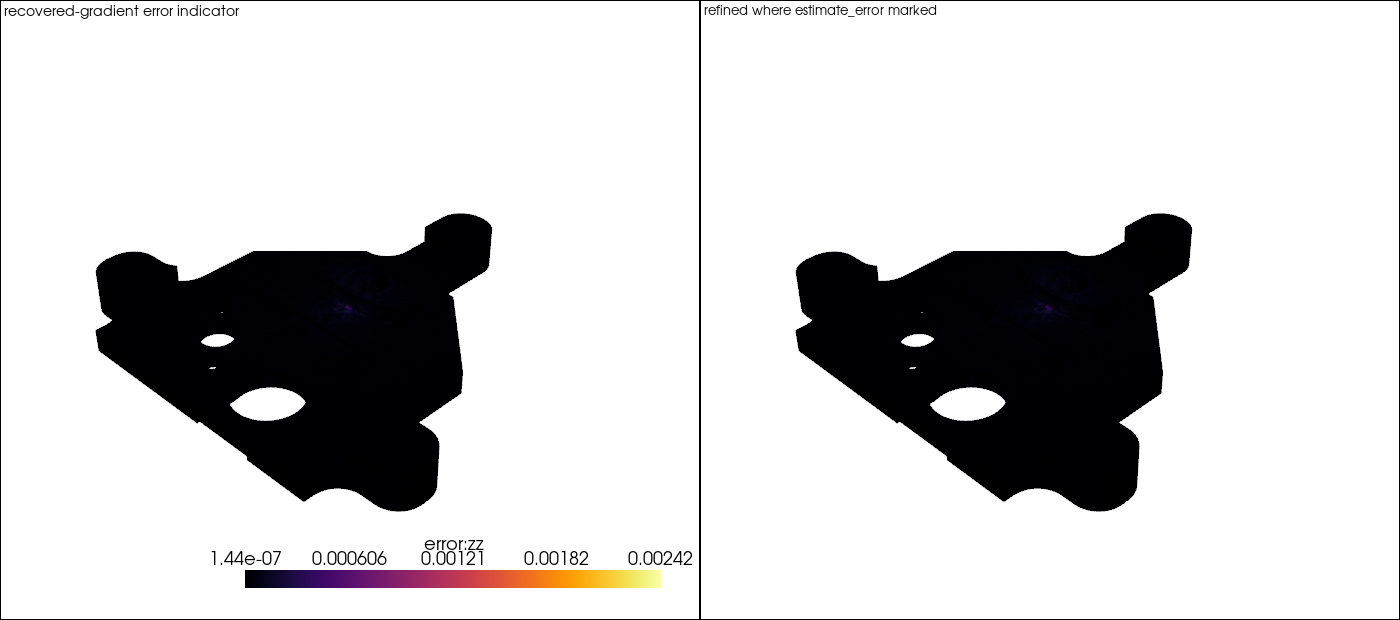
error:zz (Float64) is always attached; error:marked (Int64) only when marking is requested. Default names are fixed and can be overridden:
out = mp.estimate_error(mesh, "T", output="my_indicator")
out = mp.estimate_error(
    mesh, "T", marking="absolute", marking_value=1.0, marked="hot_cells",
)
Unlike gradient's deliberately unusual <input>:<operator> convention, these are fixed constants (error:zz, error:marked) following the repo's usual prefix:name scheme (quality:*, partition:*, refine:*) — the estimator has exactly one continuous output and one boolean output regardless of which field produced them, so there is nothing for the name to disambiguate.
Byte-identity and its limits
The raw (pre-recovery) gradient stays bit-exact across the C++/numpy boundary, since gradient itself needs no tolerance. The recovery step, and so the final indicator, matches the numpy twin only to within a numeric tolerance — the same, already-accepted precedent data_average's own Measure weighting has (test_data_location.py::test_cpp_matches_python compares it with np.allclose, not exact equality). Output stays byte-identical across the three mesh backends and across thread counts.
The numpy twin raises NotImplementedError for:
- a mesh with a ragged/polygon/polyhedron block, and
- a mesh with a quadratic 3-D cell type (
tetra10,hexahedron20/27,wedge15),
both for the same reason _convert_cells.py's simplexify twin is exempt: detail::cell_measure repairs a closed 3-D cell's winding via orient_rings — a discrete branch on a sign — and the Python reference does not attempt to replicate it. A mesh of ordinary linear cells (tetra, hexahedron, wedge, pyramid, and any 1-D/2-D type) is unaffected.
Worked composition — the adaptive loop
import meshioplusplus as mp

mesh = mp.read("solution.vtu")
estimated, report = mp.estimate_error(
    mesh, "T", marking="dorfler", marking_value=0.6, return_report=True,
)
print(f"global error: {report['global_error']:.4g}, "
      f"marked {report['num_marked']} of {len(mesh.cells[0].data)} cells")

adapted = mp.refine(estimated, where="error:marked > 0.5", closure="redgreen")
mp.write("adapted.vtu", adapted)meshioplusplus data estimate-error solution.vtu estimated.vtu \
--array T --marking dorfler --marking-value 0.6
meshioplusplus refine estimated.vtu adapted.vtu \
--where "error:marked > 0.5" --closure redgreenRe-running the loop on adapted.vtu (once a fresh solve has produced a new T) picks up where the last pass left off, since refine's own refine:cell_id/refine:parent_id (record_hierarchy=True) tracks parent/child relationships across passes if you need them.
CLI
meshioplusplus data estimate-error IN OUT --array NAME \
    [--method zz] \
    [--marking none|absolute|fraction|dorfler] \
    [--marking-value V] \
    [--output NAME] [--marked NAME] [--overwrite] [--quiet]
Both CLIs produce the same array names and report the same counters (subject to the recovery step's own numeric tolerance, above). See the CLI reference.
Other languages
double global_error = 0.0;
int64_t skipped = 0, marked = 0;
mio_mesh* out = mio_estimate_error(mesh, "T", "zz", "absolute", 1e-6, NULL,
NULL, 0, &global_error, &skipped, &marked);type(mio_mesh) :: e
real(real64) :: gerr
integer(int64) :: nskip, nmark
e = m%estimate_error('T', marking='absolute', marking_value=1.0d-6, &
global_error=gerr, num_skipped=nskip, num_marked=nmark)e = estimate_error(mesh, "T"; marking=:dorfler, marking_value=0.6)
e.mesh, e.global_error, e.num_markede <- mio_estimate_error(mesh, "T", marking = "dorfler", marking_value = 0.6)
e$mesh; e$global_error; e$num_markedconst e = await m.estimateError(mesh, 'T', 'zz', 'dorfler', 0.6);
e.mesh.cell_data['error:marked'];On the flat ABIs (C, Fortran, Julia, R, WASM) the counters are out-parameters or fields of a returned record, never an opaque handle — gradient/smooth's shape, since there are no index maps to hand back.
This operation is also reachable as an EstimateError step in the settings pipeline and in the browser viewer's convertSurfaceOps chain ({op: 'estimateError', array: 'T', marking: 'dorfler', markingValue: 0.6}), since it is a pure data step: geometry is untouched.