
Polyhedral refinement (subdivide)
subdivide(mesh, record_parent_ids=False) splits every eligible 3D cell into one polyhedral child per face, connected to a new interior point. It is a mesh operation, not a file format, uses only standard C++, and runs under every mesh backend.
refine and decimate both raise by name on a polyhedron block, pointing at convert_cells(mode="simplexify") — both are built on fixed same-type subdivision templates, and an arbitrary polyhedron has none. subdivide is the answer for polyhedral refinement specifically.
import meshioplusplus as mp

mesh = mp.read("bracket.msh")
out = mp.subdivide(mesh, record_parent_ids=True)
mp.write("bracket_subdivided.vtu", out)
No per-type template table
Unlike refine, which is driven by a fixed table per cell type (detail/refine_templates.hpp), subdivide needs none. It goes through detail::cell_rings — the same uniform face-ring abstraction gradient and compute_quality already use — which treats a tabulated type (tetra, hexahedron, wedge, pyramid, and their quadratic variants, reduced to corners) and an existing polyhedron block identically. So the same code handles every 3D cell type the mesh already supports.
The construction
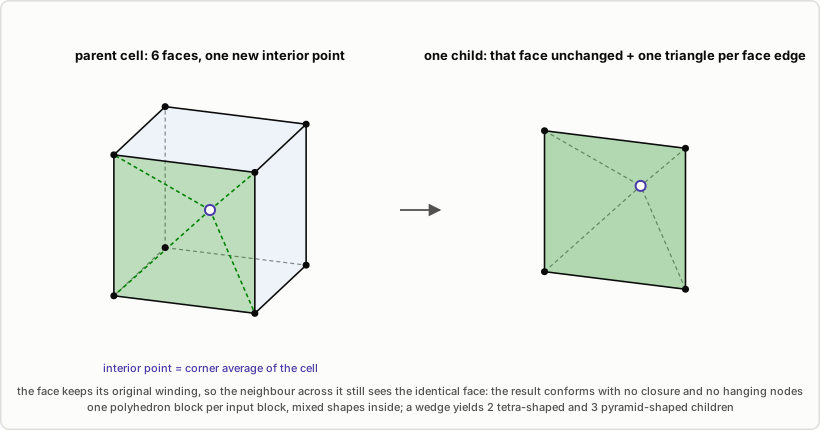
For each eligible 3D cell:
detail::cell_ringsgives the cell's faces as global node-id rings, uniformly whether the cell is tabulated or already a polyhedron.detail::orient_ringsrepairs winding so every face points outward; a cell whose faces are not a closed orientable surface raises (ValueErrorin Python), naming the cell — the same guardconvert_cells(mode="simplexify")uses for its own polyhedron branch.- One new point is added per cell: the plain arithmetic mean of the cell's own corner node coordinates. This is deliberately not the volume centroid (
poly_measure'smCentroid, a different, volume-weighted point) — the corner average is what makes the children's total volume literally the same sum as the parent's own volume computation. - For each face, one polyhedron child is emitted whose boundary is that face unchanged (original winding, so a neighbouring cell across it still sees the identical face) plus one new triangle per face edge, connecting that edge to the cell's new interior point.
This makes the result automatically conforming: no closure, no 2:1 balance, no refine:hanging/refine:entity analogue is needed, because a shared face between two input cells is never touched — only the interior of each cell is subdivided.
Output structure
One polyhedron output block per input 3D block, with genuinely mixed cell shapes inside — AddPolyhedronBlock stores cells as ragged CSR with no constraint that they share a node or face count, so there is no need to group children by distinct node count into polyhedronN blocks the way some readers (CGNS's NFACE_n, OpenFOAM, EnSight) do for their own format-compatibility reasons. A single hexahedron already demonstrates this: a wedge cell's 5 faces (2 triangular, 3 quadrilateral) subdivide into 2 tetrahedron-shaped children and 3 square-pyramid-shaped children, all in one coherent output block.
Non-3D blocks (2D/1D boundary markers) and 3D blocks with no cell_faces row (the full-Lagrange family — hexahedron64, tetra20, the VTK_LAGRANGE_* types) pass through unchanged.
Volume conservation
Since every child is a fan from the parent's own corner average, the children's total volume equals the parent's — checkable near-exactly, not just by the divergence theorem's abstract equality:
before = mp.compute_stats(mesh)["signed_volume"]
out = mp.subdivide(mesh)
after = mp.compute_stats(out)["signed_volume"]
assert abs(after - before) < 1e-9 * abs(before)
Regions
Point and Cell regions (and so point_sets/cell_sets) survive: a parent's children occupy a contiguous run in the output block, so the carry uses CellMapKind::FirstChild — the same shape convert_cells already uses for its own one-to-many splits. Named Side regions survive too (since v16.27.0): a parent facet becomes the child facet that tiles it, which here is the child whose base is the parent's face. See how operations treat regions.
There is no point map to request (unlike convert_cells): subdivide never prunes or renumbers an original point, and new apex points are by construction unreferenced by any existing Point region.
Naming
record_parent_ids=True attaches an Int64 subdivide:parent_cell cell_data array recording, per output cell, the index of the input cell it came from within its own block (blocks correspond 1:1 with the input).
No numpy fallback
This operation is C++-core only, with no pure-Python reference implementation at all — unlike most operations in this repo, which fall back to numpy when the compiled core is unavailable. The winding repair (orient_rings) is a discrete branch on the sign of an enclosed volume, and a second, independently written implementation of that branch could land on the opposite side for a near-degenerate cell and then diverge macroscopically rather than by round-off — the same reasoning _convert_cells.py's polyhedron branch and _smooth.py's inversion guard already document. A pure-Python build (meshioplusplus._core unavailable) raises NotImplementedError naming the reason, for any input, tabulated or not.
CLI
meshioplusplus subdivide IN OUT [--record-parent-ids]Both CLIs produce byte-identical output (there being only one implementation). See the CLI reference.
Other languages
mio_subdivide_result* r = mio_subdivide(mesh, /*record_parent_ids=*/1);
const mio_mesh* out = mio_subdivide_result_mesh(r);
/* ... */
mio_mesh* owned = mio_subdivide_result_take_mesh(r);
mio_subdivide_result_free(r);type(mio_mesh) :: s
s = m%subdivide(record_parent_ids=.true., stat=st)s = subdivide(mesh; record_parent_ids=true)
s.mesh, s.cell_mapss <- mio_subdivide(mesh, record_parent_ids = TRUE)
s$mesh; s$cell_mapsconst out = await m.subdivide(mesh, true);On the flat ABIs (C, Fortran, Julia, R, WASM), SubdivideResult carries no point map at all — a deliberate divergence from convert_cells's shape, since subdivide never prunes or renumbers a point. WASM's subdivide(mesh, recordParentIds, returnMaps) returns {mesh, cellMaps} when returnMaps is set; Fortran still skips exposing the per-block cell maps (a documented flat-ABI gap, the same one convert_cells's own Fortran binding has).
This operation is also reachable as a Subdivide step in the settings pipeline and in the browser viewer's convertSurfaceOps chain ({op: 'subdivide', recordParentIds: true}).