
Volume meshes on an octree — octree_mesh
octree_mesh meshes the inside of a skin on a balanced octree. The skin is any surface (triangle, quad and polygon blocks, read from STL, OBJ, PLY or any other format; the boundary of a volume mesh is taken), closed or slightly dirty: inside and outside come from the fast generalised winding number, so holes, self-intersections and non-manifold edges are tolerated. It is the volume-meshing sibling of octree, which builds the tree around a skin without meshing its inside; octree itself is unchanged.
import meshioplusplus as mp

skin = mp.read("bracket.stl")
cells, report = mp.octree_mesh(skin, output="castellated", min_size=0.5, max_size=4.0, return_report=True)
mp.write("bracket_cells.vtu", cells)
There are three outputs (plan):
output | what it is |
|---|---|
"castellated" | the leaves inside the skin as hexahedron cells, with surrogate-boundary tags, for embedded and Shifted Boundary Method solvers |
"tet" (default) | conforming graded tetrahedra fitted to the skin, sharp features preserved |
"hex" | all-hexahedra: a grid at the skin size, made manifold, pillowed, fitted to the skin and untangled |
The size field
Leaves are no larger than the size field h(x) = clamp(min(h_max, h_curv, h_feat, h_gap, h_user), min_size, max_size), evaluated on every skin triangle as the smallest size its vertices ask for:
| option | term |
|---|---|
max_size | the size away from the skin (default: an eighth of the skin's bounding-box diagonal) |
curvature_angle | h_curv = 2 sin(θ/2) / κ_max: a leaf edge subtends at most θ degrees on the skin's largest principal curvature (default 15; 0 disables) |
feature_angle, feature_size | h_feat along edges sharper than feature_angle degrees (default 30) and non-manifold edges (default: min_size) |
gap_cells | h_gap = t / gap_cells, t the distance an inward ray from a skin vertex travels to the far wall (default 2; 0 disables); gap_outside also resolves the gaps between separate parts |
size_array | h_user, a point_data array of target sizes on the skin |
min_size | the floor (default max_size / 32) |
min_size and max_size only clamp the field: a sphere meshed with min_size=0.01 is still as coarse as its curvature asks for (about 0.26 at the default 15° on a unit sphere). To refine, tighten a criterion (curvature_angle, feature_size, size_array) or, under uniform grading, set surface_size.
The root lattice has L = ceil(log2(max_size / min_size)) levels (at most 19; max_level caps it) with root cells of edge min_size · 2^L, centred on the padded box (padding, padding_relative, or bounds). A leaf the skin cuts (exact triangle–box overlap) is split until it is no larger than the size its triangles ask for, every other leaf until it is no larger than max_size; then grading_layers rings of leaves around every cut leaf are kept at its level, and the tree is 2:1-balanced across faces, edges and corners. skin_grading="uniform" puts every cut leaf at one level instead (surface_size, by default the smallest size the field asks for on the skin), with two rings around it and at least three skin sizes of padding.
Inside and outside
A point is inside where its generalised winding number exceeds winding_threshold (0.5). The winding number is evaluated with the tree approximation of Barill et al. (2018): far triangles are replaced by their area-weighted dipoles and first and second moments when they are more than winding_beta (2) times their extent away, which gives about three correct digits; values within 0.1 of the threshold are evaluated again at a quarter of the error. winding_beta=0 sums every triangle exactly. A skin wound inside out is detected by its negative volume, its winding numbers negated, and a warning reported.
The castellated output
The kept leaves (fill: "inside", the default, those whose centre is inside; "cover", those and every leaf the skin cuts; "all") are one hexahedron block in Morton order, with:
| name | kind | meaning |
|---|---|---|
inside | cell region | the cells whose centre is inside |
boundary_cells | cell region | the cells the skin passes through |
surrogate_boundary | side region | the faces of inside cells with no inside cell across them: the surrogate boundary of the Shifted Boundary Method |
sdf:distance | point data | the signed distance to the skin (negative inside, 0 on it) |
sdf:closest_point | point data, 3 components | the nearest point on the skin |
octree:hanging | point data | 1 for a node in the interior of a face or edge of a cell |
octree:level, octree:cut | cell data | as for octree |
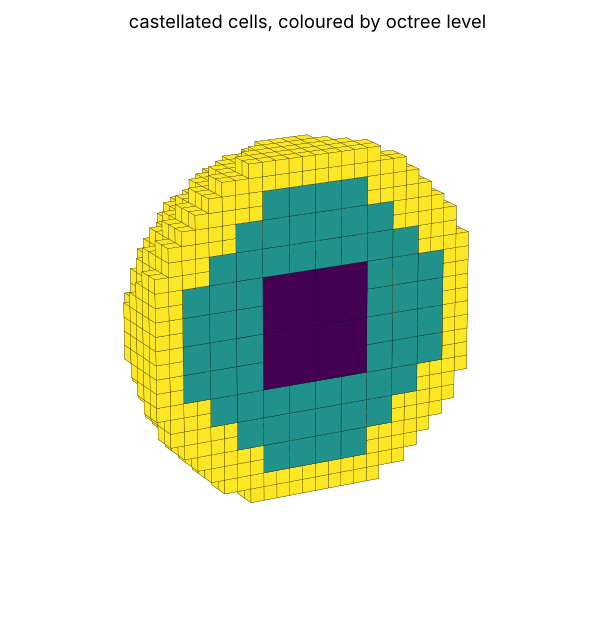
An inside leaf beside a finer leaf that is not inside is split until every face of the surrogate boundary is a whole face of an inside cell, so the side region describes it exactly; the surrogate faces enclose the inside cells' volume (the tests check the divergence theorem). attach_distance=False skips the two sdf:* arrays.
The tetrahedral output
The default output is a conforming, graded tetrahedral mesh of the skin's inside, in three stages.
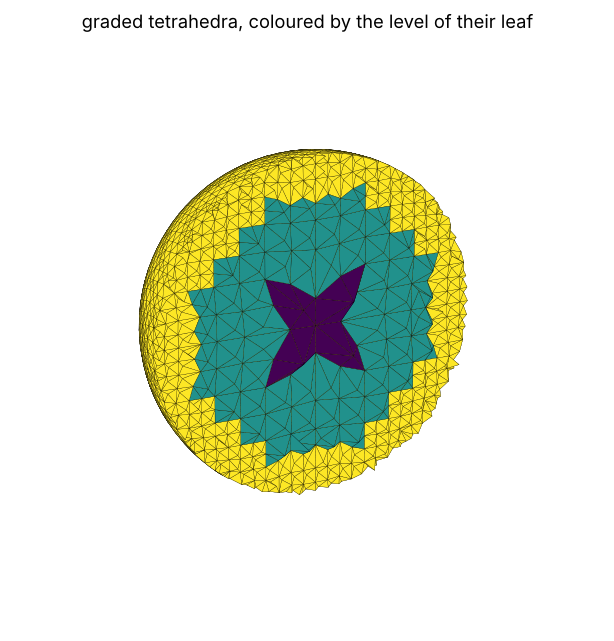
The lattice. The balanced octree is tetrahedralised as a graded body-centred cubic (BCC) lattice on the doubled integer lattice, so every vertex is exact: each leaf is a cone from its centre over fans of its face portions (a face shared with four finer leaves is four portions), and across a face between two leaves of the same size the two cones become the BCC tetrahedra around the segment between the centres. Six shapes occur, with dihedral angles between 35.26° and 125.26°; a region of equal leaves is all BCC tetrahedra (60°–90°). This is our own construction after Labelle and Shewchuk's lattice, and the tests pin its angle table.
Stuffing. Isosurface stuffing (Labelle and Shewchuk, SIGGRAPH 2007) cuts the lattice to the skin: a lattice edge whose ends lie on either side gets a cut point where it crosses the skin (exactly, through the winding-number tree, or by bisection where it passes through a hole); a lattice vertex closer to a cut point than alpha_short (edges between a leaf centre and another vertex) or alpha_long (the others) times the edge is warped onto it; then every tetrahedron the skin crosses is cut by a stencil. Quadrilaterals take the diagonal through their lower-numbered lattice vertex on lattice faces and their shorter diagonal on the skin, so both sides of every face agree. With the paper's alpha_long = 0.24799 and alpha_short = 0.40173, every tetrahedron of a uniform lattice has dihedral angles between 10.7° and 164.8°; the tests check this on spheres, tori and random ellipsoids. The lattice's own boundary is never warped, so keep_outside=True, which also keeps the tetrahedra outside the skin as the outside region, fills the root lattice exactly.
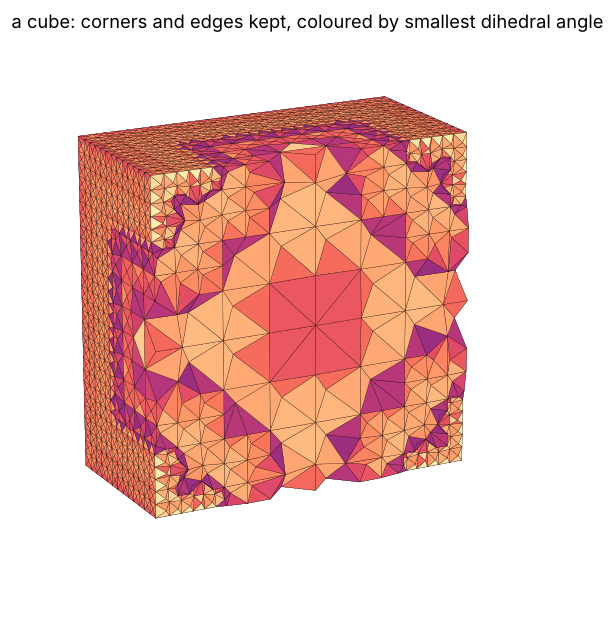
Features. With preserve_features (the default), the skin's edges sharper than feature_angle form a graph of corners (where it branches, ends, or turns by more than corner_angle) and chains between them. Each corner moves the nearest boundary node within reach onto itself, exactly; each chain is traced on the boundary by a shortest path in a tube around it, whose nodes move onto the chain. Every move is refused if it would invert a tetrahedron or create a dihedral angle below 2° that was not already there; a corner or chain that cannot be recovered is counted (num_corners_snapped, num_feature_chains_missed) and reported in warnings. The output carries the feature_corners and feature_edges point regions.
conformity="cleaving" meshes nested shells (a skin whose winding number reaches 2 or more, such as a sphere inside a sphere): the interface at each winding level winding_threshold + k is stuffed in turn through the tetrahedra between the previous interfaces, with the earlier interfaces held fixed, so the materials conform. It follows the idea of lattice cleaving (Bronson, Levine and Whitaker, IEEE TVCG 2014), one interface at a time rather than with its multi-material stencils. The materials are the octree_mesh:material cell data and the material_<k> cell regions.
| name | kind | meaning |
|---|---|---|
inside | cell region | the tetrahedra inside the skin |
outside | cell region | keep_outside: the tetrahedra outside it |
boundary | side region | the boundary faces |
feature_corners, feature_edges | point regions | the nodes on the skin's corners and feature chains |
material_<k> | cell regions | cleaving: each material |
octree:level | cell data | the level of the leaf a tetrahedron came from |
octree_mesh:shape | cell data | the lattice shape (1–6), 0 for a tetrahedron stuffing cut |
octree_mesh:material | cell data | the material, when there is more than one |
sdf:distance | point data | the signed distance to the skin |
Optimisation. fit_iterations rounds (default 5) then improve the mesh: an optimal-Delaunay (ODT) relocation of the interior nodes (the pass of smooth), a slide of every skin node towards the mean of its skin neighbours projected back onto the skin, and the 2-3 and 3-2 flips of optimize_volume. With dihedral_floor_guard (the default) a node is put back when it would lower the mesh's smallest dihedral angle or raise its largest, and a round of flips is kept only when it does neither, so optimisation never makes the worst angles worse; feature nodes, the box and interfaces between materials never move, and flips are made only for one material. num_optimized_moves and num_flips count what changed.
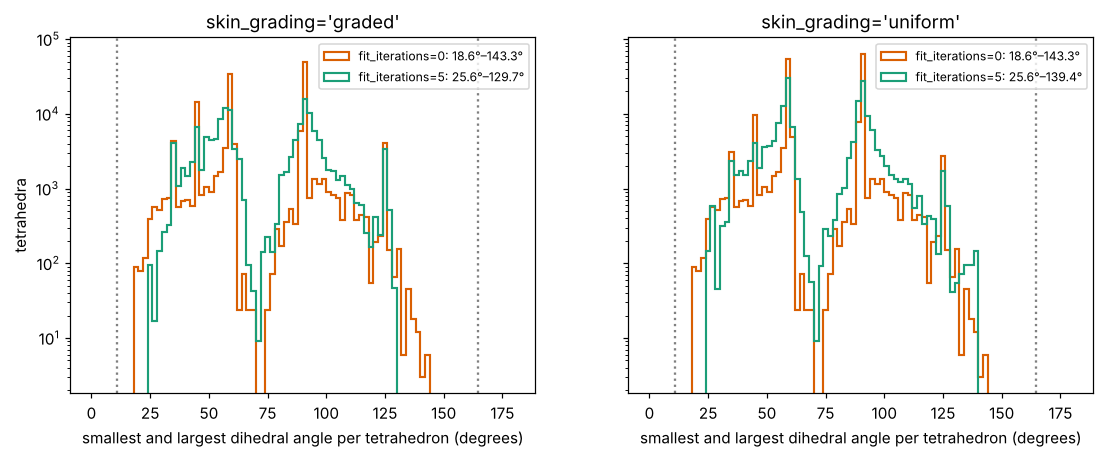
guarantee_applies in the report is true when the 10.7°–164.8° bound covers the whole mesh: uniform skin grading, no warp refused, and no node moved onto a feature. What the stuffing trades for the bound is the boundary, which is the skin's within hausdorff_to_skin rather than its triangles: on the unit sphere's skin from mesh_cad_surface under uniform grading at surface_size = h, it is within 0.036 h, 0.028 h and 0.03 h at h = 0.2, 0.1 and 0.05, and the enclosed volume the skin's within 0.30%, 0.075% and 0.019%. Otherwise the actual angles are in min_dihedral and max_dihedral; snapping to a sharp corner can lower them locally, and graded skins cut transition shapes.
The hexahedral output
output="hex" gives a mesh of hexahedra only, in four stages.
The grid. The cells of edge h (the skin size: surface_size, or the smallest size the field asks for on the skin, rounded down to a level of the frame) whose centre is inside are kept. The grid is uniform: the octree's grading is not carried into the hexahedra yet (the graded dual of Livesu, Pitzalis and Cherchi's templates is roadmap work). max_cells caps its cell count.
Manifold repair. Kept cells may touch along an edge or at a corner only, which no hexahedral mesh with a manifold boundary can have. Around every grid vertex the kept and the empty cells of its 2×2×2 block must each be face-connected; where they are not, the empty cell with the largest winding number is added, until every block passes. The boundary is then a closed 2-manifold of quadrilaterals (the tests check every block by brute force and the boundary's volume by the divergence theorem).
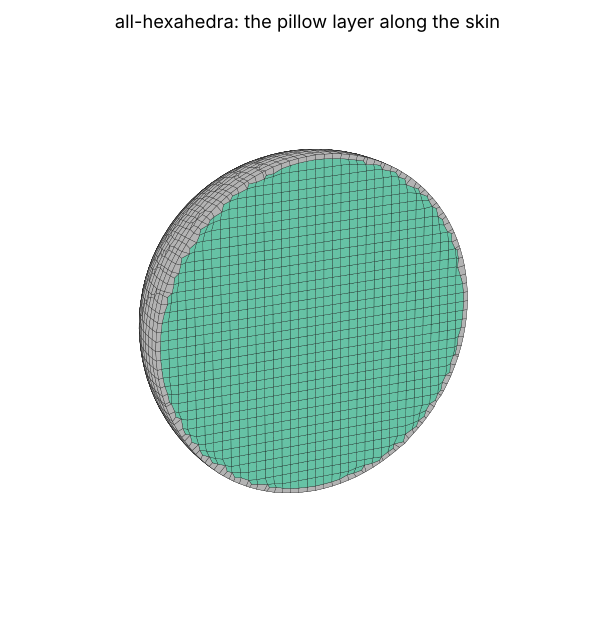
Pillow and fit. With pillow (the default), a layer of hexahedra goes along the boundary (Mitchell and Tautges 1995), so no hexahedron has two faces on the skin: each boundary node gets a copy on its closest skin point, and the node itself moves half a cell inside along the skin's normal. Without it, the boundary nodes move onto the skin themselves, and cells with several faces on the skin can stay poor. With preserve_features, each feature corner takes the nearest boundary node within 1.5 cells exactly, and each chain the shortest path between its corners' nodes on the boundary's quadrilateral edges, in a tube of 1.25 cells around it.
Untangling. untangle_iterations sweeps (default 50) raise each node's worst corner scaled Jacobian: every node below 0.6 tries the mean of its edge neighbours and six axis steps (a fifth of its mean edge, halving every ten sweeps) and takes the best, the skin nodes sliding along the skin and the feature nodes held. The sweeps run in ascending node order, so the result does not depend on the thread count.
| name | kind | meaning |
|---|---|---|
inside | cell region | every hexahedron |
boundary | side region | the boundary faces (with pillow, the outer face, facet 5, of each pillow cell) |
feature_corners, feature_edges | point regions | the nodes on the skin's corners and feature chains |
octree:level | cell data | the grid's level |
octree_mesh:pillow | cell data | 1 for a pillow cell |
sdf:distance | point data | the signed distance to the skin |
The report's min_scaled_jacobian is the smallest over the cells, surface_level is the grid's level, and num_optimized_moves counts the untangler's moves; a smallest corner scaled Jacobian below 0.2, or a corner left inverted, is reported in warnings. On a sphere, a torus and a cube the tests find it above 0.4 with the pillow (0.28 on the cube, whose pillow cells bend round its edges), every corner and edge kept, the boundary closed and within 0.05 of the skin.
Report
return_report=True returns the frame (origin, root_size, root_cells, max_level, finest_level, surface_level, min_size, max_size), the tree (num_leaves, leaves_per_level), the counts (num_points, num_cells, num_hexahedra, num_tetrahedra, num_inside, num_boundary_cells, num_surrogate_faces, num_hanging, num_cut_points, num_warped, num_warp_refused), the features (num_corners, num_corners_snapped, num_feature_chains, num_feature_chains_missed, num_feature_moves), the optimisation or untangling (num_optimized_moves, num_flips), guarantee_applies, the quality (min_scaled_jacobian, min_dihedral, max_dihedral, num_inverted, hausdorff_to_skin (the two-sided distance between the mesh's boundary and the skin), num_boundary_edges_open and num_non_manifold_boundary_edges (of the boundary, both 0 for a watertight one), and quality, the compute_quality summary with its histograms), num_winding_rechecks, timings (seconds per stage) and warnings. Anything that misses its target is reported in warnings, never hidden.
Determinism
Every leaf and point is an integer coordinate on the finest lattice, deduplicated by sorting, and every parallel loop writes disjoint slots: the output is byte-identical across parallel backends and thread counts.
Bindings
Python mp.octree_mesh, the pipeline step OctreeMesh, the CLI verb octree-mesh (both CLIs) and the MCP tool octree_mesh take the same options; see pipelines, CLI and MCP. The C API has mio_octree_mesh with mio_octree_mesh_opts and mio_octree_mesh_report (C API), and the Fortran, Julia, R and WASM (octreeMesh) bindings wrap it. The notebook example/python/41_octree_mesh.ipynb walks through every output and draws the figures on this page.