
Size-field tetrahedral remeshing (adapt_volume)
adapt_volume turns a valid but over-refined tetrahedral mesh, typically the graded output of octree_mesh, into one with fewer and better-shaped tetrahedra. It works towards an isotropic size field with a gradation and a bound on how far the boundary may move, and keeps corners, ridges, materials, regions and boundary tags. It is native, MIT-licensed, has no dependency and is deterministic: an alternative to post-processing with the LGPL MMG backend's adapt.
import meshioplusplus as mp

tets = mp.octree_mesh(mp.read("part.stl"), min_size=0.5)
out, report = mp.adapt_volume(tets, hmin=0.5, hgrad=1.5, return_report=True)
print(report["num_tets_before"], report["num_tets_after"], report["max_boundary_deviation"])

# the same as an opt-in octree_mesh post-stage
out = mp.octree_mesh(mp.read("part.stl"), min_size=0.5, post_adapt=True, adapt_hgrad=1.5)meshioplusplus adapt-volume tets.vtu adapted.vtu --hmin 0.5 --hgrad 1.5 --json
meshioplusplus octree-mesh part.stl adapted.vtu --min-size 0.5 --post-adapt --adapt-hgrad 1.5Where it sits
optimize_volume raises a tetrahedral mesh's worst quality with flips and relocation but keeps its vertex set, so it cannot coarsen. decimate_volume coarsens by quadric shape error with no size field, gradation or Hausdorff bound. remesh_volume discards the input for a fresh lattice. adapt_volume changes the vertex set and the connectivity together, towards a target size, under the guards a remesher needs: it is the volume counterpart of MMG's mmg3d isotropic mode, written from the published algorithms.
The size field
Every vertex gets a target edge length h:
- on the boundary, by
boundary_sizing:"input"(the default): the smallest of the mean length of its boundary edges (the input boundary keeps its own resolution), thesize_arraypoint data where given, and, withcurvature_sizing,sqrt(8 hausd R)for the local radius of curvatureR(the chord of a circle of radiusRwith sagittahausd);"geometry":hmax, bounded bysize_arrayand bysqrt(8 hausd R), as MMG sizes a boundary from its geometry, so a flat or gently curved boundary coarsens too and the Hausdorff and normal guards keep its shape;
- inside,
hmax(andsize_arraywhere given); - then graded,
h(v) = min(h(v), h(u) + (hgrad - 1) |uv|)along every edge, by a Dijkstra sweep from the smallest sizes, and clamped to[hmin, hmax].
hmin therefore also raises the boundary sizes: under "input" sizing it is the lever that matches octree_mesh's min_size when the stuffed boundary has edges shorter than the skin needs. The default keeps the specified rule (the boundary's resolution is the caller's); "geometry" is what to use for the fewest tetrahedra (see measured). By default hmin is the smallest boundary size (no clamp), hmax an eighth of the bounding-box diagonal and hausd 1e-3 of it (hausd_relative reads hausd as a fraction of the diagonal). Sizes vary geometrically along an edge, so its metric length is |ab| (hb - ha) / (ha hb ln(hb / ha)), |ab| / ha when the sizes agree (Dapogny, Dobrzynski and Frey 2014), and a new vertex takes the interpolated size.
The cycle
Each iteration runs four passes, each serial in a fixed order:
- Collapse the edges shorter than 4/5 in the metric, shortest first (a queue with version stamps): the half-edge collapse
a -> bmovesa's tetrahedra ontob. Both directions are tried, the less constrained end going first. - Split the edges longer than 4/3, longest first, at the metric midpoint. A boundary edge's new vertex goes on its ridge chain (by arc length) or is projected onto its patch of the input boundary when the guards allow, and stays at the straight midpoint otherwise. The 4/5 and 4/3 thresholds are Botsch and Kobbelt's (2004).
- Swap: the 2-3 flip, edge removal (3-2 and larger rings, up to 7) and multi-face removal of
optimize_volume, run on each material class alone, so an interface face and every boundary face stay. Each move strictly raises the least dihedral angle of the tetrahedra it replaces. - Smooth: inside,
optimize_volume's guarded ODT relocation (Alliez et al. 2005), or withquality_metric="amips"a descent of the star's conformal AMIPS energy (Hu et al. 2020), then the worst-cell smoothing for tetrahedra under 40 degrees. On the boundary, a surface vertex slides half way to the mean of its boundary neighbours in the tangent plane and back onto its patch, and a ridge vertex half way to the middle of its two chain neighbours along the chain.
The iterations stop when the topological edits (collapses, splits, swaps) of one iteration change fewer than 1% of the tetrahedra, at max_iterations (10), or once the least dihedral angle reaches target_min_dihedral. A polish of swaps and worst-cell smoothing (at most three rounds) ends the run.
The guards
Every edit runs its preconditions, simulates the edit, checks the postconditions on the simulated star and only then commits (Jiang et al. 2022's precondition / edit / postcondition structure; a refused edit changes nothing). A collapse of a onto b is refused, and counted by the first guard that refuses it, when:
| Guard | Refused when | Report counter |
|---|---|---|
| Class | a is a corner or frozen; a surface vertex would leave its patch (the edge is not an edge of two boundary faces of a's patch); a ridge vertex would leave its chain | num_rejected_by_class |
| Link | the link condition fails: the vertices, edges or triangles common to the links of a and b are not exactly those of the link of ab (a common triangle would duplicate a tetrahedron); on the boundary, the vertices sharing a boundary face with both ends are not exactly the far corners of the faces through ab, or two boundary faces would merge | num_rejected_by_link |
| Inversion | a tetrahedron is not strictly positive by the exact orient3d predicate after the move, or flatter than 1e-14 of the diagonal cubed | num_rejected_by_inversion |
| Length | an edge the collapse creates is longer than 4/3 (which also keeps collapses and splits from undoing each other) | num_rejected_by_length |
| Quality | the least quality of the new star is below min(old star's least, quality_min) | num_rejected_by_quality |
| Normal | a boundary face's normal would turn by more than max_normal_deviation (30 degrees) | num_rejected_by_normal |
| Hausdorff | a sample of a new boundary face lies farther than 0.9 hausd from its patch of the input boundary, or a point of the input boundary the old faces covered is no longer within max(0.9 hausd, its old distance) of the new faces and the unchanged ones around them | num_rejected_by_hausdorff |
Splits check the children's orientation and quality, and a projected boundary vertex the normals and both halves of the envelope too. Smoothing moves keep every tetrahedron positive and the star's least quality, and a boundary move also the normals and the envelope. Swaps compare the worst new tetrahedron with the worst old one. quality_min defaults to 10 degrees for min_dihedral and 0.2 for mean_ratio and amips (the mean ratio 12 (3 V)^(2/3) / sum(l^2), 1 for the regular tetrahedron; the conformal AMIPS energy is its reciprocal).
The forward half of the Hausdorff guard samples each new boundary face on a barycentric grid of spacing at most hausd (2 to 6 subdivisions) against the input boundary's bounding-volume hierarchy, filtered to the face's own patch; the reverse half indexes the input boundary's vertices, edge midpoints and centroids in a uniform grid. The 10% margin covers the face between its samples.
Classification
The input's boundary faces are the faces of one tetrahedron and the faces between two tetrahedra of different material class (an interface is an internal boundary). A class is the input block, the cell regions a tetrahedron belongs to and its values of the material arrays (octree_mesh:material, medit:ref, gmsh:physical, gmsh:geometrical, cell_tags, or material_arrays). A boundary edge is a ridge when it does not have exactly two boundary faces, when its faces differ in side-region tags or classes, or (with preserve_features) when their normals turn by more than feature_angle (30 degrees). Patches are the faces connected across non-ridge edges. Ridges form chains between corners, where the ridge graph branches, ends, turns by more than corner_angle (30 degrees) or changes the pair of patches it separates; a closed loop with no corner (a cylinder's rim) is cut into two chains at two corners, as feature_edges' graph does. Corners never move; ridge vertices move only along their chain, surface vertices only within their patch, interior vertices freely. preserve_boundary freezes every boundary vertex, so the boundary triangles are left bit for bit (an interior vertex may still collapse onto one), and frozen pins any vertex.
Guarantees
- No tetrahedron is inverted or flat (exact
orient3d), except one that was already flat in the input and that no edit could remove; a tangled input, two tetrahedra on the same side of their shared face, is refused by name (rununtanglefirst). - The output is conforming, its outer boundary closed, and every material class keeps its side of every interface, with the interface topology unchanged.
- The least quality never drops below
min(the input's least, quality_min), and swaps and smoothing never lower it. max_boundary_deviation, the symmetric Hausdorff distance between the output's boundary and the input's, measured withhausdorff_distanceafter the run, is at mosthausdon the tests' sphere, box, cylinder and nested shells; the guard is sampled, so this is a measured bound, not a proof.- With
preserve_boundarythe boundary vertices and triangles are bit for bit those of the input and the volume is preserved to rounding. - The output is byte-identical across the mesh backends, the parallel backends and thread counts: every pass is serial in a fixed order with total-order keys, and only per-element measurements run in parallel.
tools/bench_ops.sh --hashchecks this on theadapt_volumerow (benchmarks); on this change the digests agreed on SEQ and OpenMP at 1, 4 and 8 threads, foradapt_volume,optimize_volumeandoctree_mesh_tetat tiers S and M (TBB was not installed).
What survives
Float point_data is interpolated on splits and keeps the survivor's value on collapses; smoothing moves points and not their data (as in optimize_volume). Integer point_data keeps the value of the input point each vertex comes from. The material arrays are kept by class; any other cell_data (octree:level, octree_mesh:shape, quality arrays) is dropped with a warning (recompute quality with attach_quality). Cell regions are rebuilt from the classes, side regions from the boundary faces' tags (a split face's halves keep its tags), and point regions keep their surviving members; a split vertex joins a point region when both ends of its edge are members and it has the kind of one of them, so the midpoint of an edge between two corners does not join a region of corners. field_data and property sets pass through. The output has one tetra block per input block.
Report
num_tets_before, num_tets_after, num_points_before, num_points_after; the edits num_collapsed, num_split, num_swapped, num_smoothed; the refusals num_rejected_by_link, _inversion, _quality, _length, _class, _hausdorff, _normal; min_dihedral_before/after, max_dihedral_before/after, mean_quality_before/after; max_boundary_deviation; the hmin, hmax and hausd used; volume_before, volume_after and region_volume_change per class; the classification counts num_corners, num_ridge_vertices, num_chains, num_patches; iterations; timings per stage (setup, collapse, split, swap, smooth, polish, output); warnings.
Measured
tools/adapt_volume_bench.py meshes each skin with octree_mesh at min_size (a fraction of the bounding-box diagonal), then remeshes the tetrahedra with adapt_volume at hmin = min_size, hmax = the octree's max_size, hgrad 1.3 and the default hausd (1e-3 of the diagonal), once with each boundary_sizing, and runs MMG 5.8's mmg3d_O3 on the same tetrahedra with the same four parameters (as a separate program on a Medit file: nothing links it). tetgen and gmsh were not installed and are skipped. The skins are the unit sphere (icosa_sphere(1, 5)), the unit cube, a cylinder of radius 0.5 and height 2, example/data/Bunny.stl, and the Happy Buddha and XYZ RGB dragon scans from common-3d-test-models (--fetch). One run each, serial, on a 4-core x86-64 container, Release build; the raw rows, with the scaled-Jacobian minimum and dihedral histograms, are benchmark/adapt_volume.csv (input sizes) and benchmark/adapt_volume_geometry.csv (geometry sizes).
"Under 20°" is the share of tetrahedra whose least dihedral angle is below 20 degrees. "Hausdorff to skin" is the symmetric hausdorff_distance from the output's boundary to the original skin, so it includes octree_mesh's own distance from the skin (its first row per case); adapt_volume's bound is on its distance from its input's boundary, which its report gives as max_boundary_deviation. The volume error is against the octree_mesh mesh. On the sphere, octree_mesh meshes the icosphere's own resolution at both min_size values the script tries, so only one is shown.
| Case | min_size | Method | Tetrahedra | Points | Dihedral range | Under 20° | Hausdorff to skin | Volume error | Seconds |
|---|---|---|---|---|---|---|---|---|---|
| sphere | 0.02 | octree_mesh | 18,552 | 3,871 | 35.3–125.3 | 0.00% | 0.00323 | 0.000% | 0.6 |
| sphere | 0.02 | adapt_volume, input sizes | 14,975 | 3,276 | 38.1–135.1 | 0.00% | 0.00338 | 0.022% | 5.0 |
| sphere | 0.02 | adapt_volume, geometry sizes | 7,215 | 1,861 | 34.9–138.4 | 0.00% | 0.00385 | 0.096% | 3.9 |
| sphere | 0.02 | mmg3d | 12,094 | 2,665 | 25.3–136.5 | 0.00% | 0.00325 | 0.003% | 1.2 |
| box | 0.03 | octree_mesh | 35,702 | 8,359 | 14.9–149.8 | 0.89% | 2.78e-16 | 0.000% | 0.7 |
| box | 0.03 | adapt_volume, input sizes | 39,800 | 8,684 | 36.4–138.2 | 0.00% | 2.78e-16 | 0.000% | 12.8 |
| box | 0.03 | adapt_volume, geometry sizes | 1,283 | 328 | 30.6–138.9 | 0.00% | 2.48e-16 | 0.000% | 1.8 |
| box | 0.03 | mmg3d | 1,399 | 343 | 25.6–136.6 | 0.00% | 1e-15 | 0.000% | 1.2 |
| box | 0.015 | octree_mesh | 75,995 | 18,219 | 14.9–149.8 | 1.41% | 2.78e-16 | 0.000% | 1.8 |
| box | 0.015 | adapt_volume, input sizes | 96,749 | 21,056 | 33.6–142.7 | 0.00% | 2.48e-16 | 0.000% | 34.3 |
| box | 0.015 | adapt_volume, geometry sizes | 1,291 | 327 | 26.3–136.9 | 0.00% | 2e-16 | 0.000% | 2.9 |
| box | 0.015 | mmg3d | 1,350 | 334 | 20.0–148.4 | 0.07% | 1.01e-15 | 0.000% | 1.6 |
| cylinder | 0.02 | octree_mesh | 63,758 | 13,797 | 11.6–160.3 | 1.66% | 0.00297 | 0.000% | 1.4 |
| cylinder | 0.02 | adapt_volume, input sizes | 54,631 | 11,453 | 35.4–139.5 | 0.00% | 0.0029 | 0.099% | 14.8 |
| cylinder | 0.02 | adapt_volume, geometry sizes | 9,887 | 2,347 | 27.1–142.3 | 0.00% | 0.00313 | 0.202% | 6.2 |
| cylinder | 0.02 | mmg3d | 16,943 | 3,831 | 16.0–149.0 | 0.04% | 0.0022 | 0.030% | 2.0 |
| cylinder | 0.01 | octree_mesh | 204,598 | 42,829 | 7.9–167.1 | 2.87% | 0.00297 | 0.000% | 4.5 |
| cylinder | 0.01 | adapt_volume, input sizes | 164,220 | 33,340 | 31.3–143.9 | 0.00% | 0.00294 | 0.082% | 52.6 |
| cylinder | 0.01 | adapt_volume, geometry sizes | 10,736 | 2,534 | 30.1–136.2 | 0.00% | 0.00336 | 0.204% | 11.1 |
| cylinder | 0.01 | mmg3d | 23,218 | 5,050 | 19.8–145.6 | 0.00% | 0.00215 | 0.033% | 4.5 |
| bunny | 0.012 | octree_mesh | 242,914 | 49,423 | 0.3–179.5 | 2.05% | 0.584 | 0.000% | 7.8 |
| bunny | 0.012 | adapt_volume, input sizes | 165,202 | 33,408 | 2.4–169.5 | 0.04% | 0.587 | 0.046% | 54.4 |
| bunny | 0.012 | adapt_volume, geometry sizes | 45,849 | 10,384 | 4.0–169.8 | 0.19% | 0.587 | 0.223% | 28.5 |
| bunny | 0.012 | mmg3d | 75,251 | 16,354 | 1.1–175.8 | 0.10% | 0.418 | 0.046% | 6.3 |
| bunny | 0.008 | octree_mesh | 629,287 | 125,848 | 0.2–179.6 | 2.07% | 0.313 | 0.000% | 19.4 |
| bunny | 0.008 | adapt_volume, input sizes | 405,123 | 80,444 | 0.3–179.3 | 0.01% | 0.313 | 0.023% | 133.9 |
| bunny | 0.008 | adapt_volume, geometry sizes | 62,203 | 13,704 | 3.8–167.0 | 0.13% | 0.313 | 0.225% | 48.1 |
| bunny | 0.008 | mmg3d | 112,033 | 23,522 | 3.0–170.9 | 0.07% | 0.277 | 0.092% | 13.7 |
| buddha | 0.008 | octree_mesh | 525,773 | 108,850 | 0.1–179.9 | 2.87% | 0.00209 | 0.000% | 29.1 |
| buddha | 0.008 | adapt_volume, input sizes | 376,153 | 78,800 | 1.1–178.5 | 0.65% | 0.00216 | 0.039% | 146.4 |
| buddha | 0.008 | adapt_volume, geometry sizes | 96,771 | 24,293 | 0.9–178.5 | 3.98% | 0.00209 | 0.210% | 64.8 |
| buddha | 0.008 | mmg3d | 182,096 | 40,891 | 0.1–179.7 | 2.09% | 0.00209 | 0.060% | 22.3 |
| dragon | 0.008 | octree_mesh | 195,220 | 42,010 | 0.1–179.8 | 9.26% | 3.07 | 0.000% | 18.3 |
| dragon | 0.008 | adapt_volume, input sizes | 163,314 | 37,757 | 2.1–177.2 | 4.04% | 3.07 | 0.141% | 76.2 |
| dragon | 0.008 | adapt_volume, geometry sizes | 59,796 | 16,654 | 0.7–178.7 | 15.75% | 3.07 | 0.274% | 31.6 |
| dragon | 0.008 | mmg3d | 82,985 | 21,387 | 0.5–179.2 | 9.01% | 3.07 | 0.007% | 19.3 |
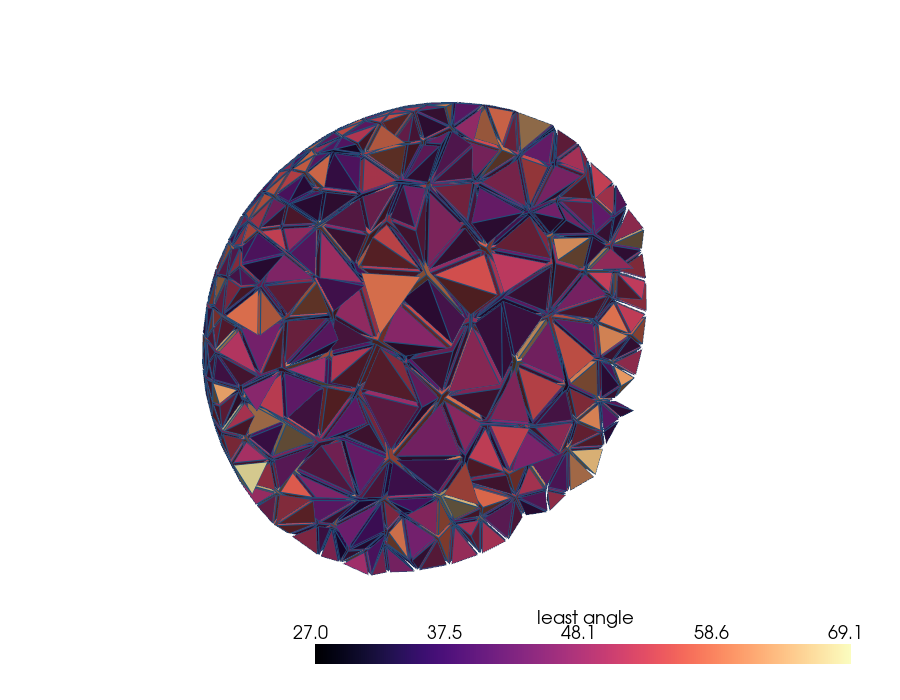
Against the targets. The goal was about 1.3 times MMG's tetrahedron count with a least dihedral angle close to MMG's.
- With
boundary_sizing="geometry"the count is 0.46 to 0.96 times MMG's on every case. The least dihedral angle is above MMG's on every case (on the scans barely: 0.9 against 0.1 degrees on the Buddha, 0.7 against 0.5 on the dragon). On the two scans, though, more tetrahedra end below 20 degrees than with MMG: 4.0% against 2.1% (Buddha) and 15.8% against 9.0% (dragon). Collapses there are accepted down to the quality floor,min(the input's least, quality_min), which a scan's sub-degree octree slivers put at the input's least angle. The volume changes by 0.1–0.27%, against MMG's 0.003–0.09%: the boundary moves withinhausd, and MMG's moves less. - With the default
"input"sizing, the boundary keeps the octree's resolution. The count is then 1.2 times MMG's on the sphere, about 2 times on the scans, 2.2 to 7 times on the bunny and cylinder, and 28 to 72 times on the box, whose flat faces MMG coarsens to a few hundred triangles. On the analytic cases its least angle is the highest of the three (31–38 degrees), and its volume error is below the geometry runs'. max_boundary_deviationstayed withinhausdon every run: on the sphere 0.00142 (input) and 0.00273 (geometry) against 0.00346, on the cylinder 0.00220 and 0.00225 against 0.00245, and 0 on the box.
Runtime. adapt_volume takes 1.5 to 4.5 times MMG's time with geometry sizes and 4 to 21 times with input sizes; most of it is the envelope and link checks of refused collapses. Every pass is serial, for determinism; mmg3d is serial too.
Gradation. At hgrad 1.3 the size grows by at most 30% of the distance, slower than octree_mesh's 2:1 grading, so under input sizing the interior gains tetrahedra; a looser gradation removes them. On the unit sphere at min_size=0.04 (13,560 tetrahedra from octree_mesh, least angle 27.9 degrees):
hgrad | Input sizes: tetrahedra | Least angle | Geometry sizes: tetrahedra | Least angle |
|---|---|---|---|---|
| 1.3 | 15,449 | 34.3 | 6,960 | 27.0 |
| 1.6 | 8,111 | 36.5 | 5,201 | 27.4 |
| 2.0 | 6,451 | 34.7 | 3,893 | 27.8 |
| 3.0 | 4,696 | 30.8 | 3,532 | 27.2 |
max_boundary_deviation was 0.0026–0.0031 against hausd 0.00346 in every row.
The whole benchmark at hgrad 2 with geometry sizes, against mmg3d at hgrad 2 (benchmark/adapt_volume_geometry_hgrad2.csv; its seconds were taken while a build ran, so they are left out), gives 0.44 to 0.96 times MMG's tetrahedra, from 4,304 on the sphere (MMG 5,590) to 46,407 on the Buddha (MMG 87,948). The least dihedral angle is above MMG's on every case, and on the scans fewer tetrahedra fall under 10 degrees than with MMG (0.74% against 1.16% on the Buddha, 2.88% against 4.14% on the dragon). The volume still changes more than with MMG (0.10–0.28% against 0.003–0.11%).
Limits.
- The Hausdorff guard samples faces, so the bound is measured on these cases, not proven.
- About 2% of edges still churn between collapse and split per iteration once smoothing moves vertices. The stop rule counts only topological edits, so a run usually takes all
max_iterations. - R, Octave and WASM have no
post_adapt; they calladapt_volumeonoctree_mesh's output instead. - No pass runs in parallel.
Everywhere else
| Surface | Call |
|---|---|
| C++ | AdaptVolumeResult r = adapt_volume(mesh, opts); with AdaptVolumeOptions (mHmin, mHmax, mHgrad, mHausd, mHausdRelative, mSizeArray, mCurvatureSizing, mFeatureAngle, mCornerAngle, mMaxNormalDeviation, mPreserveBoundary, mPreserveFeatures, mQualityMetric, mQualityMin, mMaxIterations, mTargetMinDihedral, mFrozen, mMaterialArrays, mEnableCollapse/Split/Swap/Smooth, mBoundarySizing); OctreeMeshOptions::mPostAdapt and mAdapt |
| Python | adapt_volume(mesh, *, hmin=0.0, hmax=0.0, hgrad=1.3, hausd=0.0, hausd_relative=False, size_array=None, curvature_sizing=False, feature_angle=30.0, corner_angle=30.0, max_normal_deviation=30.0, preserve_boundary=False, preserve_features=True, quality_metric="min_dihedral", quality_min=-1.0, max_iterations=10, target_min_dihedral=0.0, frozen=None, material_arrays=None, collapse=True, split=True, swap=True, smooth=True, boundary_sizing="input", return_report=False); octree_mesh(..., post_adapt=False, adapt_hmin=, adapt_hmax=, adapt_hgrad=, adapt_hausd=, adapt_max_iterations=, adapt_preserve_boundary=, adapt_boundary_sizing=, adapt_options=None) |
| Both CLIs | `meshioplusplus adapt-volume IN OUT [--hmin H] [--hmax H] [--hgrad G] [--hausd D] [--preserve-boundary] [--max-iterations N] [--boundary-sizing input |
| Pipeline | {"Op": "AdaptVolume", "Hmin": 0.5, "Hgrad": 1.5}; OctreeMesh takes PostAdapt and Adapt* (pipelines) |
| C | mio_adapt_volume_opts_init(&o); o.hgrad = 1.5; mio_mesh* out = mio_adapt_volume(mesh, &o, &report);; mio_octree_mesh_opts.post_adapt and .adapt, mio_octree_mesh_adapt_report (C API) |
| Fortran | out = m%adapt_volume(hgrad=1.5d0, report=rep, stat=ierr) (Fortran) |
| Julia | r = adapt_volume(mesh; hgrad=1.5); octree_mesh(skin; post_adapt=true, adapt_hgrad=1.5) (Julia) |
| R | r <- mio_adapt_volume(mesh, hgrad = 1.5) (R) |
| Octave / MATLAB | r = mio.adapt_volume(mesh, 'hgrad', 1.5) (Octave) |
| WASM | m.adaptVolume(mesh, {hgrad: 1.5}) (WASM) |
| MCP | tool adapt_volume(input_path, output_path, hmin, hmax, hgrad, hausd, ...); octree_mesh takes post_adapt and adapt_* (MCP) |
R, Octave and WASM have no post_adapt on octree_mesh: call adapt_volume on its mesh, which is the same operation. Fortran, Julia, R, Octave and WASM do not take frozen or the material arrays; Fortran, R, Octave and WASM not the curvature, corner and normal options either, which keep their defaults.
C++-core only, with no numpy fallback, like optimize_volume and remesh_volume: every edit is a discrete branch on exact predicates and near-tie comparisons, so a second implementation could diverge into a different mesh. MESHIOPLUSPLUS_ADAPT_VOLUME_CHECK=1 runs the invariant checker after every pass and throws on a violation; the fuzz target meshioplusplus_fuzz_adapt_volume (fuzzing) feeds it ulp-jittered, flat, sliver and offset tetrahedra.
Attribution
Implemented from published descriptions only: Dapogny, Dobrzynski and Frey, "Three-dimensional adaptive domain remeshing, implicit domain meshing, and applications to free and moving boundary problems", J. Comput. Phys. 262 (2014) — the metric edge length, the split / collapse / swap / move cycle and Hausdorff-bounded surface changes; Klingner and Shewchuk, "Aggressive Tetrahedral Mesh Improvement", 16th International Meshing Roundtable (2007), and Klingner's thesis, UCB/EECS-2008-145 — the schedule and quality measures; Freitag and Ollivier-Gooch, "Tetrahedral mesh improvement using swapping and smoothing", IJNME 40(21) (1997); Shewchuk, "Two Discrete Optimization Algorithms for the Topological Improvement of Tetrahedral Meshes" (2002) — edge and multi-face removal, through optimize_volume; Hu et al., "Fast Tetrahedral Meshing in the Wild", ACM TOG 39(4) (2020) — conformal AMIPS and envelope-checked edits; Jiang et al., "Declarative Specification for Unstructured Mesh Editing Algorithms", ACM TOG 41(6) (2022) — precondition, edit, postcondition and rollback; Botsch and Kobbelt, "A Remeshing Approach to Multiresolution Modeling" (2004) — the 4/5 and 4/3 thresholds; Alliez et al., "Variational Tetrahedral Meshing", SIGGRAPH 2005 — ODT. The exact orient3d is Shewchuk's public-domain predicate, already in the core. No code of MMG, CGAL, TetGen, Gmsh/HXT, Netgen, Mesquite, TetWild, fTetWild or Stellar is read or vendored.