
Recording a Video
View ▾ ▸ Record… captures the viewport as an animation.
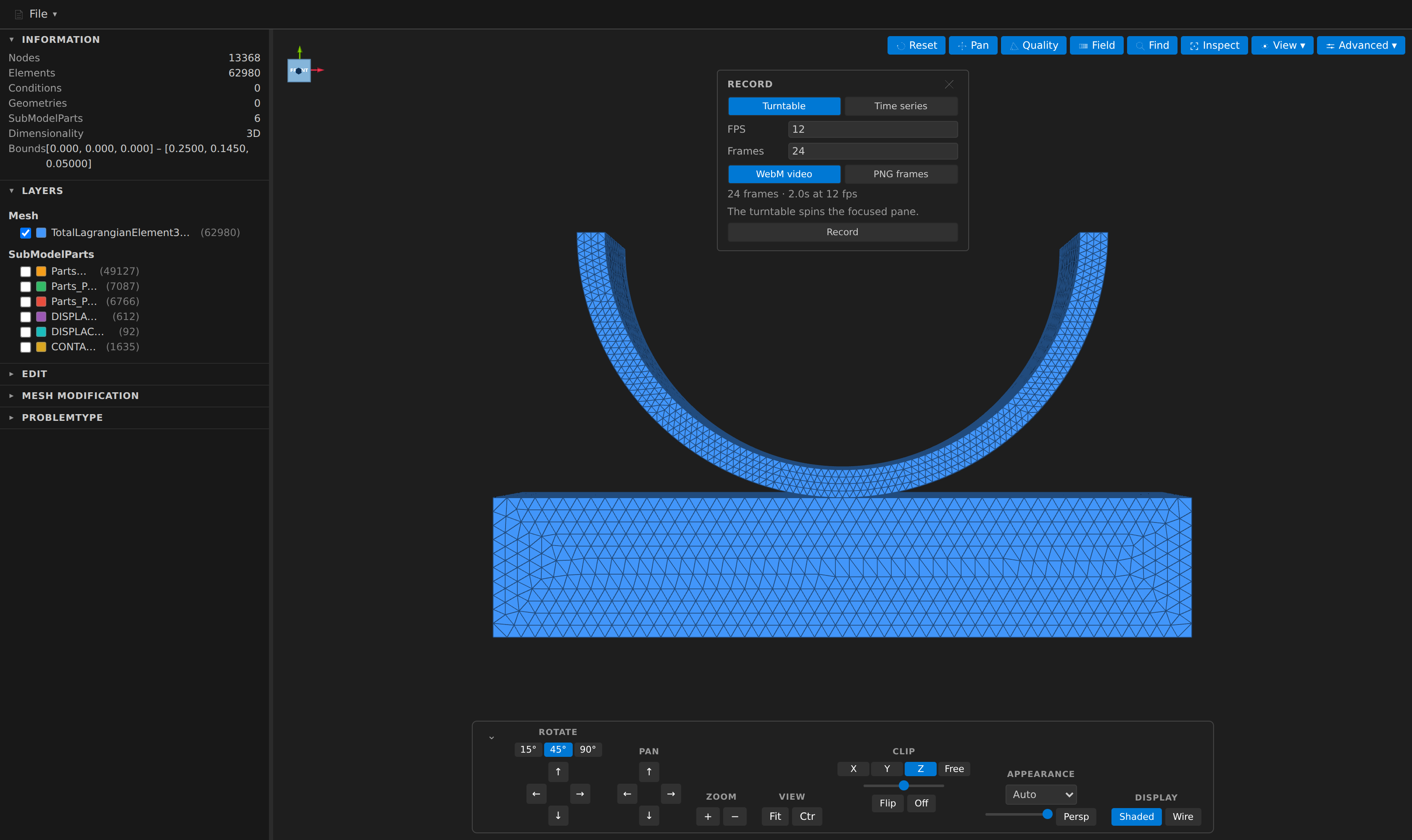
Two sources
Turntable spins the camera through one full revolution and works for any mesh — including .mdpa files, which have no time dimension at all. Choose how many frames make up the turn; they divide 360° exactly, so the loop repeats seamlessly with no duplicated frame at the seam.
Time series plays through every step of a VTK series. It is offered only when the preview actually has one.
Two outputs
| WebM video | One file, ready to play or drop into a slide. |
| PNG frames | One numbered image per frame, for encoding yourself. |
mp4 is not offered. The browser engine VS Code is built on cannot reliably encode H.264, so rather than a format that sometimes fails, the PNG sequence is the route — and when it saves, the extension prints the exact command:
ffmpeg -i mymesh_%04d.png out.mp4The names are zero-padded so both a shell glob and ffmpeg's %04d see them in the right order.
What it costs
A turntable is cheap: it only moves the camera, so frames come as fast as the scene draws.
A time-series recording is not. Every step is a full re-read of that step's file from disk, and the recorder waits for each frame to genuinely be on screen before capturing it. That is deliberate — capturing on a timer would record whichever frame happened to have arrived — but it means a long series takes real time. The panel counts frames as it goes, and Cancel keeps everything captured so far.
Split views
A recording includes every pane, with the separators between them drawn in so it matches what you see. A turntable spins the focused pane, leaving the others still — spinning all of them would destroy the side-by-side comparison a split exists for.
Why it looks the way it does
The recorder never samples the live 3D canvas on a timer. The renderer does not preserve its drawing buffer between frames, so a capture taken even one moment late comes back black — measured, not guessed. Instead each frame is drawn and copied in the same breath onto a separate canvas, which is also where the legend and the pane separators are painted. That is why a recording matches the screen rather than being a slightly different picture of it.