
MMG Remesh & Level-set
The Mesh Modification section runs the MMG remeshers in-process via the @loumalouomega/mmg-wasm WebAssembly build (MMG v5.8.0) — no native binaries. Both operations join the operation history like any other edit.
WARNING
MMG is tetrahedron / triangle based. Hexahedral, pyramid, and quadratic meshes are rejected with a message. Use it on tet volumes or triangulated surfaces.
Module auto-selection
The right MMG module is chosen automatically from the mesh (and can be overridden under Advanced):
| Mesh | Module |
|---|---|
| Tetrahedral volume (+ pass-through prisms, boundary triangles / quads / edges) | mmg3d |
| Non-planar triangulated surface | mmgs |
| Planar triangulation (+ quads) | mmg2d |
Remesh
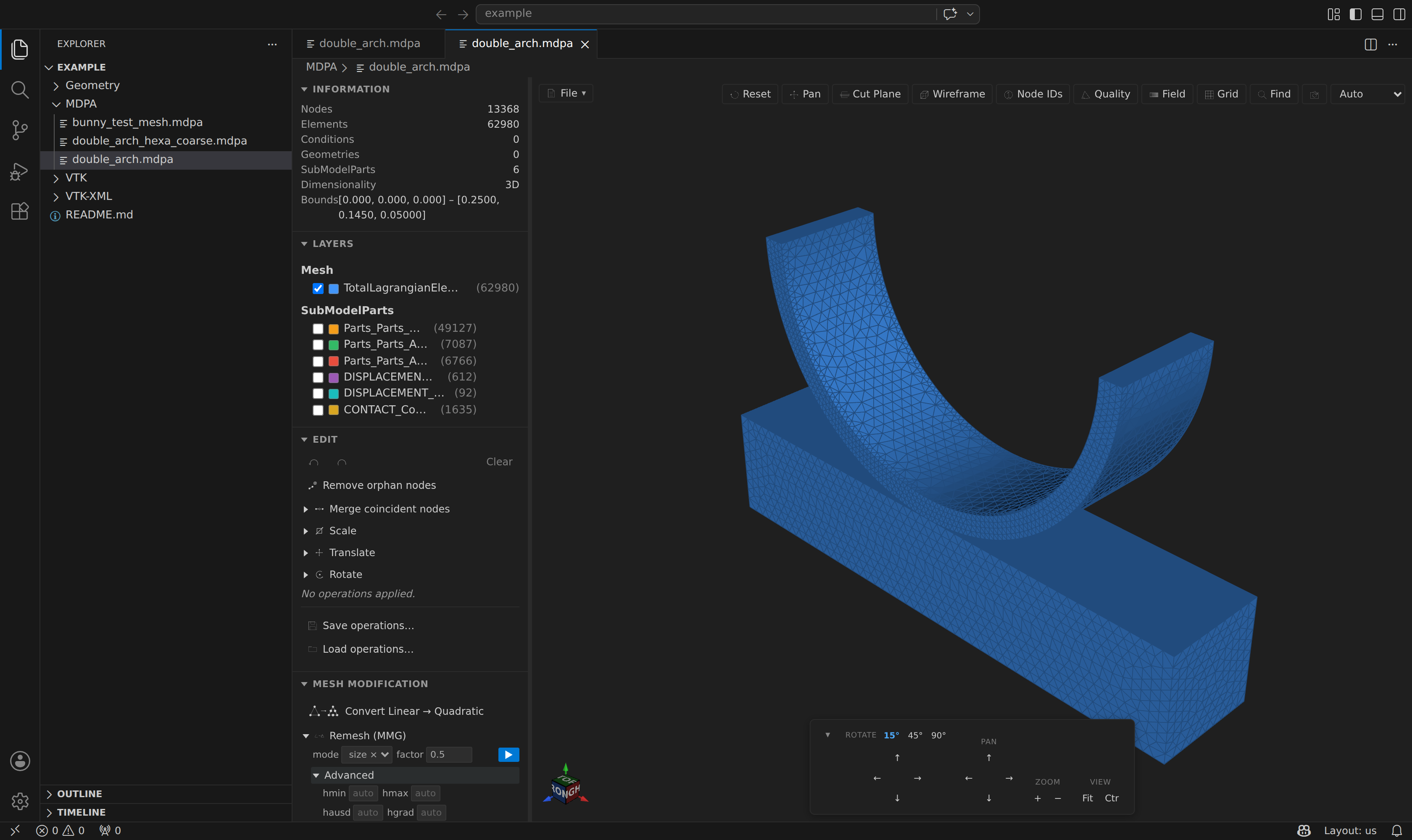
Three modes:
- size × factor — the one-knob refine / coarsen: each node gets a metric equal to its current local edge size times your factor (
0.5→ twice as fine,2→ twice as coarse). - uniform — remesh to a constant target edge size (
hsiz). - optimize — size-preserving quality optimization (
IPARAM_optim).
The Advanced sub-form exposes MMG's tuning surface:
hmin/hmax— size bounds.hausd— Hausdorff distance controlling geometry approximation. Defaults to 0.5 % of the bounding-box diagonal (MMG's own default is the absolute value0.01, which explodes on large domains).hgrad— size gradation (how fast element size may change).- angle detection threshold in degrees (≤ 0 disables ridge detection).
- keep surface (
nosurf) / no insert / no swap / no move toggles.
Level-set split
Level-set split (MMG) discretizes an isovalue of any nodal field as an explicit, conforming boundary. Pick the field (vector fields use their magnitude) and the isovalue; the mesh is split into MMG_Domain_Inside / MMG_Domain_Outside blocks separated by an MMG_Interface layer.
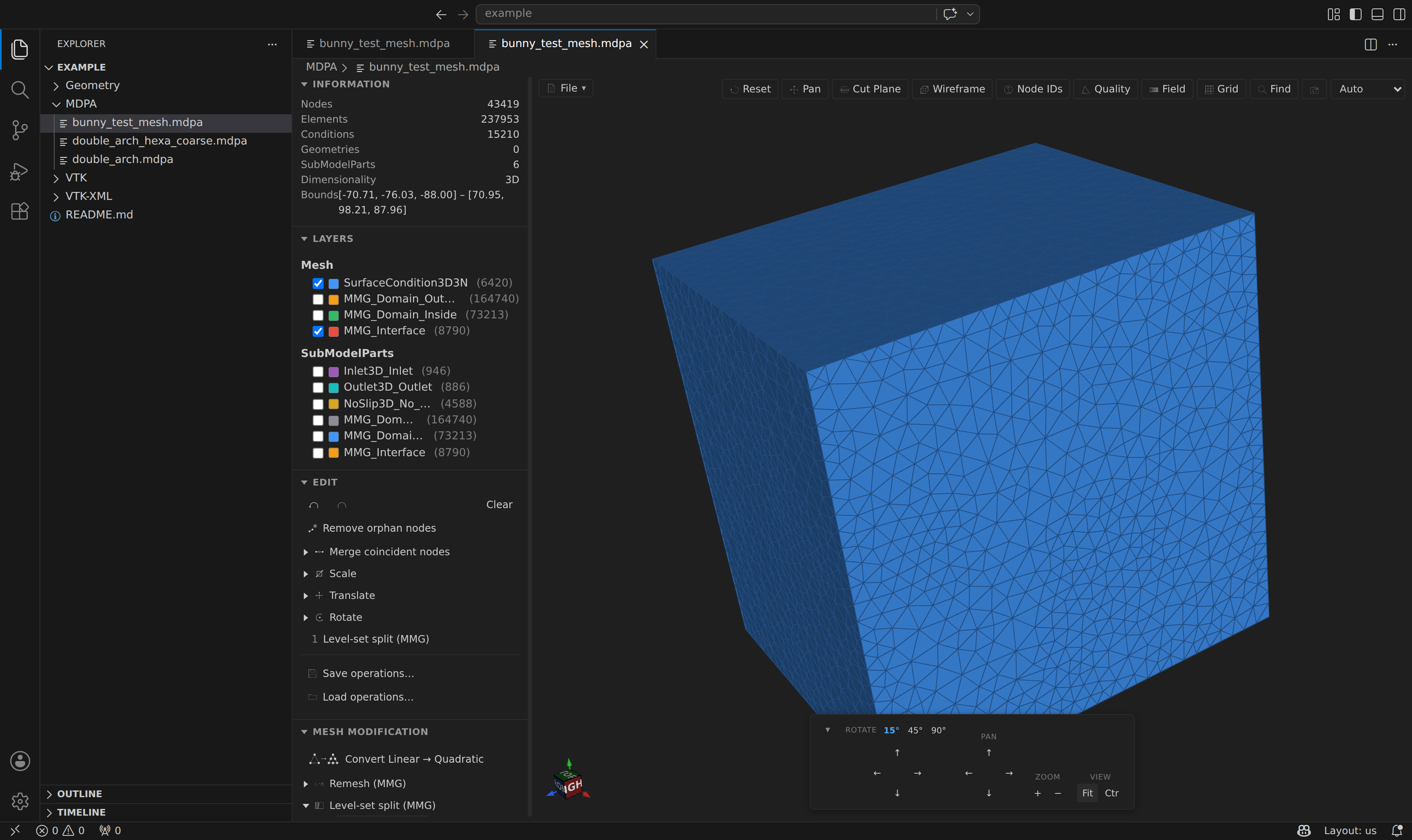
Each created region is also generated as a SubModelPart of the same name, so the domains and the interface appear in the outline's SubModelParts section — ready to be isolated, exported, or deleted, and written as real Begin SubModelPart blocks on save. On volume meshes, surface only (IPARAM_isosurf) splits just the boundary surfaces. Its own Advanced sub-form exposes the same hmin / hmax / hausd / hgrad size controls and module override.
Keeping your blocks and SubModelParts
By default a split throws your mesh's own structure away: MMG rewrites every domain cell to its reserved inside/outside references, so the result is two MMG_Domain_* blocks and the original block names and SubModelPart membership are gone.
Keep materials (in the Materials & base references sub-form) turns that off. Each split cell goes back into its original block and its original SubModelParts, and the side is carried by the generated MMG_Domain_Inside / MMG_Domain_Outside SubModelParts instead — so a part like Lower survives the split, and both sides stay separately selectable in the outline. It is off by default because it changes the shape of the output, and a saved recipe replayed after enabling it produces a differently-shaped mesh than when it was recorded.
No-split blocks / parts name materials the level set must leave uncut: they keep their own block untouched and appear in neither side part. MMG needs the whole material list, so this chooses which materials are left alone, not which are preserved — and marking every material no-split is refused, since there would be nothing left to cut.
What does not survive
Kratos Properties are still dropped, as they are by any remesh — "material" here means the block and SubModelPart structure, not the property table.
Keep materials does not apply to a surface only split and is skipped with a message there: that mode splits the boundary rather than the volume, so it leaves the domain references untouched and your blocks and SubModelParts already survive without it.
Cleaning up parasitic components
rmc deletes split components whose volume fraction of the mesh falls below it — the small detached blobs an Distance to surface → level-set chain tends to leave behind. It must be between 0 and 1; MMG's own default when enabled is 1e-5. Choose it with care: MMG range-checks nothing, and a value above a real domain's volume fraction deletes that whole domain. It is not implemented for surface only splits and is skipped there with a message.
Base reference blocks / parts name boundary entities that a split domain must touch in order to survive; any domain attached to none of them is removed. This is a topological cleanup where rmc is a size-based one, and it is inert on its own — giving base references without rmc enables it at 1e-5. A selector that matches nothing, or that names only volume cells, warns and is skipped rather than failing the run.
What survives a remesh
- Element / condition / geometry blocks keep their names — every cell is tagged with an MMG reference encoding its block + SubModelPart membership, and the output is regrouped from those references.
- SubModelParts are rebuilt the same way (their node lists become the connectivity closure of their surviving cells).
- Data fields are mapped onto the remeshed mesh — nodal values are barycentric-interpolated (exact for linear fields), elemental/conditional values come from the containing source cell — and the result message names what landed and what (if anything) was dropped with its reason. Node and entity ids are freshly renumbered.
Live progress & cancellation
MMG runs in a worker thread, so the editor never freezes during a long remesh. Press the form's ▶ play button to start: an inline loading bar just below streams MMG's live output — the analysis and meshing phases, gradation, and split / collapse / swap counters — while the play button turns into a ■ stop button that cancels the run immediately, leaving the mesh unchanged.
Because the operations are deterministic, remesh steps saved in a JSON recipe re-run MMG exactly when the recipe is replayed, and undo is instant (the result is snapshotted).