
Face Normals
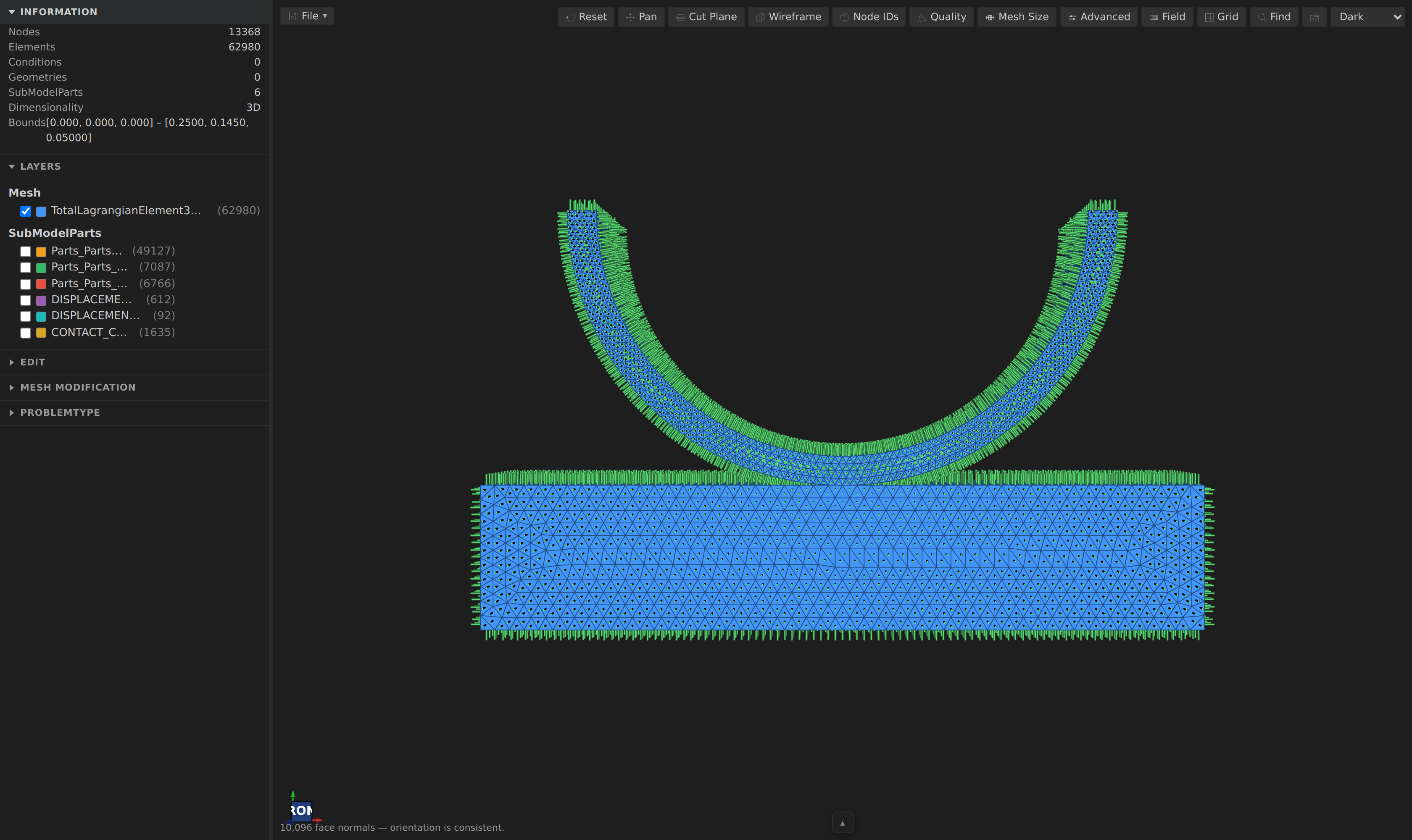
Advanced ▸ Face normals draws an arrow on every surface face, and on every boundary face of a volume mesh.
What it is for
Finding inverted elements.
The order a cell lists its nodes in — its winding — decides two things at once: which way the face normal points, and the sign of the element's Jacobian. A cell wound the wrong way therefore has a negative volume, which a Kratos solver will either refuse outright or quietly integrate with the wrong sign.
Nothing in the mesh statistics shows this. The node count is right, the element count is right, the quality metrics are computed from unsigned lengths and angles and look fine. But with normals drawn, a flipped element is unmistakable: its arrow points into the mesh while every arrow around it points out.
What you get
- Green arrows at each face centroid, along its unit normal, scaled to about 4% of the model's bounding diagonal so they read at any model scale.
- Red cells for any element wound against a neighbour.
- Orange edges along every hole rim (an edge used by exactly one face) and violet edges where three or more faces meet — where the surface is open or non-manifold, not just how many. The status line counts both, and Repair surface fixes them.
- A status line — either
N face normals — orientation is consistent.orN face normals — K element(s) wound against a neighbour (shown in red).
Interior faces of a volume mesh are dropped, so what you see is the skin. A solid block of arrows through the interior would tell you nothing and hide the surface.
How the consistency check works
Two faces that share an edge are wound consistently exactly when they traverse that shared edge in opposite directions — walk the boundary of two adjacent triangles and you will see it. So if the same directed edge (a→b) turns up in two different faces, one of them is flipped relative to the other, and both ends are reported.
Two consequences worth knowing:
- It is a relative test. A mesh whose faces are uniformly inside-out is perfectly self-consistent and reports zero problems. The arrows themselves are the check for global orientation — if they all point inwards, the whole surface is reversed.
- For volume meshes the boundary-face winding is generated from the cell type rather than read from the file, so it is consistent by construction and the count is normally zero. The test earns its keep on surface meshes — shells, extracted skins, imported STL/OBJ — which is where flipped elements actually come from.
Degenerate (zero-area) faces have no normal and are skipped rather than drawn as a NaN arrow.
Is the surface actually closed?
The consistency check above cannot answer that, and the two failures are genuinely different: a flipped face is a winding problem, a hole is a topology one. So the status line also reports what the boundary itself looks like:
- boundary edges — edges used by exactly one face. These are holes.
- non-manifold edges — edges where three or more faces meet.
- inconsistently wound face pairs — the same defect the arrows show, counted.
- zero-area faces — degenerate triangles.
When all four are zero the surface is reported as closed, manifold and consistently wound, which is the precondition for anything that needs an inside and an outside: a signed distance field, a level-set split, a volume mesher, most CFD.
The counts are given individually rather than collapsed into a pass/fail, because "not watertight" is not something you can act on. Three boundary edges is a single missing triangle you can patch; three thousand is a surface that was never closed in the first place, and the two call for entirely different responses.